
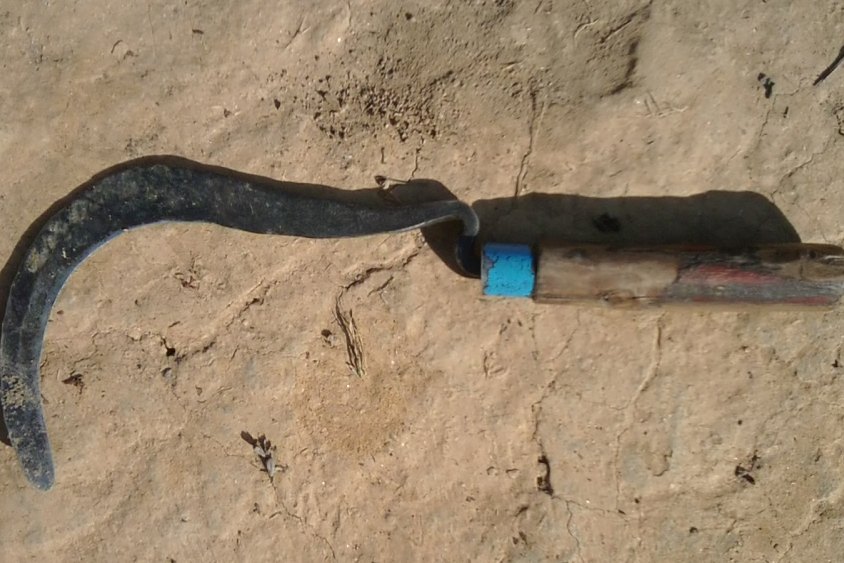
PATNA, July 29 — The very tool that helps a farmer harvest his crop is also the one that, in a flash of anger, can take a life. The Gandasi — the heavy iron blade mounted on a wooden handle that is a fixture in countless homes across rural Bihar and the rest of North India — occupies a stark dual role in the region’s agrarian economy and its everyday violence. In the fields, the Gandasi is indispensable for cutting crops, grass, and firewood.
Its availability in virtually every farming household makes it the most readily accessible weapon during domestic disputes. When a quarrel turns lethal, the Gandasi is often the first object within reach, transforming a routine argument into a fatal assault with devastating blows.
According to the National Crime Records Bureau, sharp weapons were used in 16% of all murders in India in 2020. A significant portion of those homicides occurred in disputes between family members or neighbours — precisely the settings where the Gandasi sits, unremarkable and unguarded, next to the kitchen or the toolshed.
A cultural fixture with a deadly flipside
The Gandasi is not a weapon by design. It is not purchased for violence. It is bought at local markets or forged by village blacksmiths for agricultural use, priced within the means of small farmers.
But its ubiquity means that in moments of rage, it becomes an instrument of lethal force with little deliberation. Law enforcement officials in Bihar and other states have long flagged the pattern.
Police reports from rural districts routinely list the Gandasi as the murder weapon in cases arising from land disputes, marital conflicts, or simmering caste tensions. The NCRB data underscores that these are not isolated incidents but part of a recurring national trend where everyday farm tools feature prominently in crime statistics. The challenge for policymakers is how to intervene without disrupting the tool’s legitimate agricultural function.
A Gandasi is not a licensed item; it is as commonplace as a sickle or a spade. Any move to regulate its sale or possession would face resistance from farming communities who see it as an essential implement, not a threat.
Wider implications for Asia’s agricultural belts
This duality is not unique to India. Across South and Southeast Asia — in the rice paddies of Bangladesh, the sugarcane fields of Pakistan, the rubber plantations of Thailand — everyday tools serve a dual purpose. The Gandasi’s story mirrors that of the machete in parts of Latin America or the billhook in rural Europe.
Wherever a sharp blade is essential for subsistence farming, the line between tool and weapon remains dangerously thin. For India, the Gandasi represents a specific cultural and economic reality.
It is a product of local craftsmanship, low-tech and durable, passed down through generations. But as urbanisation pulls young people away from farming, the tool’s role in rural violence is drawing renewed scrutiny from criminologists and sociologists. Analysts note that addressing the Gandasi problem requires more than just policing.
It demands conflict resolution mechanisms at the village level, better access to counselling and legal aid for families in dispute, and efforts to reduce the availability of sharp objects during volatile arguments — none of which are straightforward in communities where the Gandasi is stored openly. The National Crime Records Bureau’s statistic — 16% of murders in 2020 involving sharp weapons — provides a national baseline.
What the number does not capture is the moment of heat: a raised voice, a sudden shove, a hand reaching for the handle of a Gandasi leaning against a wall. That split-second decision, repeated in hundreds of villages every year, is the story behind the data. For now, the Gandasi remains what it has always been: an essential tool for millions of farmers, and an ever-present risk in the homes where it is kept.
The question of how to separate the two is one that rural India has not yet answered.




