
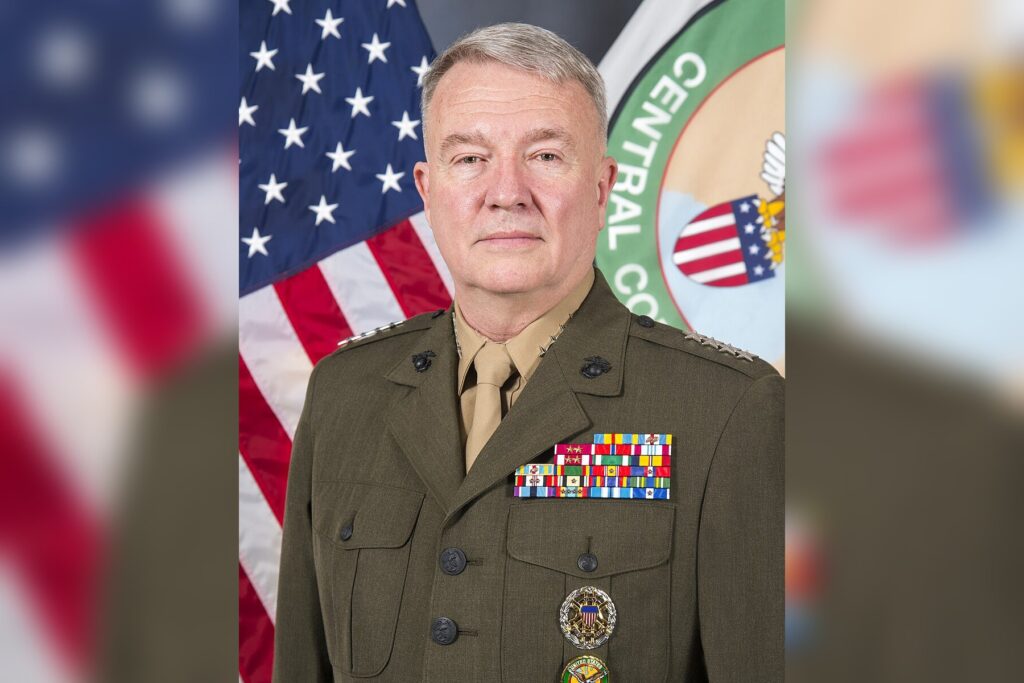
“I have a moral obligation to go there.” Marine Gen. Frank McKenzie said that in early February 2020, when he flew into Iraq to meet leaders who were still angry about the American drone strike that had killed Iran’s most powerful general a month earlier. It is a fair snapshot of his three years running U.S. Central Command: he was the officer who went to the places where things were breaking.
McKenzie, formally Gen. Kenneth F. McKenzie Jr., took over CENTCOM in March 2019 and handed it to Army Gen. Michael “Erik” Kurilla at a ceremony in Tampa, Florida, on April 1, 2022. Through all of it, he named Iran as the command’s main worry.
After the Baghdad airport strike
The strike on January 3, 2020 hit Baghdad’s international airport. It killed Qassem Suleimani, but also an Iraqi, Abu Mahdi al-Muhandis, deputy commander of the Iran-backed Popular Mobilization Forces. Iraq’s parliament answered with a non-binding resolution urging American troops to leave. More than 6,000 were in the country. On January 8, Iran fired ballistic missiles at two Iraqi bases that housed U.S. forces, among them al-Asad. No one was killed, though at least 64 service members were later diagnosed with traumatic brain injury, and the Americans had no air defenses in Iraq able to stop such missiles.
McKenzie met Iraq’s outgoing prime minister, its president and the speaker of parliament, then spent two hours with troops at al-Asad. They told him they had not heard the missiles coming, he said, and that some at the edge of the base saw warheads dropping from the sky in the final five or six seconds. He came away “heartened”, but he was frank about the risk: “it is a really dangerous time”. Iran and its proxy forces in Iraq, Syria and elsewhere, he believed, remained a live threat.
The farewell
By 2022 the command’s priorities had shifted. The Pentagon was talking about China as its “pacing challenge,” Russia’s invasion of Ukraine had pulled attention toward Europe, and the United States had left Afghanistan after more than 20 years. Still, Defense Secretary Lloyd J. Austin III told the ceremony that the region was where America protects waterways so global commerce can flow, and where it stands with partners against the instability that Iran and its proxies cause.
Austin listed the moments that defined McKenzie’s tenure: Israel’s move into the command’s area of responsibility, the shift to an advise-and-assist role in Iraq, and the evacuation from Afghanistan that rescued more than 124,000 people. Thirteen service members died in a suicide bombing during it.
McKenzie did not gloss over the cost. “Since I assumed command in March of 2019, CENTCOM has suffered 43 killed and 468 wounded in action,” he said. He called the job the “greatest honor of my career.” Gen. Mark A. Milley, then chairman of the Joint Chiefs, said McKenzie had guided the command “through some of our most tough times.”
His successor spoke of the same geography. Kurilla said CENTCOM needed the resources to guard the sea lanes and straits that carry global trade and to keep commerce flowing through the region. Austin said that, in the longer term, the work would include tackling Iran’s use of missiles and its spread of unmanned aerial systems.
Sources
- Kurilla Takes Command of CENTCOM, Says It 'Must Maintain the Requisite Resources'
- Top US general in the Middle East visits Iraq for talks to salvage relations (Lolita C. Baldor, The Associated Press, via Navy Times)




