
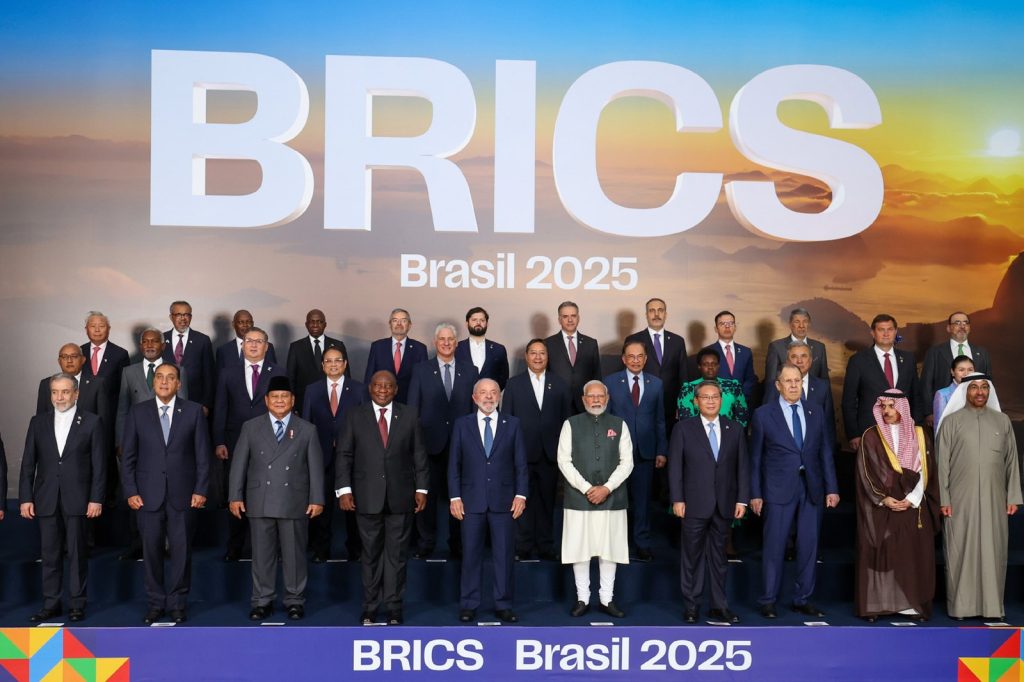
BRICS now counts 10 full members and more than 20 partner or aspiring countries. The bloc began as Brazil, Russia, India and China, and South Africa joined to complete the original five. The latest wave of newcomers, covered in an analysis of the 2025 summit in Rio de Janeiro, brought in Egypt, Ethiopia, Iran, Indonesia and the United Arab Emirates.
Each addition brings something specific, according to that analysis. Indonesia is the largest economy and democracy in Southeast Asia and adds Pacific trade routes. Iran is a major energy producer. Egypt and Ethiopia extend the bloc’s reach in Africa. The UAE is described as a financial and technology hub that adds investment weight.
Size of the club
The analysis puts the bloc at 45% of the world’s population and 35% of global GDP. Elsewhere the same text gives figures of around 40% of GDP and nearly half the world’s population for the wider BRICS+ group, so the numbers vary with how the group is counted. It also says the bloc controls over 40% of global crude oil production and 32% of natural gas output, and holds 75% of the world’s manganese, 50% of its graphite and 28% of its nickel.
The dollar question
Much of the bloc’s agenda is about money. Members want to settle more trade in local currencies and rely less on the US dollar. Tools mentioned include China’s Cross-Border Interbank Payment System, Russia’s ruble-based trade, and initiatives called BRICS Pay and the BRICS Bridge. A currency backed by commodities such as gold and oil is under discussion. The New Development Bank is widening its lending as an alternative to the IMF and World Bank.
Skeptics have a case. The dollar still accounts for nearly half of global payments, and the analysis says actual trade volumes in BRICS currencies remain low. India prefers interoperability to outright replacement. Its summary: BRICS is “shaking the tree, but the dollar’s roots run deep.”
Friction inside and out
The members do not agree on everything. Political systems range from democracies to autocracies, and gaps in wealth, such as China against Ethiopia, make consensus harder. China and Russia push a firmer anti-Western line, while India and Brazil favor a balanced approach built on economic cooperation.
Washington has noticed. President Trump has threatened 100% tariffs on BRICS nations pursuing de-dollarization or alternative currencies, and he has accused the group of “anti-American policies.” The bloc, for its part, condemned US strikes on Iran. China and Brazil lead a “Friends for Peace” initiative on Ukraine, and India is due to take the chairmanship.




