
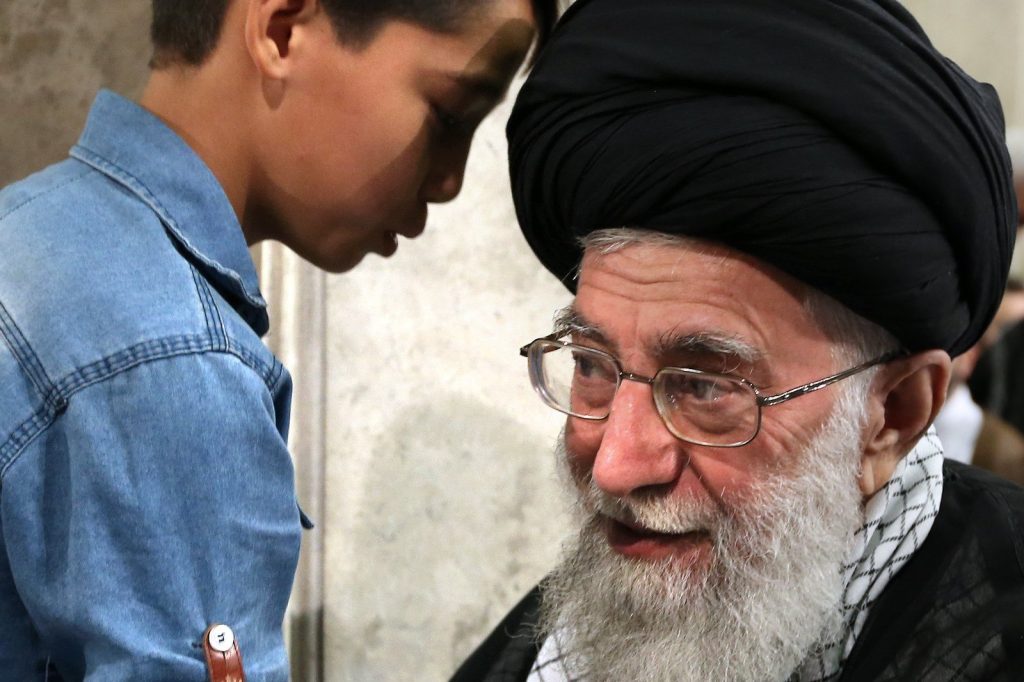
For nearly four decades, Ayatollah Ali Khamenei has held the highest political and religious authority in Iran, a position that grants him final say over the military, the judiciary, and the media. Born on July 17, 1939, Khamenei succeeded Ruhollah Khomeini in 1989, after a constitutional change was made to allow him to assume the role despite lacking certain religious credentials expected of the office.
His leadership has been defined by a consistent hardline posture toward the United States, which he has called the “Great Satan,” and a persistent opposition to American military presence in the Persian Gulf. Through decades of consolidating power, he has become the ultimate decision-maker on matters ranging from nuclear policy to whether Iran fires missiles at American allies.
Decades of Consolidating Power
Khamenei’s rise to the supreme leadership began as a student of Khomeini during the opposition to the government of Mohammad Reza Pahlavi, which led to several arrests and a period of exile. After the 1979 revolution, he held various government posts and served as president from 1981 to 1989.
During the Iran-Iraq war, he developed strong ties with the Islamic Revolutionary Guard Corps. An assassination attempt during that era left his right arm paralyzed. Once in power, Khamenei pushed for the privatization of state industries, used Iran’s oil and gas reserves to increase the country’s energy influence, and expanded the military apparatus to project power across the region.
His leadership determines the stability of the Middle East; he manages the Axis of Resistance and maintains a hardline stance against Israel and the United States. Because he controls the state’s primary security tools, his decisions dictate whether regional tensions escalate into open conflict.
Under Khamenei’s watch, Iran has also pursued a nuclear program that has raised international concern. According to the International Atomic Energy Agency as of 2023, Iran has enriched uranium to 60% purity, a level just a technical step away from weapons-grade material. The practical upshot is that Iran can now produce bomb-grade fuel in a matter of days if the leadership decides to sprint across that finish line.
Khamenei has publicly supported the nuclear program as a matter of national pride and strategic necessity, framing it as peaceful. However, the enrichment data tells a more aggressive story, and the IAEA has repeatedly flagged activities that lack civilian justification.
Proxy Forces and Regional Strategy
Beyond its nuclear ambitions, Iran under Khamenei has backed proxy groups across the Middle East, including Hezbollah in Lebanon and Hamas in the Palestinian territories. These groups receive funding, weapons, and training from Iran, acting as forward-deployed assets that allow Tehran to project power without putting Iranian boots on the ground. That strategy enables Khamenei to apply pressure on adversaries while maintaining plausible deniability.
A key component of his regional strategy involves the Strait of Hormuz, a chokepoint for about a fifth of the world’s oil shipments. Khamenei has threatened to close the strait, a move that would send energy prices into a tailspin and trigger a global economic shock.
Such an action would be a direct military escalation, one that would draw in the U.S. Navy and likely trigger a broader conflict. The United States has had Khamenei under sanctions since 2019, freezing his assets and barring American companies and individuals from doing business with him. It is a symbolic and financial squeeze on the man at the top of Iran’s power structure. Khamenei’s health has been a subject of speculation for years.
Reports indicate he underwent prostate cancer surgery in 2014. No official updates on his current condition have been released, but the question of succession looms over every policy decision Iran makes.
If he were to become incapacitated, the regime would face an internal power struggle with no clear successor.
What to Watch Next
The key question is whether Khamenei will follow through on his threat to close the Strait of Hormuz. For now, the rhetoric is sharp, but the practical upshot depends on whether Iran’s leadership sees a path to victory or just a path to more pain.
Every move Khamenei makes is designed to push the U.S. out of the region, akin to a chess player who never stops attacking the same corner of the board. As the supreme leader approaches his 88th birthday, his decisions continue to shape the trajectory of Middle Eastern stability and global energy markets.




