
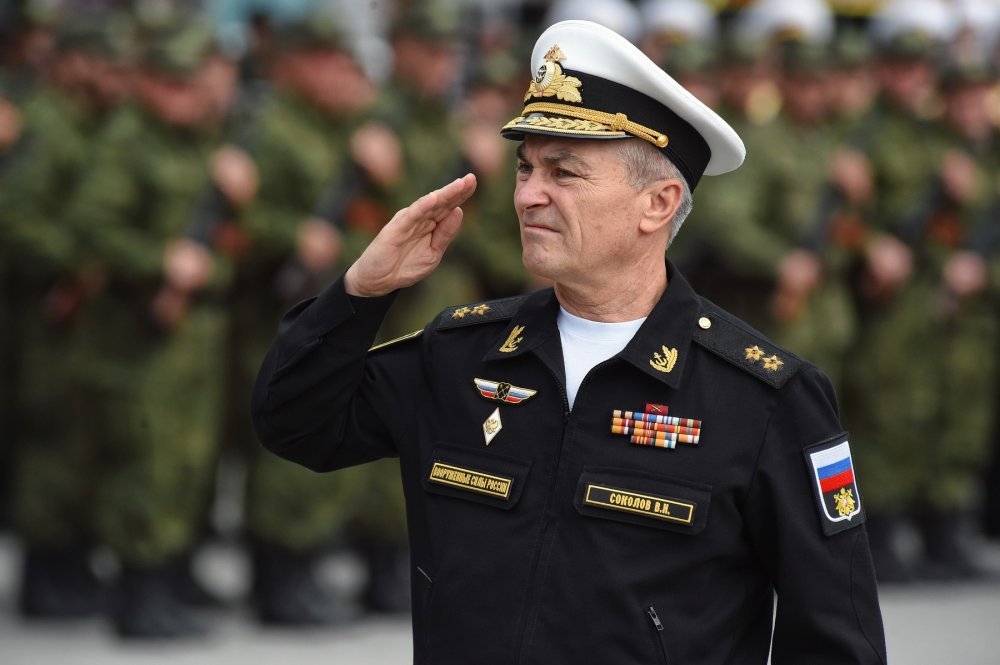
MOSCOW, July 9 — Admiral Viktor Sokolov remains at the helm of Russia’s Black Sea Fleet, a posting that has placed him at the center of one of the most consequential naval campaigns in modern Russian history. Officials confirmed that Sokolov, appointed in August 2022, replaced Admiral Igor Osipov in the wake of the sinking of the cruiser Moskva, a loss that fundamentally altered the strategic calculus in the Black Sea theater.
The Moskva, the flagship of the fleet, was struck and sunk in April 2022, a humiliation that Moscow attributed to a fire and ammunition explosion, though Ukrainian officials claimed a missile strike. The Kremlin’s decision to install Sokolov was widely read as an attempt to steady a command shaken by the loss of its most visible asset.
According to the record, Sokolov was born in 1962 in Moldova, graduated from the Nakhimov Naval School in 1983, and spent the bulk of his career in the Northern Fleet before transferring to the Black Sea. He had served as chief of staff of the Black Sea Fleet from 2020 to 2022, a position that gave him intimate knowledge of the fleet’s structure and vulnerabilities before he assumed overall command.
A commander under fire — literally and figuratively
In September 2023, Ukrainian officials claimed that Sokolov was killed in a missile strike on the fleet headquarters in Sevastopol. The strike, which targeted the nerve center of the Black Sea Fleet, sent shockwaves through the Russian military establishment. However, Russia later released video of Sokolov appearing at a meeting, a move that suggested he had survived the attack.
The discrepancy between Ukrainian claims and Russian visual evidence has never been fully resolved, though the official Russian position holds that Sokolov remains alive and in command. The episode underscored the high stakes of the naval campaign.
Sokolov has overseen the fleet during a period of heavy losses that extend well beyond the Moskva. Multiple landing ships have been damaged, and the fleet has struggled to maintain its operational tempo in the face of persistent Ukrainian drone attacks. Russian military bloggers, who have emerged as a vocal and often critical constituency within the country’s defense discourse, have publicly criticized Sokolov for the fleet’s inability to stop these attacks.
The drones, often launched from improvised platforms, have struck at the fleet’s remaining assets with a frequency that has embarrassed the command. According to the statement from Russian officials, Sokolov’s primary task as of October 2023 was to protect the fleet’s remaining assets and maintain a naval presence in the Black Sea.
That mission has become increasingly difficult as Ukraine has developed a capacity to strike at Russian naval infrastructure and vessels far from the front lines. The fleet, once a dominant force in the region, has been forced into a defensive posture, with many of its major combatants relocated to safer ports in the eastern Black Sea, away from Ukrainian missile and drone range.
Strategic context and the long view
The appointment of Sokolov in August 2022 came at a moment of acute crisis for the Russian Navy. The sinking of the Moskva was not merely a tactical setback but a strategic blow to Russia’s ability to project power across the Black Sea. The cruiser had been the centerpiece of the fleet’s air defense and command-and-control architecture.
Its loss forced a fundamental reassessment of how the fleet would operate in a contested environment. Sokolov’s background in the Northern Fleet, where he served in the Cold War-era submarine and surface forces, gave him experience in Arctic and Atlantic operations, but the Black Sea presented a different set of challenges.
The theater is constrained by geography, with narrow chokepoints and limited room for maneuver. Ukrainian anti-ship missiles, including Western-supplied systems, have made it hazardous for Russian surface combatants to operate close to the Ukrainian coast. The fleet has increasingly relied on submarines and long-range missile strikes to maintain a threat to Ukrainian infrastructure, while surface ships have been pulled back.
The criticism from Russian military bloggers has been pointed. These unofficial commentators, often with ties to the military, have accused the fleet command of complacency and poor tactical adaptation.
They have pointed to the drone attacks as evidence that the fleet has not learned the lessons of the Moskva sinking. Sokolov, as the commander, has borne the brunt of this criticism, though the Kremlin has not signaled any intention to replace him. As of October 2023, the record shows that Sokolov remains in command, tasked with a mission that has become as much about survival as about offensive capability.
The fleet’s remaining assets — a mix of frigates, submarines, and smaller missile boats — are being husbanded carefully. The question that hangs over the Black Sea Fleet is whether it can rebuild its combat power or whether it will continue to be ground down by a determined Ukrainian campaign that has shown no signs of abating.
The next phase of the conflict in the Black Sea will likely hinge on whether Russia can develop effective countermeasures against drone and missile attacks, or whether Ukraine can sustain the pressure that has already cost Moscow so much. For Sokolov, the task is clear: hold what remains, and try to restore a credible naval presence.
The record of the past years suggests that will be no small feat.




