
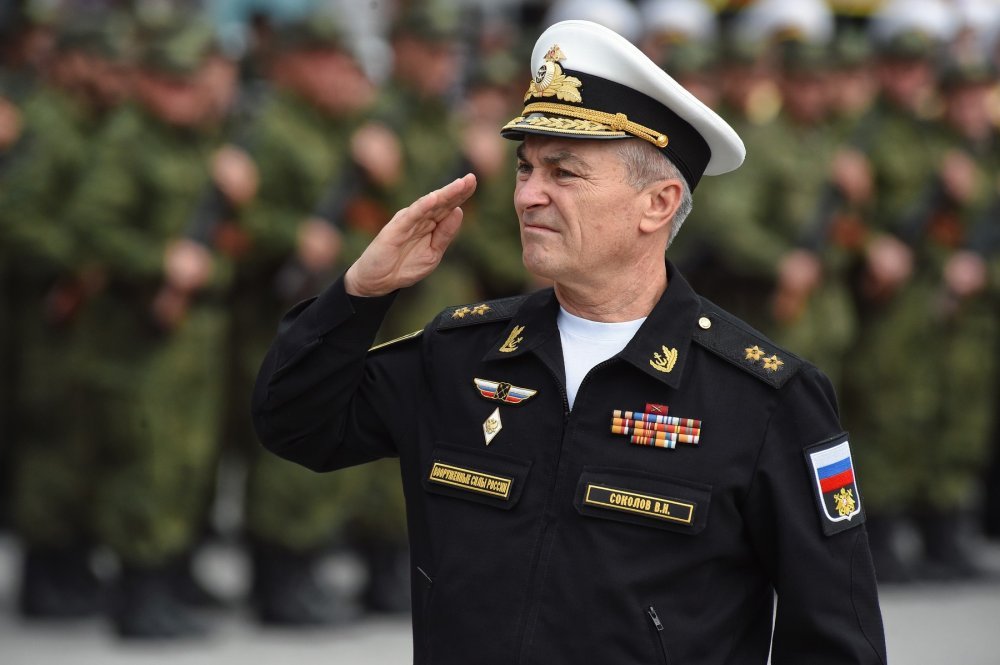
MOSCOW, July 9 — The shift is subtle but unmistakable: Admiral Viktor Sokolov, commander of Russia’s Black Sea Fleet, is presiding over a navy that has been fundamentally hollowed out by Ukrainian strikes. The trend underneath is not just a series of embarrassing losses—it is a structural degradation of Russian naval power in the Black Sea that has already altered the strategic calculus for the war. Sokolov took command in September 2022, replacing Admiral Igor Osipov at a moment when the fleet was already reeling.
Born in 1962, Sokolov brought a resume that included command of the Caspian Flotilla and the Northern Fleet’s submarine forces—a background in both surface and undersea warfare. But the Black Sea Fleet he inherited was a wounded force.
The Losses That Defined His Command
The most devastating blow came before Sokolov even assumed command. In April 2022, the Moskva, the flagship of the Black Sea Fleet, was sunk. The loss of the missile cruiser—a vessel that served as both the fleet’s air defense backbone and its symbolic centerpiece—was a catastrophic operational and psychological blow.
Then, in March 2022, the landing ship Saratov was destroyed while docked at the port of Berdyansk. That strike, captured on video and widely circulated, showed the vulnerability of Russian naval assets even in supposedly secure rear areas.
Under Sokolov’s leadership, the fleet has continued to absorb punishment. The cumulative effect of these losses has been a marked reduction in the fleet’s ability to enforce a blockade on Ukrainian ports. That is the strategic consequence that matters most: a navy that was supposed to strangle Ukraine’s maritime trade and isolate it from global markets has found itself fighting for survival rather than projecting power.
Watch this space: what’s changing is the Russian navy’s posture in the Black Sea. The fleet has been forced to operate farther from the Ukrainian coast, its surface combatants increasingly vulnerable to anti-ship missiles.
The blockade, once a serious threat to Ukraine’s economy, has become porous.
The Sokolov Death Claim That Wasn’t
In September 2023, Ukrainian sources claimed that Sokolov had been killed in a missile strike on the Black Sea Fleet headquarters in Sevastopol. The claim was dramatic and widely reported. But Russian state media showed Sokolov attending a meeting just days later, alive and apparently unharmed.
The incident highlighted the fog of war and the information warfare dimension of the conflict—but it also underscored just how high a priority the Ukrainian military places on decapitating the fleet’s leadership. The strike on the headquarters itself was real, and it killed or wounded a number of Russian personnel.
Whether Sokolov was actually present at the time of the strike remains a matter of conflicting claims. What is not in dispute is that the attack demonstrated Ukraine’s ability to reach into the heart of Russian-occupied Crimea and strike a high-value target.
What This Means for the War at Sea
The degradation of the Black Sea Fleet under Sokolov’s command has direct consequences for the broader war. Russia’s ability to project amphibious power—to land troops behind Ukrainian lines or threaten the coast—has been severely curtailed. The loss of the Saratov and the damage to other landing ships means that an amphibious assault on Odesa, once a real threat, is now far less feasible.
The fleet’s submarine force, which Sokolov once commanded in the Northern Fleet, has been used primarily for launching Kalibr cruise missiles against Ukrainian infrastructure. But even that mission has been complicated.
Ukrainian naval drones and anti-ship missiles have forced Russian submarines and surface ships to operate at greater standoff ranges, reducing the accuracy and effectiveness of their strikes. The blockade, meanwhile, has been a central issue in global food security. Ukraine is a major exporter of grain and sunflower oil, and the Russian blockade threatened to trigger shortages and price spikes in developing countries that depend on those exports.
The fact that the blockade has been weakened—not broken, but weakened—is a direct result of the fleet’s losses.
The Man Behind the Command
Sokolov’s career trajectory tells a story of a naval officer who rose through the ranks in a period of Russian military modernization. Born in 1962, he came of age in the late Soviet era and served through the chaotic 1990s and the resurgence of the Russian military under Vladimir Putin. His command of the Caspian Flotilla placed him at the center of Russia’s intervention in Syria, where the flotilla launched cruise missiles against rebel targets.
His command of the Northern Fleet’s submarine forces gave him expertise in the most secretive and strategically important branch of the Russian navy. But the Black Sea Fleet has been a different kind of challenge.
The Caspian Flotilla operated in a relatively permissive environment; the Northern Fleet’s submarines operate under the Arctic ice, far from enemy anti-ship missiles. The Black Sea, by contrast, is a confined body of water where Ukraine has demonstrated a remarkable ability to strike Russian ships with relatively inexpensive drones and missiles. Sokolov has had to adapt to a war that his navy was not designed to fight.
The Black Sea Fleet was built for power projection against NATO and for amphibious operations against a weaker adversary. Instead, it has found itself on the defensive, its ships hiding in port or operating at extreme ranges to avoid Ukrainian fire.




