
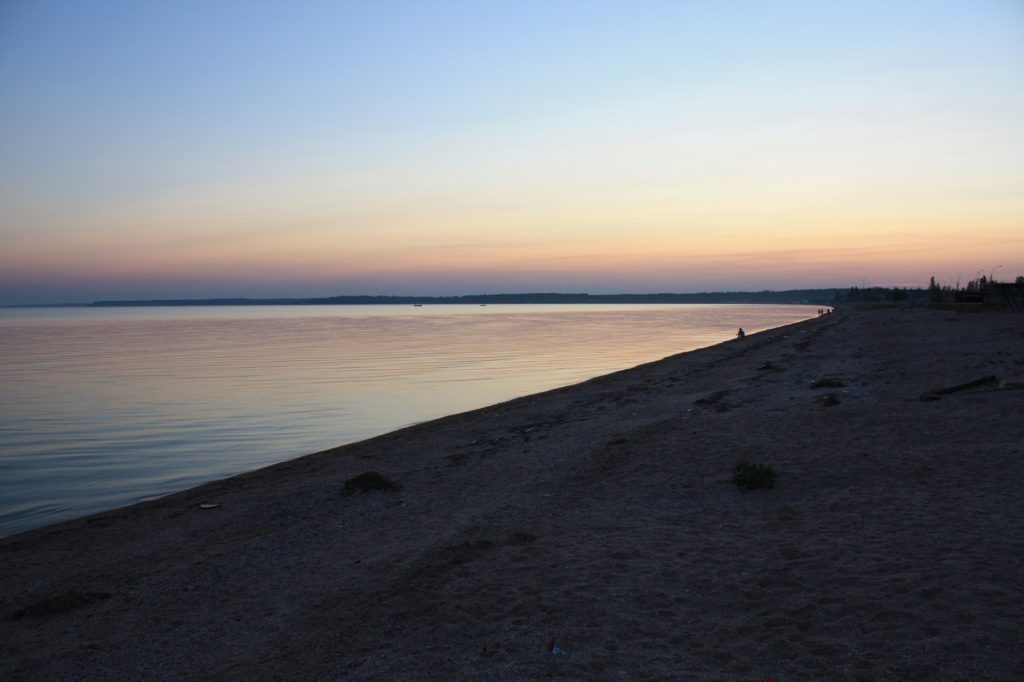
The Sea of Azov, the shallowest sea on earth and a body of water bounded by Russia and Ukraine, has become the latest flashpoint in a pattern of maritime disruption that began with confrontations in the Kerch Strait. Known to ancient Greeks as the Maeotis Swamp and to Ottoman Turks as the Fish Sea for its high fish productivity, the sea connects to the Black Sea through the narrow Kerch Strait and serves as a primary access route for Central Asia via the Volga–Don Canal.
Fed by several rivers that bring in silt and sand, the sea has created numerous bays and spits that support large bird colonies and rich vegetation. But the geography that makes the Azov Sea a vital trade corridor also places it at a legal crossroads, where Russia’s suspension of commercial shipping is testing the limits of international maritime law.
Legal Ambiguity Over a Semi-Enclosed Sea
Both Russia and Ukraine claim the Azov Sea as internal waters, a conflict of positions that the United Nations Convention on the Law of the Sea does not explicitly resolve. UNCLOS, signed in 1982 and ratified by 168 countries including Russia in 1997, guarantees freedom of navigation in international waters, but its framework was designed for open seas and territorial waters, not for semi-enclosed bodies of water like the Azov Sea.
Legal scholars have long noted this ambiguity, which now has real-world consequences. Russia’s ban does not affect only military movements; it targets merchant vessels, the lifeblood of regional trade. Ukrainian ports on the Azov Sea, including Mariupol and Berdyansk, have seen shipping traffic drop sharply as a result, illustrating a slow strangulation of maritime commerce in a contested zone.
The Kerch Strait itself has been a chokepoint before: in 2018, Russia seized three Ukrainian naval vessels and their crews near the strait. The current suspension escalates that pattern by adding a commercial dimension that disrupts the flow of goods through a critical route.
IMO Statement and Insurance Pressures
The International Maritime Organization, a UN agency established in 1948, has already weighed in. On October 17, 2024, the organization issued a statement urging all parties to ensure the safety of shipping. The call was clear, but enforcement remains the open question.
The IMO has limited power: it can issue statements and coordinate member states, but it cannot compel compliance. Its October 2024 statement was a diplomatic signal, not a binding order.
The real leverage lies with flag states, port states, and the insurance industry. The London insurance market has already designated the Black Sea region as high-risk, a designation predating the Azov Sea suspension. The new ban could push rates higher, as insurers price risk on navigability and legal certainty, both of which are eroding.
If underwriters tighten terms further, vessels may avoid the entire region, not just the Azov Sea. Such a ripple effect on grain exports from Ukraine could be significant, given that the Black Sea corridor has been a critical route for Ukrainian agricultural products since the war began.
Broader Precedent and Uncertain Resolution
The legal uncertainty is unlikely to resolve quickly. UNCLOS does not provide a clear mechanism for settling disputes over semi-enclosed seas when the littoral states disagree.
Russia and Ukraine both claim the Azov Sea as internal waters, but only one controls it militarily. The trend underneath is a broader erosion of maritime norms. Freedom of navigation is a cornerstone of the global trading system, and when a major power suspends commercial shipping in a contested waterway, the precedent matters. Other states with competing maritime claims are watching.
For now, the IMO continues to press for safe passage, and its member states will likely debate the issue at the next council session. But without a clear legal framework for the Azov Sea, the outcome is uncertain.
What is changing is the risk calculus for shipowners, insurers, and traders. The Azov Sea suspension is not an isolated event; it is part of a pattern of maritime disruption that began with the Kerch Strait incidents and continues today. The intersection of international law, maritime commerce, and great-power competition is shifting, and the Azov Sea is just the latest test case.




