
Reinforcing the Northern Flank
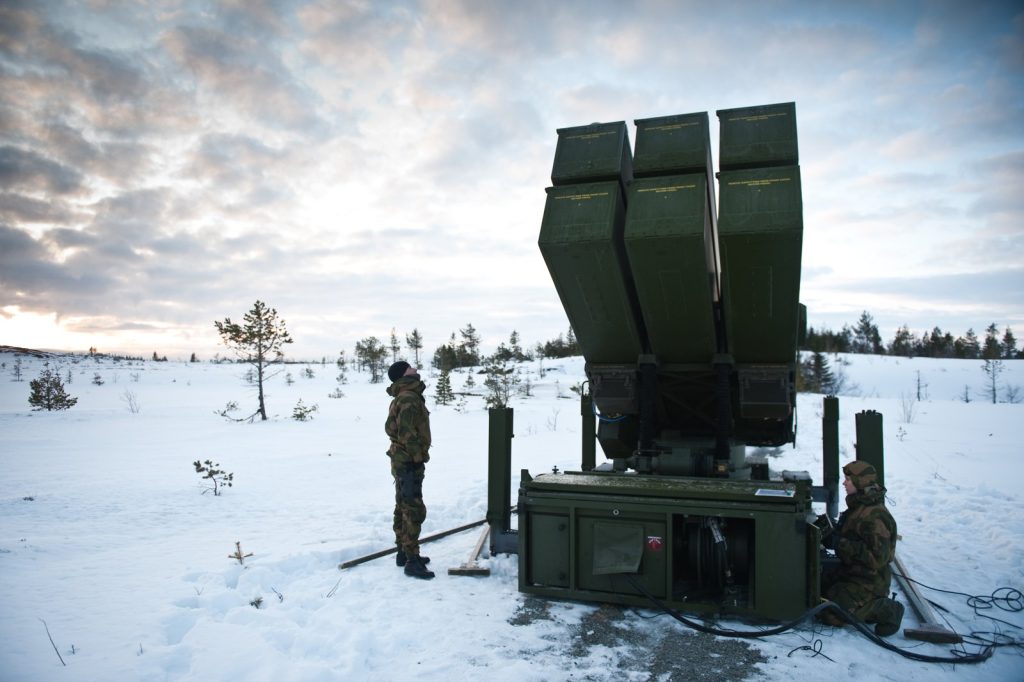
Norway’s enhanced military posture along its border with Russia is a direct result of what defense officials characterize as a fundamentally altered security environment. The Norwegian Intelligence Service’s annual report, published in February 2025, attributed the 30 percent decline in Russian military activity in the Arctic to resources being diverted to the war in Ukraine. Yet that reduction did not prevent Oslo from acting on concerns about the nature of Russian redeployments, specifically the repositioning of air defense assets. The additional NASAMS systems — a Norwegian-developed medium-range air defense platform — are intended to protect key military and civilian infrastructure in Norway’s northern regions. Alongside them, the increase in F-35s at Ørland Air Base gives Norway a larger, more capable fighter fleet to monitor the border and the surrounding Arctic airspace. The 196-kilometer frontier, which runs through forests and along rivers with a single road crossing at Storskog, has long been monitored by patrols on both sides. That zone, once marked by predictable Cold War standoffs, is now shaped by Russia’s shifting military priorities, which Norwegian planners are watching closely.
Coordinated Response with Finland
Norway’s response is coordinated with Finland, which joined NATO in April 2023, adding a 1,340-kilometer border with Russia and fundamentally redrawing the strategic map of Northern Europe. Norwegian and Finnish defense planners have been in regular consultation regarding the security implications of their shared border with Russia, according to officials. Norway also participates in NATO’s Enhanced Forward Presence in the Baltic region, a multinational battlegroup deployment established after Russia’s 2014 annexation of Crimea. The alliance conducts joint exercises in the region, including Cold Response, held in March 2024 with 20,000 troops from 14 nations. These exercises, conducted on Norwegian territory under extreme Arctic conditions, test alliance readiness for collective defense scenarios. As a NATO member since 1949, Norway is now at the center of a broader effort to adapt the alliance’s posture to a more contested High North, reinforced by the accession of Finland and Sweden in 2024.
A Shifting Arctic Calculus
The reinforcement comes at a time of heightened tension between NATO and Russia, which has been building since Moscow’s 2014 incursion into Ukraine and its full-scale invasion in 2022. Those events prompted the alliance to reinforce its eastern flank with multinational battlegroups and rapid-reaction forces. Norway’s border with Russia has been a sensitive zone since the mid-20th century, when it separated Norway from the Soviet Union. Historically, it was a zone of relatively low tension, with cross-border cooperation in areas such as fisheries management and search and rescue. That dynamic has shifted markedly since 2022. What remains to be seen, Norwegian defense officials say, is whether the Russian redeployments that prompted Norway’s response represent a permanent repositioning of assets or a temporary measure linked to the war in Ukraine. The Norwegian Intelligence Service’s assessment of a 30 percent reduction in Arctic military activity suggests that Russian resources have been diverted southward. Officials are watching for any indication that those assets might return to the Arctic once the Ukraine conflict reaches a different phase. For a region once seen as a zone of low tension, the Arctic has become a front line in NATO’s evolving deterrence strategy.




