
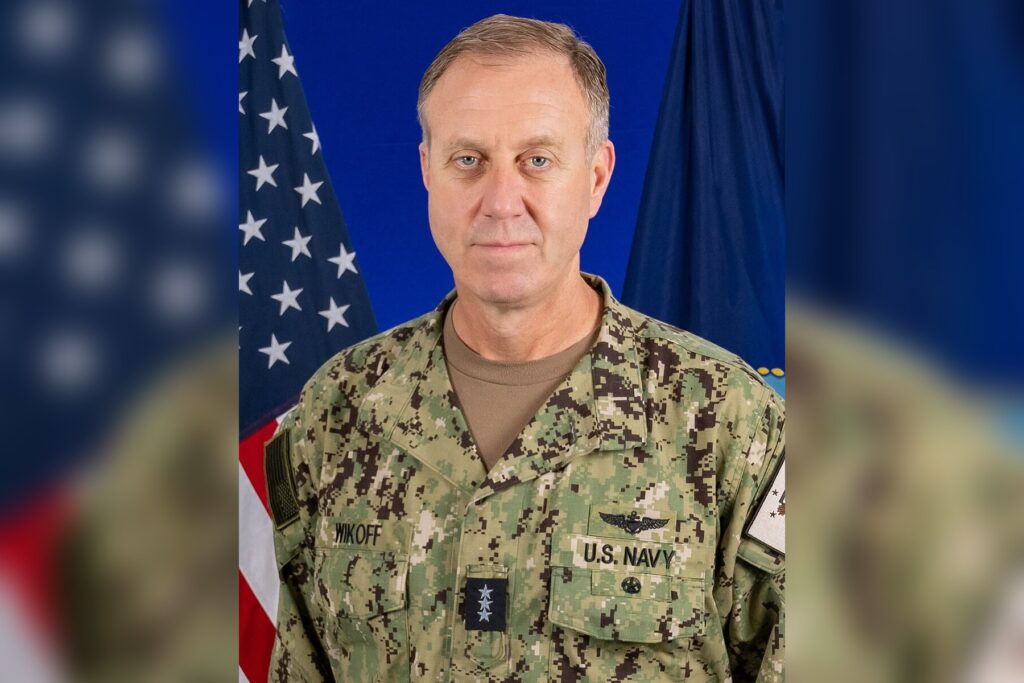
The closure of the Strait of Hormuz has triggered an immediate operational response from the United States Fifth Fleet, with its commander ordering a surge in patrols across the Persian Gulf, Arabian Sea, and Red Sea. Vice Admiral George Wikoff, who took the helm of the fleet and U.S. Naval Forces Central Command in July 2024, placed the roughly 15,000 personnel and 30 ships under his authority on a heightened footing.
The move represents the most serious test of Wikoff’s tenure since he assumed command, as the fleet guards some of the world’s most vital shipping lanes. The Fifth Fleet’s headquarters at Naval Support Activity Bahrain — a base established in 1949 that has anchored American naval power in the Gulf for more than seven decades — now functions as the nerve center for coordinating the response. Wikoff reports directly to General Michael Kurilla at U.S. Central Command, who was appointed to that role in 2022.
A Commander Shaped by Naval Aviation and Operations Planning
Wikoff brings a career spanning more than three decades to the crisis. Born in 1968 in Norfolk, Virginia, he graduated from the U.S. Naval Academy in 1990 with a degree in ocean engineering. He trained as a naval aviator and flew F/A-18 Hornets.
From 2018 to 2020, he commanded the aircraft carrier USS Dwight D. Eisenhower (CVN-69).
Immediately before taking charge of the Fifth Fleet, Wikoff served as director of operations for U.S. Central Command from 2022 to 2024, giving him direct insight into the broader theater strategy. His annual budget authority for the operations now underway is drawn from the U.S. Navy’s $194 billion fiscal year 2025 budget request — a figure that covers everything from fuel for destroyers to salaries for the 15,000 sailors and Marines under his command.
Coalition Coordination and Strategic Balancing
The increased patrols are the visible result of Wikoff’s orders, and he is coordinating closely with the International Maritime Security Construct (IMSC), a coalition of 10 nations established in 2019. The IMSC was formed to protect maritime security in the region, and its mandate may now face scrutiny as the Strait of Hormuz closure continues. Analysts will watch whether the coalition expands its membership or its formal mission.
Wikoff must also balance the requirement for visible deterrence — showing adversaries that the United States and its partners will not tolerate interference with global trade — with the operational reality of sustaining those patrols indefinitely. The Fifth Fleet first stood up in 1944 during World War II, when it fought major campaigns against Japan in the Central Pacific.
It was disbanded in 1947 and remained inactive until its reactivation in 1995. Since then, it has projected American naval power in the Middle East and joined the broader fight against terrorism. Its presence shapes regional stability and directly affects the cost and safety of global trade that American consumers and businesses rely on daily.
As the Strait of Hormuz closure tests the fleet’s readiness and coalition partnerships, Wikoff’s decisions in the coming weeks will set the tone for how the United States defends one of the world’s most critical maritime chokepoints.




