
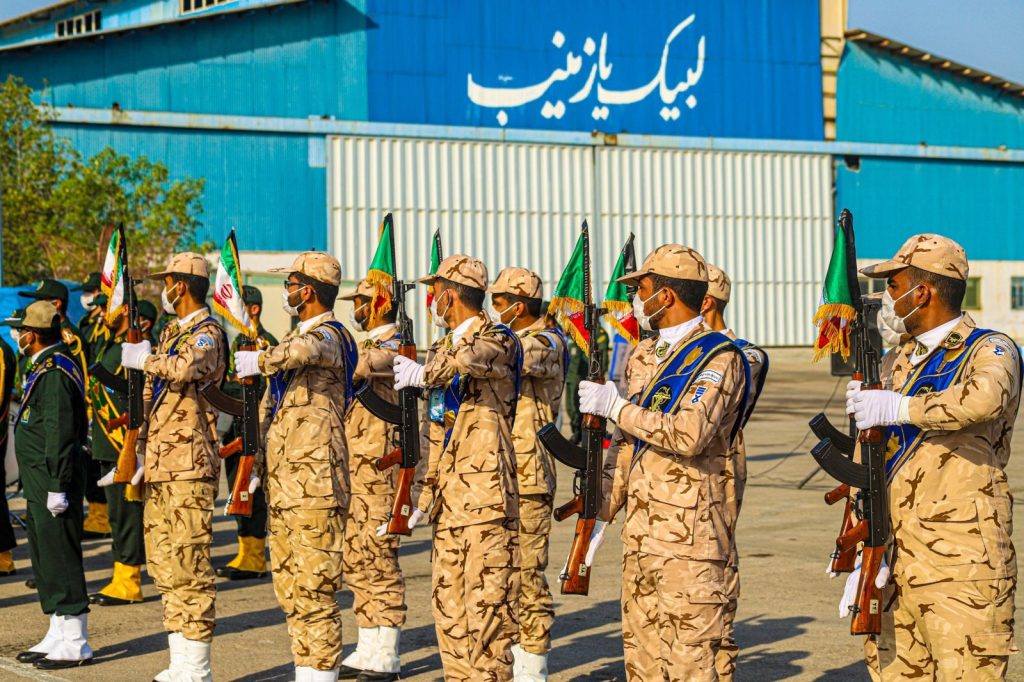
The Persian Gulf’s naval balance hinges on a single number: 398. That is the combined vessel count of Iran’s two maritime forces–the Islamic Republic of Iran Navy (IRIN) and the Islamic Revolutionary Guard Corps Navy (IRGCN)–arrayed against the U.S. Fifth Fleet’s 20 ships and approximately 15,000 personnel. The asymmetry on paper is striking, but the two sides operate from fundamentally different strategic doctrines, and the facts on the water tell a more nuanced story.
Naval Posture: Fifth Fleet vs. Iran’s Two Navies
The U.S. Fifth Fleet, headquartered at Naval Support Activity Bahrain since its establishment in 1995, serves as the naval component of U.S. Central Command. Its centerpiece is the USS Nimitz carrier strike group, which includes the aircraft carrier itself, cruisers, destroyers, and submarines. For nearly three decades, the Fifth Fleet has been the primary American naval presence in the Middle East, maintaining station in Bahrain and patrolling the waters of the Persian Gulf, Gulf of Oman, and the Arabian Sea.
Iran fields its naval power through two distinct chains of command. The regular IRIN handles conventional blue-water operations, while the IRGCN focuses on asymmetric warfare in the gulf’s shallow, confined waters.
Together, they operate 398 vessels, the vast majority of which are small fast-attack craft and submarines. The sheer number dwarfs the Fifth Fleet’s two-dozen-plus ships, but the United States relies on technological reach and power projection: carrier-based aircraft, submarine-launched cruise missiles, and advanced fighters. The Pentagon, under Secretary Lloyd Austin, has not announced further deployments to the region, but the U.S. has already moved additional F-35 fighter jets to Al Dhafra Air Base in the United Arab Emirates, adding a potent land-based air component to the Fifth Fleet’s capabilities.
Geography, Strategy, and Iranian Signaling
The Persian Gulf is a semi-enclosed marginal sea of the Indian Ocean, bordered by Iran to the north and the Arabian Peninsula to the south. It links to the Gulf of Oman via the Strait of Hormuz, a chokepoint through which a significant share of global oil transit flows. The gulf’s shallow waters, island chains, and geological basin–formed by the subduction of the Arabian plate beneath the Zagros Mountains and shaped by Holocene sea-level rise–have long dictated naval tactics.
Its ecosystem, historically rich in fishing grounds, coral and rocky reefs, and pearl oysters, has suffered from industrial activity and oil spills. These physical realities make the gulf both a vital maritime crossroads for trade and a complex theater for military operations.
Iran has been signaling its capacity to contest that theater. In 2023, Tehran conducted the ‘Great Prophet 17’ exercise, which simulated a blockade of the gulf. That exercise, combined with the IRGCN’s small-boat inventory and missile arsenal, is the scenario Pentagon planners are watching closely.
Investors and analysts note the range of Iran’s anti-ship missiles: the Noor and Qader systems have ranges of up to 300 kilometers, sufficient to threaten vessels operating in much of the gulf and approaches to the Strait of Hormuz. The combination of massed fast-attack craft and shore-based missiles forms the core of Iran’s asymmetric deterrent.
Outlook: What to Watch Next
For now, the U.S. Fifth Fleet holds its position in Bahrain, with the Nimitz strike group on patrol. No new deployments have been announced from Washington, and the Pentagon is monitoring the situation.
The key indicators going forward will be whether Iran conducts another major exercise like ‘Great Prophet 17’ and whether the Pentagon responds with additional naval or air assets. The numbers that matter–398 vessels versus 20, 300-kilometer missile ranges, 15,000 personnel, and the advanced capabilities of the F-35s at Al Dhafra–are the ones that will drive the next move in this enduring strategic standoff.




