
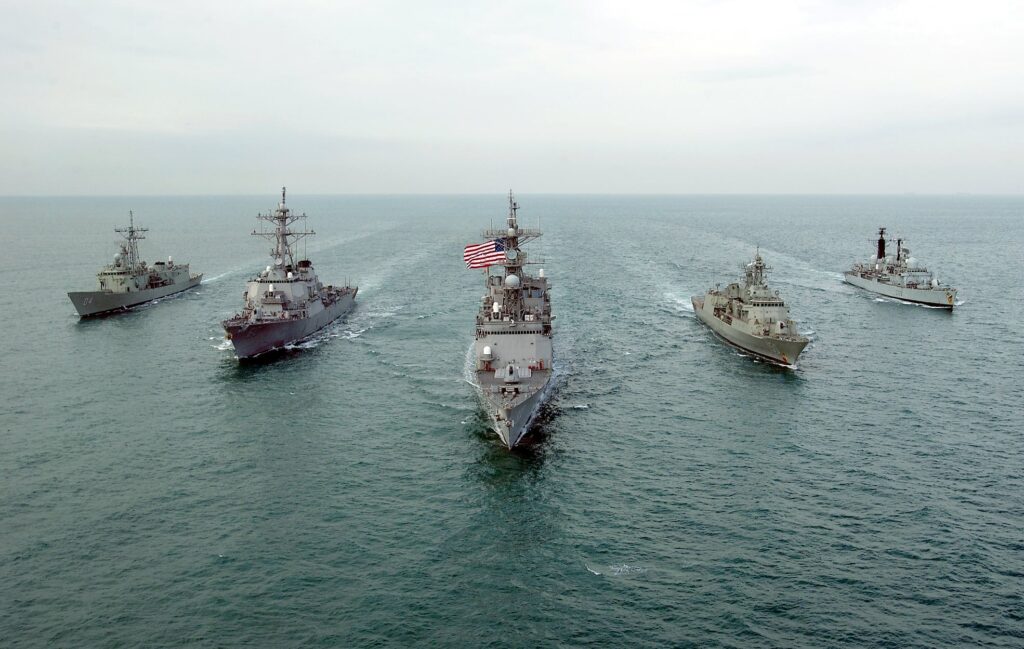
The United States Fifth Fleet, operating from its headquarters in Bahrain, is adjusting its posture across the Persian Gulf as Iran continues to field new naval capabilities in the narrow waters of the region. The fleet, which serves as the primary naval component of U.S. Central Command, now confronts a security environment shaped by Iranian attacks that have prompted Washington to increase patrols and expand joint exercises with allied navies.
The shift reflects a strategic calculation among American planners that deterring further aggression in these critical waterways requires a coordinated, multinational response rather than a unilateral American show of force alone.
Coordinated Patrols and Maritime Security
The Fifth Fleet’s operational response has taken the form of increased patrols and combined training events with key allies, including the United Kingdom’s Royal Navy, Saudi Arabia’s naval forces, and other members of the Gulf Cooperation Council. These exercises are not designed as symbolic gestures; they represent a deliberate, coordinated effort to signal to Tehran that any attempt to disrupt shipping will be met by a coalition capable of sustained operations.
The International Maritime Security Construct, established in 2019, now includes the United States, the United Kingdom, Australia, and additional partner nations, all working together to protect commercial shipping from threats in the region. The mechanism underscores a recognition that no single navy can adequately secure these waters alone. The scope of the fleet’s responsibility is vast.
Its area of operations covers approximately 2.5 million square miles of water, encompassing the Persian Gulf, the Red Sea, the Arabian Sea, and parts of the Indian Ocean. This expansive domain demands constant vigilance, and the U.S. has deployed specialized assets to meet the challenge.
Mine countermeasure vessels and maritime patrol aircraft have been positioned in the region to detect and neutralize mines that could be used to disrupt shipping lanes. These assets are critical for countering one of the most potent asymmetric threats in the Gulf: naval mines that could be sown across chokepoints to cripple commercial traffic.
Strategic Stakes at the Strait of Hormuz
The broader stakes of the fleet’s mission are most clearly visible at the Strait of Hormuz, the narrow waterway that serves as a chokepoint for roughly one-fifth of the world’s oil supply. Any significant disruption to shipping through this strait could send shockwaves through global energy markets, affecting prices and supply chains worldwide. The Fifth Fleet’s mission is not merely defensive in nature; it is about maintaining freedom of navigation and ensuring that the rules-based order holds in a region where adversaries are actively testing its limits.
The fleet’s presence aims to prevent disruptions in waters that carry a large share of the world’s energy supplies, a responsibility that directly affects the flow of global trade. Iran, for its part, has responded to the increased American naval presence by deploying fast attack craft and anti-ship missiles along its coastline.
These assets are positioned to challenge naval dominance in the narrow, confined waters of the Gulf, where the room for maneuvering is limited and the potential for miscalculation remains high. The positioning of these weapons represents a clear attempt by Tehran to complicate any American or allied naval operation in the region. Looking ahead, the calculus for the Fifth Fleet will hinge on how Iran calibrates its response in the coming months.
The U.S. and its allies are signaling that they will not back down, but the strategic chessboard is far from settled.
Historical Precedent and Renewed Mission
The Fifth Fleet is not a new creation. The Navy first established the fleet in 1944 during World War II, when it fought Japanese forces in the Central Pacific, including the campaigns for Iwo Jima and Okinawa. After the war, the fleet was stood down in 1947 and remained inactive for several decades.
It was not until 1995 that the Navy reactivated the fleet, assigning it to operate as a component of U.S. Central Command with headquarters in Bahrain. Since reactivation, the fleet has provided forces for the Global War on Terrorism and has maintained a continuous presence across the Persian Gulf, the Red Sea, the Arabian Sea, and parts of the Indian Ocean.
This positioning allows the United States to project naval power across the Middle East, a capability that has become increasingly central to American strategy as the region’s maritime security environment grows more complex. The fleet’s activity directly affects the flow of global trade, and its presence remains the cornerstone of American naval power in the Gulf.




