
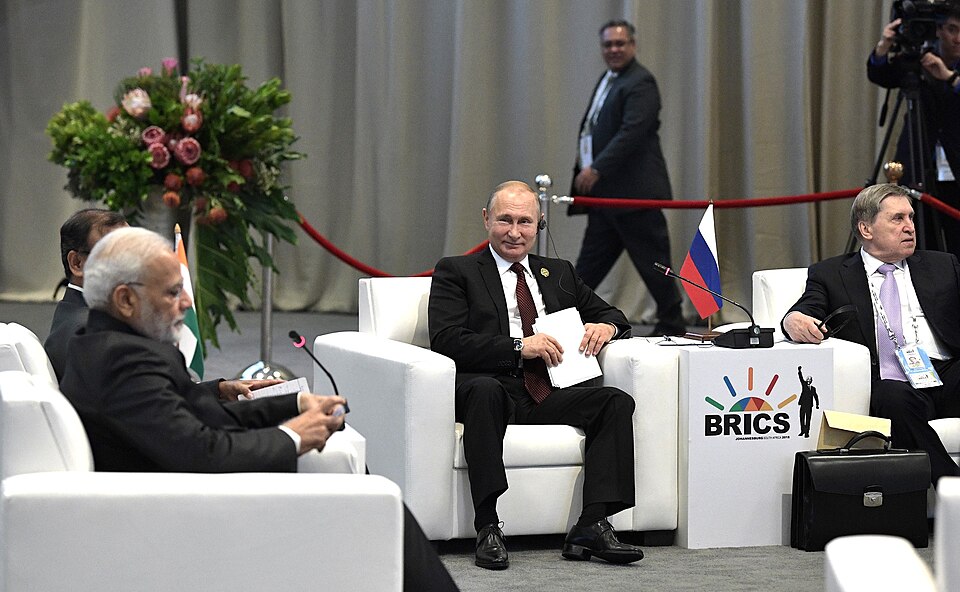
SHANGHAI, September 13 — The 2026 BRICS summit convenes this week with the bloc’s expanded membership now numbering nine full participants: Brazil, Russia, India, China, South Africa, Egypt, Ethiopia, Iran, the United Arab Emirates and Indonesia. For Asian capitals, the gathering is less about ceremony than about whether a grouping that has grown faster than its institutions can hold its own agenda together. The expansion has been uneven.
At the 2023 summit in Johannesburg, the bloc invited six new members — Argentina, Egypt, Ethiopia, Iran, Saudi Arabia and the United Arab Emirates — with full membership taking effect on January 1, 2024. Argentina declined to join under its new government in December 2023.
Saudi Arabia accepted the invitation but has not formally completed accession. Indonesia officially joined in January 2025, becoming the first Southeast Asian member.
An expanding bloc, an incomplete one
The group began as BRIC, founded by Brazil, Russia, India and China in 2004. Its first formal summit was held in Yekaterinburg, Russia, in 2009, and South Africa was admitted in 2010, adding the ‘S’ to the name. The expanded bloc accounts for roughly 45% of the world’s population and about 35% of global GDP on a purchasing power parity basis, according to World Bank and IMF data.
Two institutional pillars sit beneath the summitry. The New Development Bank, established in 2014 with headquarters in Shanghai and initial authorized capital of US$100 billion, has approved more than US$30 billion in infrastructure and sustainable development loans since 2016.
The 2024 summit in Kazan, Russia, produced the Kazan Declaration, which endorsed the use of local currencies in trade and called for reform of the Bretton Woods institutions. On the table this year are proposals for a BRICS grain exchange and a cross-border payment system intended to reduce reliance on the US dollar and the SWIFT network. The summit agenda also includes trade, energy, food security and global governance reform.
What to watch
The event is being held amid heightened geopolitical tensions, including the ongoing Russia-Ukraine war and the Israel-Hamas conflict, which have accelerated calls for alternative financial architectures. The summit’s outcomes will be closely watched by Washington as a gauge of the bloc’s cohesion and its ability to challenge US-led economic order. For Asian readers, the salient point is structural.
Indonesia’s membership gives the bloc its first Southeast Asian voice, while the New Development Bank’s Shanghai headquarters and the proposed payment system place Asian financial infrastructure at the centre of any credible alternative to dollar-clearing. Whether the nine can convert that geography into agreed policy is the question the summit will answer — or defer.




