
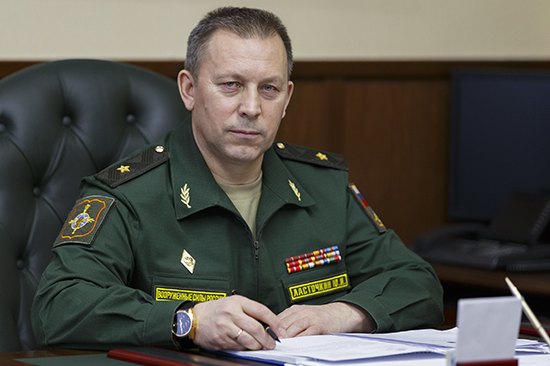
MOSCOW, July 9 — The shift in modern warfare is happening in the invisible spectrum, and one Russian commander is at the center of it. Colonel General Yuri Lastochkin, head of the Russian Armed Forces’ Electronic Warfare Troops since 2018, has built a career on disrupting the electromagnetic spectrum, a domain now as contested as any battlefield in Ukraine. Lastochkin, born in 1967, is a product of the Soviet military education system.
He graduated from the Tambov Higher Military Command School of Electronic Warfare in 1988, a specialized institution that has produced a generation of Russian signals intelligence and jamming officers. Under his command, Russian electronic warfare, or EW, units have been credited with jamming Ukrainian communications and drones, including the satellite-based Starlink system used by Kyiv’s forces.
The systems he has overseen are not abstract. The Krasukha-4, a ground-based mobile jamming system, is designed to suppress airborne radars and drones. The R-330Zh Zhitel targets satellite communications and cellular networks.
These are the tools of Lastochkin’s trade, deployed across the theater to blind and deafen Ukrainian command-and-control networks. Lastochkin has publicly stated that electronic warfare is a priority for the Russian military.
That is not a throwaway line. It reflects a doctrinal shift that began after Russia’s 2008 war with Georgia, when Moscow realized its communications and jamming capabilities lagged behind NATO standards. Since then, investment in EW has been steady, and Lastochkin’s career tracks that trajectory.
His role is central to understanding the Russian side of the electronic warfare battle in Ukraine.
The Man Behind the Systems
Lastochkin’s biography reads like a career path designed for this moment. He has been decorated with the Order of Alexander Nevsky and other awards, reflecting the Kremlin’s esteem for his work. The Order of Alexander Nevsky is one of Russia’s highest military honors, typically awarded for personal courage and leadership.
It signals that Lastochkin is not a desk officer; he has delivered results in the field. The Tambov Higher Military Command School of Electronic Warfare, his alma mater, is a niche institution.
It produces officers who understand the physics of radio waves, the architecture of communications networks, and the tactics of denial and deception. Lastochkin has spent nearly four decades in this world, from his graduation in 1988 to his current post as head of the entire EW branch. Under his command, Russian EW units have become a persistent threat to Ukrainian operations.
Drones, which Ukraine has used extensively for reconnaissance and strikes, are vulnerable to jamming. When a drone loses its link to its operator, it is effectively dead.
Lastochkin’s systems are designed to create that dead zone.
The Battle for the Spectrum
The electronic warfare battle in Ukraine is not static. It is a constant back-and-forth, with each side adapting to the other’s countermeasures. Lastochkin’s forces have been credited with jamming Starlink, the satellite internet system provided by SpaceX.
Starlink has been a lifeline for Ukrainian military communications, enabling real-time data sharing and drone operations. Jamming it is a strategic priority for Russia.
The systems Lastochkin oversees—Krasukha-4, R-330Zh Zhitel, and others—are part of a layered EW architecture. The Krasukha-4 operates in the centimeter-wave band, targeting airborne early warning and control aircraft, as well as drones. The Zhitel focuses on the meter-wave band, disrupting satellite phones and GPS signals.
Together, they form a blanket of interference. Lastochkin has publicly stated that electronic warfare is a priority for the Russian military.
That statement, made in official channels, is a window into Moscow’s thinking. In a conflict where artillery and drones dominate the headlines, the quiet work of EW officers often goes unnoticed. But Lastochkin’s prominence suggests the Kremlin sees EW as a war-winning capability.
What to Watch Next
The trend underneath Lastochkin’s career is the professionalization of Russian electronic warfare. He is not a political appointee; he is a specialist who has risen through the ranks. His graduation from Tambov in 1988 places him in the late-Soviet cohort that has since become the backbone of Russia’s military-technical establishment.
As the war in Ukraine grinds on, the electronic warfare dimension will only grow. Lastochkin’s forces will continue to develop countermeasures to Ukrainian adaptations, and Ukraine will respond with new frequencies, new encryption, and new hardware.
For now, Colonel General Yuri Lastochkin remains a key figure, one whose name is not widely known outside military circles but whose work shapes the daily reality of combat in Ukraine. His systems jam, his units adapt, and the Kremlin rewards him. What’s changing is the recognition that electronic warfare is not a niche specialty—it is central to modern conflict.
And Lastochkin is at the center of it.




