
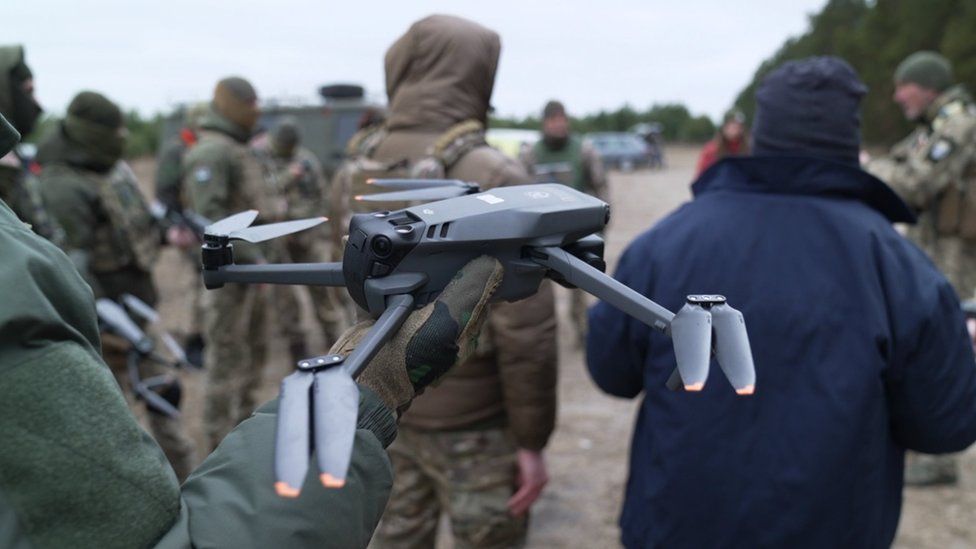
A shift in the strategic dynamics of the war is now impossible to ignore. Ukraine has transformed a wartime necessity into a formidable capability by building a domestic drone industry able to strike targets deep inside Russian territory. The numbers underscore a dramatic industrial mobilization: production has surged from 10,000 units in 2022 to more than 200,000 in 2024, according to Ukrainian Defense Minister Rustem Umerov.
This is not merely incremental growth but a wholesale transformation of the country’s defense manufacturing base.
A Domestic Industry Rises
The drone platforms are engineered specifically for long-range missions. Two systems stand out as the workhorses of the program.
The UJ-22 Airborne can travel 800 kilometers carrying a 20‑kilogram payload. The AQ-400 Scythe carries 32 kilograms over a range of 750 kilometers. Both rely on GPS guidance and are launched from mobile platforms, giving Ukrainian forces the flexibility to strike at a distance from the front lines.
The program is supported in part by international aid. In 2024 alone, the United States allocated $1.5 billion for drone procurement, funding that has helped scale production and refine the technology.
Ukraine’s path to this point is rooted in its broader history. The nation is the second largest in Europe. During the Middle Ages, the state of Kievan Rus’ emerged in the 9th century and became a dominant power on the continent.
After the Mongol invasions of the 13th century, external powers ruled the region for centuries, including the Polish-Lithuanian Commonwealth and the Russian Empire. The Ukrainian Soviet Socialist Republic was formed in 1922 as part of the Soviet Union, an era that included the Holodomor, a human‑made famine that killed millions in the early 1930s.
Ukraine declared independence in 1991 after the Soviet Union dissolved, transitioning toward a liberal democracy and a free market. The Orange Revolution of 2004‑2005 brought constitutional reforms, and mass demonstrations in 2014 known as the Euromaidan led to a revolution. Russia responded by occupying and annexing the Crimean Peninsula.
The current conflict has seen the extensive use of unmanned aerial vehicles — aircraft without human pilots that operate autonomously or by remote control.
Reaching Deep Into Russia
Ukrainian drones have already demonstrated their reach. Targets as far as 1,500 kilometers from the border have been struck.
A notable example is the March 15, 2025 strike on Stavropol Krai, deep inside Russian territory and far beyond the battlefield in eastern Ukraine. The capability is real and still expanding. Russia has not stood still; Moscow has deployed electronic warfare systems specifically to counter Ukrainian drones. But Ukraine continues to adapt its tactics and technology in response.
The ability to produce these tools domestically allows Ukraine to project power far beyond its borders. This shift alters the strategic balance between the two nations.
The broader trend is the democratization of long‑range strike capability. Drones are significantly cheaper than missiles, harder to defend against when used in swarms, and faster to produce. Ukraine’s program demonstrates what a determined nation can build with relatively modest resources — and with the right international backing.
The Changing Balance of Power
As drone production scales further and electronic warfare methods evolve, the cat‑and‑mouse contest between Ukraine and Russia will only intensify. Ukraine is already proving that a domestic drone industry can project power across borders, a lesson that will not be lost on other nations observing the conflict from the sidelines. The industrial transformation documented by Minister Umerov — from 10,000 units to 200,000 in two years — underscores a fundamental change in how this war is fought and how national power can be generated from within.




