
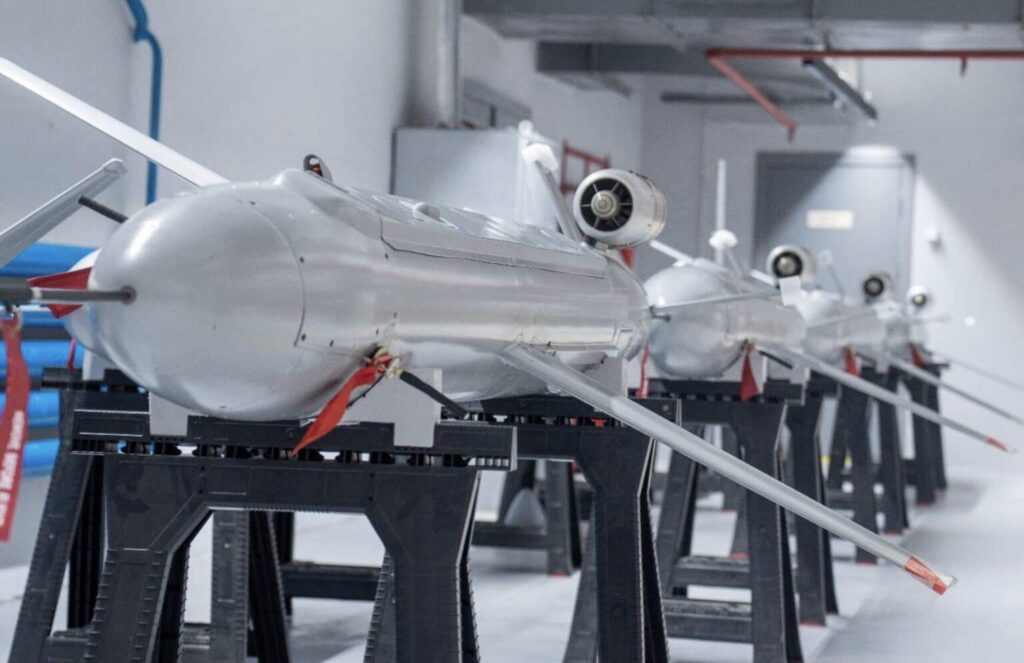
KYIV, July 13 — The shift in modern warfare is happening at low altitude, at night, and without a pilot in the cockpit. Ukraine’s deep strike campaign has quietly rewritten the rules of long-range engagement, relying on a fleet of unmanned aerial vehicles (UAVs) that can fly hundreds of kilometers to hit targets deep inside Russia. These are not experimental prototypes.
They are operational, battle-tested systems, and they are changing what is possible for a nation without a traditional air force. The workhorse of this campaign is believed to be the ‘Liutyi’ drone — Ukrainian for “Fierce.” Developed by the state-owned defense conglomerate Ukroboronprom, the Liutyi is a purpose-built strike platform.
It carries a payload of 50 to 75 kilograms and can travel up to 1,000 kilometers from its launch point. That range puts a vast swath of Russian territory within reach. What makes the Liutyi effective is not just its range.
It flies at low altitudes to stay below radar coverage, using a combination of GPS and inertial navigation systems to find its way. For the final approach, it switches to a thermal camera for terminal guidance — a setup that allows it to identify and lock onto heat signatures, even in the dark or through smoke.
Ukraine’s drone arsenal is not a one-trick pony. The country has also deployed the ‘UJ-22 Airborne’ drone, which has an 800-kilometer range, and the ‘Bober’ — or “Beaver” — drone, first used in combat in May 2023. Each platform brings different capabilities, but they share a common logic: hit high-value targets at a fraction of the cost of a manned strike.
That cost is a decisive factor. Each drone is estimated to cost between $50,000 and $100,000. Against a target like an oil depot or a fuel storage facility — infrastructure worth millions — the math is brutally simple.
On March 1, 2025, that math played out in Stavropol Krai, a region in southern Russia. A strike using what analysts believe were Liutyi variants hit targets inside the territory.
The operation demonstrated that Ukraine can project force at distance, on its own terms. Russia has not stood still. Electronic warfare systems like the ‘Krasukha-4’ are designed to jam drone control signals, effectively cutting the tether between operator and aircraft.
But Ukraine has adapted. By programming autonomous flight modes into the drones, the aircraft can complete their missions even when communications are severed.
The drone flies itself to the target, using pre-loaded waypoints and onboard sensors. ## The trend underneath The trend underneath all of this is a fundamental shift in cost and access. A drone that costs as much as a luxury sedan can disable infrastructure that took years and billions to build. It does not require an airbase, a runway, or a pilot who needs to be recovered.
The launch platforms are mobile, often operating from inside Ukrainian territory, and can be on the move minutes after the drone is airborne. Watch this space. As electronic warfare continues to evolve, and as both sides refine their countermeasures, the drone itself is becoming a smarter, more independent weapon.
The era of the remotely-piloted aircraft may be giving way to something more autonomous — where the human sets the target, and the machine does the rest. What is changing is not just the technology.
It is the strategic calculus for any nation facing a larger, better-funded adversary. Ukraine has shown that a relatively small investment in long-range UAVs can force an opponent to defend its entire territory, not just the front lines. That lesson is not going away.




