
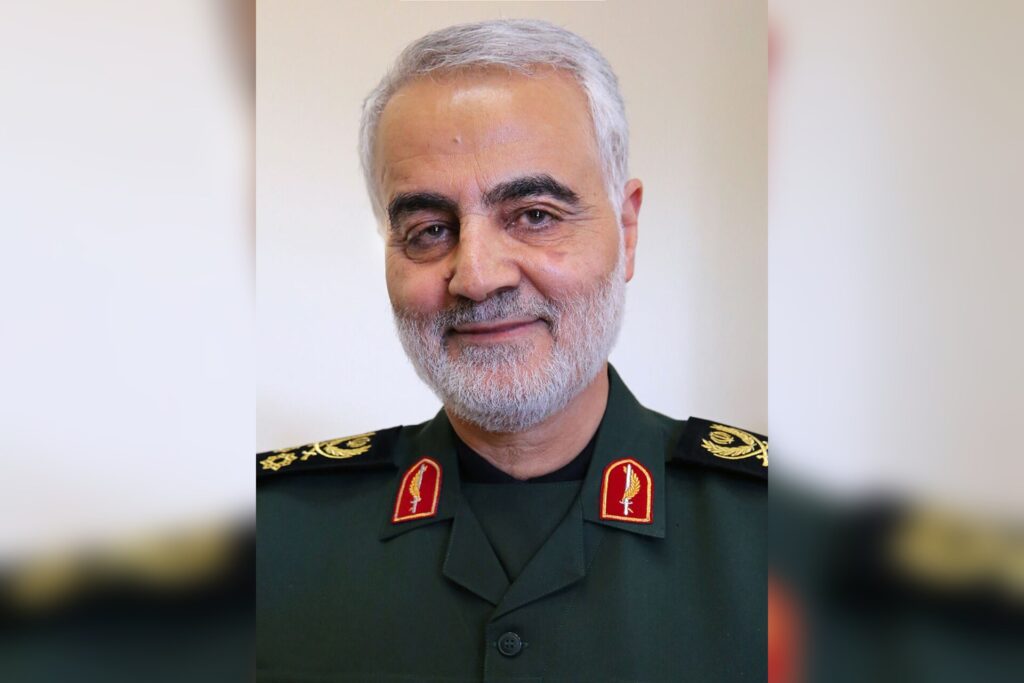
WASHINGTON, July 8 — Six years after a U.S. drone strike killed Iranian Major General Qasem Soleimani, the shadow of that single operation still stretches across the Middle East. The man who built Iran’s network of proxy armies and shaped its regional strategy for decades is gone, but the structure he left behind continues to operate. Soleimani was born on March 11, 1957, in the Iranian city of Qom.
He rose through the ranks of the Islamic Revolutionary Guard Corps, eventually taking command of the Quds Force in 1998. For more than two decades, he was a key figure in Iran’s military strategy, including operations in Iraq, Syria, and Yemen, and was responsible for Iran’s proxy forces.
The strike that changed the region
On January 3, 2020, Soleimani was killed near Baghdad International Airport. The U.S. drone strike, ordered by President Donald Trump, also killed five others, including Abu Mahdi al-Muhandis, the deputy commander of Iraq’s Popular Mobilization Forces. The U.S. cited Soleimani’s role in planning attacks on U.S. personnel, including the December 2019 attack on the U.S. embassy in Baghdad.
The strike was a dramatic escalation in the long-running shadow war between the United States and Iran. Soleimani was widely seen as the architect of Iran’s regional influence.
Iran’s response and the aftermath
Iran retaliated five days later. On January 8, 2020, Tehran launched ballistic missiles at two Iraqi bases housing U.S. troops. Over 100 U.S. service members were injured in those strikes.
The attack was widely seen as calibrated to avoid all-out war while sending a clear message of Iran’s capability and resolve. In the immediate aftermath, there were widespread fears that Iran would target commercial shipping in the Strait of Hormuz, the narrow waterway through which a significant portion of the world’s oil passes.
No major disruption occurred, but the threat underscored how Soleimani’s death had raised the temperature across the region. Soleimani was succeeded by Esmail Qaani, another IRGC officer who inherited the Quds Force command.
What remains
Soleimani’s legacy is the architecture of Iranian influence he built. The proxy forces in Iraq, the support for the Assad government in Syria, the arming of Houthi rebels in Yemen — all of these predated him, but he was the figure who coordinated them into a coherent strategy. His death did not dismantle that system, but it removed the man who knew its every lever.
For the United States and its allies, the question that lingers is whether Iran’s next move will be more cautious or more aggressive without Soleimani’s guiding hand. The ballistic missile strike in January 2020 showed that Tehran is willing to retaliate directly.
The question now is what form future responses might take.




