
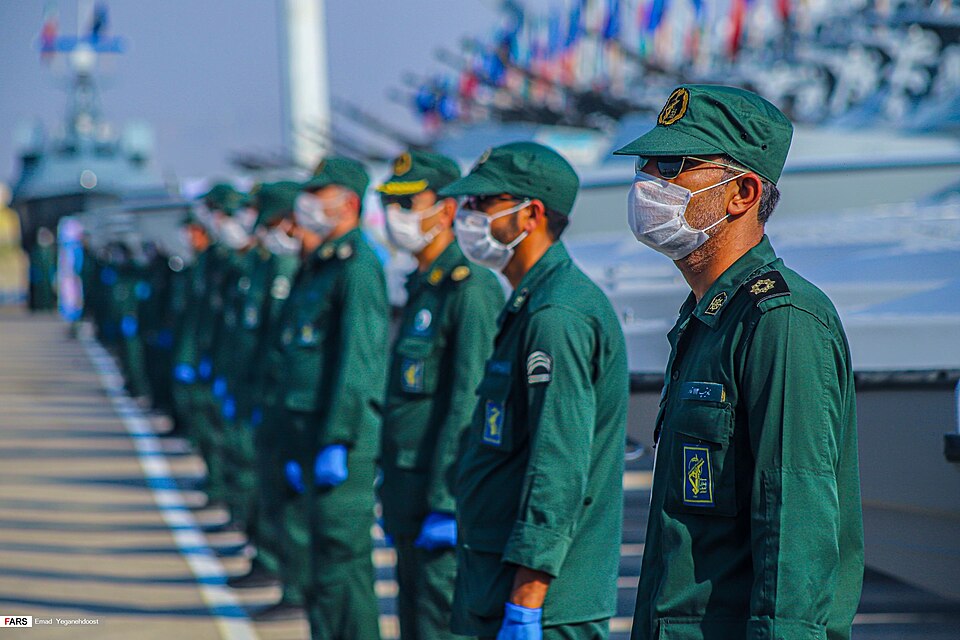
The Islamic Revolutionary Guard Corps Navy, a parallel naval force distinct from Iran’s conventional navy, operates under a doctrine of asymmetric warfare in the Persian Gulf and the Strait of Hormuz. Established in 1985 by order of Iran’s supreme leader, the force was created specifically to operate alongside the regular navy but with a different mission, training, and equipment profile.
Its origins trace to the mid-1980s, and its doctrine was shaped during the Iran-Iraq War, when swarming speedboats, surprise raids, and mining of key shipping lanes became central to Iran’s maritime strategy. That period culminated in the 1988 clashes known as Operation Praying Mantis, in which the United States directly intervened. Today, the IRGC Navy fields small fast-attack craft, anti-ship cruise missiles including the Noor and Qader, naval mines, and swarming boats — systems built not for traditional naval engagements but for low-cost, high-impact operations.
A Separate Force with a Distinct Doctrine
The IRGC Navy is one of two parallel naval structures within Iran, but it functions with a command chain separate from the regular navy. While the conventional navy focuses on blue-water operations and fleet defense, the IRGC Navy concentrates on coastal waters, choke points, and deterrence through disruption rather than control. As of 2025, the force is commanded by Rear Admiral Alireza Tangsiri, whose tenure continues the emphasis on low-cost operations designed to deter or retaliate against adversaries, particularly the United States and its regional allies.
The force’s early engagements during the Iran-Iraq War included mining shipping lanes and targeting tankers, actions that drew direct U.S. naval intervention. The asymmetric model has been refined over decades, becoming a defining feature of Iran’s maritime security posture.
The Noor and Qader anti-ship cruise missiles represent the primary stand-off strike capability. When combined with swarming boat tactics and naval mines, these systems create a layered defensive zone. The swarming boats themselves are a signature capability: dozens of small, fast craft that can attack simultaneously from multiple axes.
The Strait of Hormuz and Asymmetric Leverage
The IRGC Navy’s significance lies in the Strait of Hormuz, a narrow waterway through which most of the world’s oil transits. The force has conducted exercises simulating the closure of the strait, including the 2020 ‘Great Prophet 14’ exercise. The strait remains a critical artery for global oil shipments, and the IRGC Navy’s ability to threaten or disrupt shipping there gives Tehran asymmetric leverage beyond its conventional naval power.
The force has been involved in several incidents that underscore its operational posture. In 2016, it captured U.S. Navy sailors in the Persian Gulf.
In 2019, the force downed a U.S. drone. These actions reflect a doctrine that prioritizes low-cost, high-leverage tools — fast-attack craft, anti-ship missiles, naval mines, and coordinated swarm tactics — to counter stronger adversaries.
A Persistent Challenge for Regional Stability
The IRGC Navy’s continued investment in asymmetric systems suggests it will remain a persistent challenge for U.S. and allied naval forces operating in the Gulf. As a key instrument of Iranian deterrence, the force is built to inflict disproportionate costs on a superior adversary.
Any future confrontation in the Strait of Hormuz will likely test the balance between the IRGC’s swarming tactics and the technological edge of American naval power. The regular navy focuses on blue-water operations and fleet defense, while the IRGC Navy maintains its focus on coastal waters, choke points, and deterrence through disruption. Commanded by a senior IRGC officer and operating with a distinct command chain, the force ensures its doctrine stays centered on deterrence, retaliation, and asymmetric advantage.
For regional actors and global powers alike, the IRGC Navy represents a persistent, adaptable challenge in one of the world’s most critical maritime corridors.




