
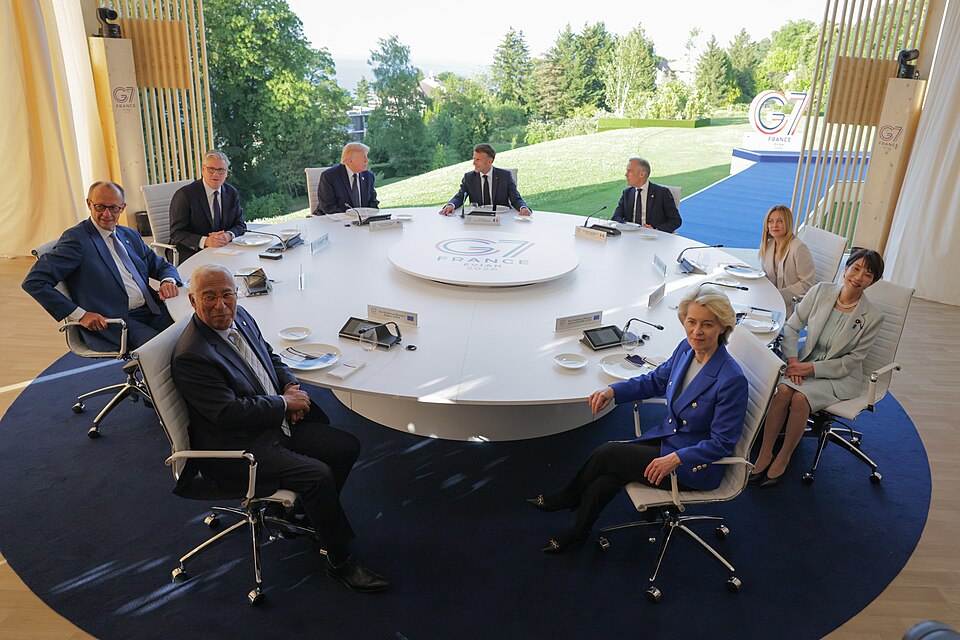
ÉVIAN-LES-BAINS, September 3 — The 49th G7 summit, held in this French lakeside town from June 15 to June 17, exposed deep fractures in the Western-led international order as leaders grappled with war, artificial intelligence (AI) governance, and supply-chain realignment. The summit’s agenda was dominated from the outset by the provisional ceasefire agreement between the United States and Iran, announced by U.S. President Donald Trump shortly before his arrival. G7 leaders called the agreement a “historic opportunity” and backed follow-up diplomatic efforts to prevent Iran from acquiring nuclear weapons.
They also endorsed a multinational, defensive maritime security initiative led by France and the United Kingdom to restore commercial shipping through the Strait of Hormuz and verify mine-clearing operations. On Ukraine, the G7 reaffirmed “unwavering support” for Ukraine’s freedom, sovereignty, and territorial integrity, pledging increased air-defense assistance, potential licensing of military production to expand Ukraine’s defense manufacturing, support for winter energy resilience, and additional sanctions on Russia’s wartime economy.
President Trump met with Ukrainian President Volodymyr Zelensky, who attended as a guest leader, and said he would “do what he can to end the war.” European leaders urged Trump to facilitate direct talks between Ukraine and Russia, according to The Guardian. AI governance remained a longer-term strategic issue, with France inviting executives from OpenAI, Google, Anthropic, and Mistral AI to discuss regulation, infrastructure, and online safety, continuing the digital agenda adopted by G7 ministers the previous month.
In parallel, China showcased an alternative framework through the Shanghai Cooperation Organisation (SCO), staging its own event alongside the summit. Chinese state media, including the Global Times, criticized the G7 as an “exclusive club of a handful of countries” and a “hypocritical, self-interested, and disconnected group,” arguing that the G7 represents less than 10% of the world’s population and a shrinking share of global GDP, and that addressing global challenges requires the participation of the Global South, including China.
The summit highlighted the widening rift between the West and the non-Western bloc led by China and Russia, with China promoting multipolarity and greater representation for the Global South.




