
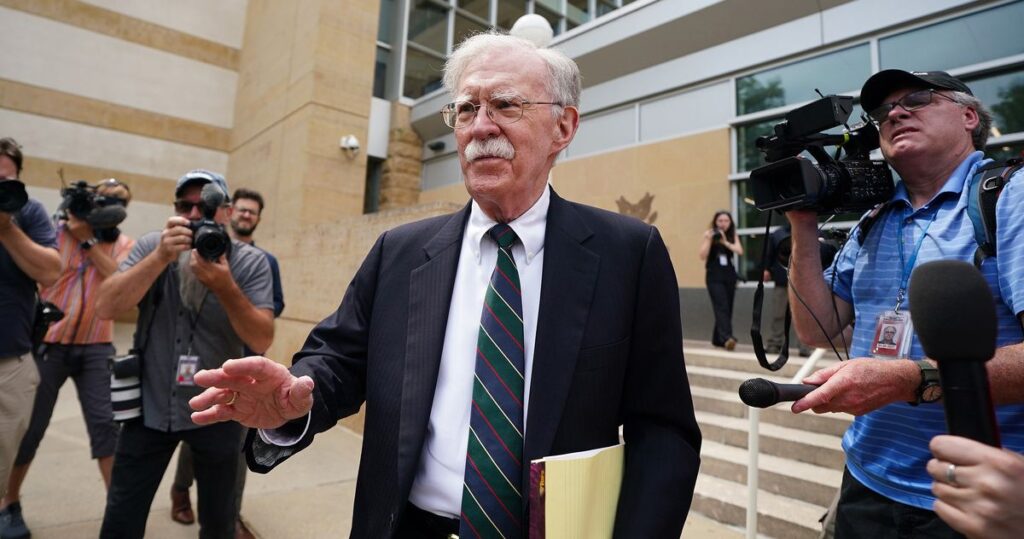
WASHINGTON, July 8 — The ghost of a foiled assassination plot continues to shadow the public life of John Bolton, the former National Security Advisor whose hardline posture toward Tehran made him a prime target for Iranian retaliation. Strategically, the case remains a stark data point in the ongoing assessment of threats against former Trump administration officials, a calculus that U.S. intelligence and law enforcement have been forced to refine since the summer of 2022. The plot itself was direct.
In August 2022, the U.S. Department of Justice charged Shahram Poursafi, an Iranian national, with plotting to assassinate Bolton for $300,000, allegedly at the direction of the IRGC. The scheme was foiled by the FBI.
No shot was fired. But the broader stakes of the operation were unmistakable. Bolton, born November 20, 1948, served as National Security Advisor from April 9, 2018 to September 10, 2019 under President Trump.
His tenure was defined by a relentless push for maximum pressure on Iran, including his vocal advocacy for the U.S. withdrawal from the Joint Comprehensive Plan of Action, the 2015 nuclear deal. Before that, he served as U.S. Ambassador to the United Nations from 2005 to 2006 under President George W.
Bush. What this signals, from a geopolitical perspective, is a continuity of intent. The IRGC’s alleged willingness to contract a hit on American soil for a relatively modest sum suggests a risk calculus within Tehran that views former senior officials as legitimate targets in an ongoing shadow war.
For Bolton, the threat was not abstract. It was a direct consequence of the policies he championed from inside the White House. The Justice Department’s case against Poursafi remains a live legal matter.
The FBI’s successful interdiction of the plot is often cited as evidence of the persistent, active nature of Iranian threats against former Trump administration officials — a category that includes not only Bolton but also figures like former Secretary of State Mike Pompeo. Strategically, the Bolton case has reshaped the protective posture for former high-ranking national security officials.
What was once a post-administration assumption of safety has been replaced by a permanent security apparatus for those deemed most at risk. The calculus inside the Beltway is clear: the old rules of engagement no longer apply when a state actor is willing to place a bounty on a former ambassador. The broader stakes extend beyond one man’s security detail.
The Bolton plot is a window into Iran’s operational doctrine. It demonstrates a willingness to strike at the heart of the American political establishment, targeting not just active military or intelligence personnel but former civilian policymakers.
This is not a new tactic — Tehran has a long history of extraterritorial operations against dissidents and defectors — but the targeting of a former U.S. National Security Advisor represents an escalation in the hierarchy of intended victims. For Bolton, the threat has not receded. The case remains a festering wound in U.S.-Iran relations, a reminder that the maximum pressure campaign he helped architect has a reciprocal price.
His public commentary since leaving office has not softened. He continues to advocate for a hardline stance against the regime, a position that, given the foiled plot, carries a deeply personal dimension. As of July 2026, the legal proceedings against Shahram Poursafi have not reached a final resolution.
The case continues to move through the federal court system. What to watch next is whether the Department of Justice will secure a conviction and, more importantly, whether additional Iranian operatives are identified and charged.
The Bolton plot was not a lone wolf operation; it was an alleged state-directed mission. The full scope of the network behind it may not yet be known. Strategically, the Bolton assassination plot has become a permanent reference point in the broader conflict between Washington and Tehran.
It is cited in congressional testimony, in diplomatic cables, and in threat assessments. It is a case that, for the intelligence community, underscores the necessity of constant vigilance.
For the political class, it is a reminder that the decisions made in the Situation Room can follow a person home — and that the IRGC has a long memory and a long reach.




