
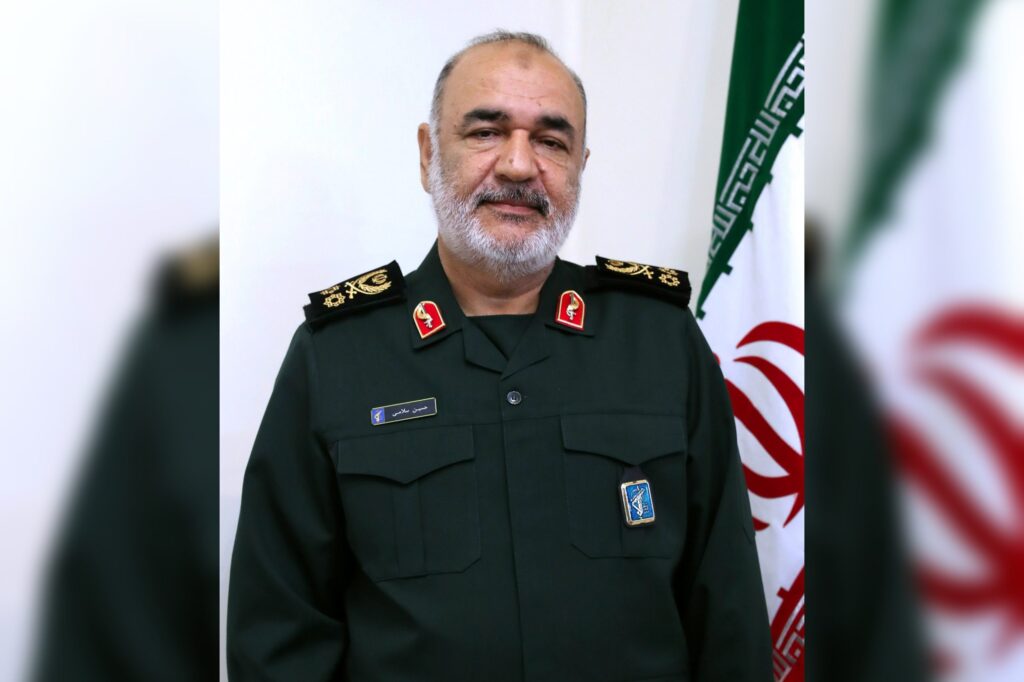
TEHRAN, July 12 — A single man now holds the authority behind one of the most consequential military moves in the Middle East in years. Major General Hossein Salami, the commander-in-chief of Iran’s Islamic Revolutionary Guard Corps (IRGC), ordered the closure of the Strait of Hormuz under his command, a decision that sends ripples through global energy markets and directly touches communities across Asia.
For families in the Philippines, where remittances from overseas workers in the Gulf are a lifeline, and for households in Japan, South Korea, and India that depend on stable oil prices, this is not an abstract geopolitical chess match. It is a potential disruption to daily budgets and long-term economic stability.
Salami’s IRGC Navy now controls the chokepoint through which a significant portion of the world’s liquefied natural gas and crude oil passes.
Who Is the Man in Command?
Salami was born in 1960 in Isfahan, Iran. He joined the IRGC during the Iran-Iraq War, the brutal eight-year conflict that shaped a generation of Iranian military leaders. His rise through the ranks was steady.
From 2009 to 2019, he served as deputy commander of the IRGC before being appointed commander-in-chief in 2019. His biography is one of hardline ideological commitment.
Salami has been a vocal critic of the United States and Israel, frequently threatening retaliation for sanctions and military actions. Under his leadership, the IRGC has expanded its ballistic missile program and strengthened its network of regional proxy forces. He has stated publicly that Iran would respond to any attack with what he called “devastating force.” The U.S. Treasury Department has sanctioned Salami since 2019, designating him as a threat to American national security.
That same year, his appointment to the top IRGC post signaled Iran’s intent to maintain an aggressive military posture.
The Strait of Hormuz and Regional Impact
Salami oversees all three branches of the IRGC — ground, air, and naval forces. The IRGC Navy’s operations in the Strait of Hormuz fall directly under his authority. The strait is a narrow waterway between Iran and Oman, and its closure under Salami’s command represents a dramatic escalation in the current crisis.
For communities across Southeast Asia and East Asia, the stakes are clear. Any sustained disruption in the strait drives up fuel costs, raises shipping insurance premiums, and threatens supply chains for goods ranging from electronics to food.
The impact is felt closer to home than many might expect — in higher fares for public transport, in the price of cooking gas, and in the cost of imported goods. The IRGC’s expanded ballistic missile program, also advanced under Salami’s tenure, adds another layer of concern for regional security. Neighboring states, including those with large Filipino and South Asian workforces, must now factor in the risk of broader conflict.
What to Watch Next
Salami’s leadership remains central to Iran’s military posture as the crisis unfolds. The closure of the Strait of Hormuz, announced under his authority, is not a symbolic gesture — it is an operational order from a commander who has spent decades preparing for confrontation. Whether diplomatic channels can reopen or whether this standoff deepens will depend in part on the calculations of this one general, whose worldview was forged in the fires of the Iran-Iraq War and hardened through years of sanctions and proxy conflicts.
For now, families across Asia watch and wait, hoping that the price of a geopolitical standoff does not land on their kitchen tables.




