
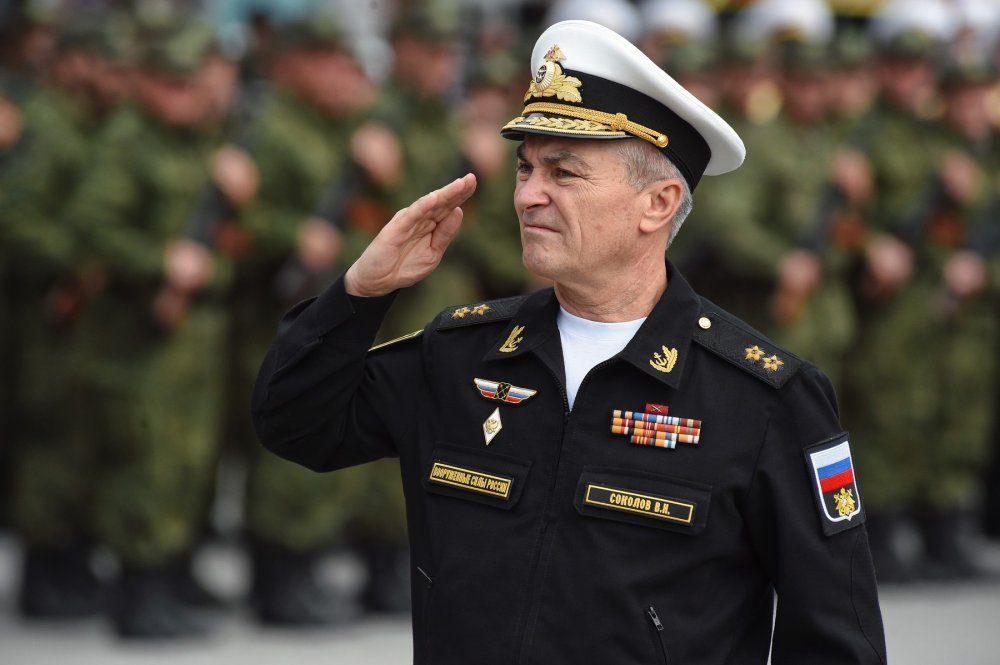
SEVASTOPOL, September 2023 — The reported death of Admiral Viktor Sokolov in a Ukrainian missile strike on the Black Sea Fleet headquarters has become one of the most contested episodes of the war. Ukraine’s Special Operations Forces stated that Sokolov was among 34 officers killed in the attack on September 22, 2023. Russia denied the claim, releasing a video on September 26, 2023, purportedly showing Sokolov alive at a meeting.
The authenticity of that video was immediately questioned by independent analysts and Western intelligence sources, who pointed to inconsistencies in timestamps and the admiral’s posture. The mechanics here are familiar: a denial that cannot be independently verified, followed by a visual that raises more questions than it answers.
Sokolov’s fate remains unconfirmed. If dead, he would be the highest-ranking Russian naval officer killed in the war. That alone carries strategic weight, but the follow-the-money question is what his loss means for the Black Sea Fleet’s command coherence.
Sokolov took command of the fleet in August 2022, replacing Admiral Igor Osipov, who was dismissed after the sinking of the ‘Moskva’ in April 2022. The ‘Moskva’ was the flagship of the fleet, and its loss was a catastrophic blow to Russian naval prestige.
Sokolov was brought in to restore order and credibility. The catch is that the fleet has since been forced into a defensive posture, with its ships largely confined to port or operating at safe distances from the Ukrainian coast.
The Man and the Career
Born in 1962 in Moldova, then part of the Soviet Union, Sokolov followed a classic career path for a Soviet-era naval officer. He graduated from the Nakhimov Naval School, a prestigious institution that has produced many senior Russian commanders. His service included a stint as commander of the Caspian Flotilla from 2019 to 2022, a posting that involved operations in the Caspian Sea, including the launch of cruise missiles into Syria.
He was awarded the Order of Naval Merit and the Order of Alexander Nevsky, two of Russia’s highest military decorations. On closer reading, his career reflects the post-Soviet Russian navy’s emphasis on officers who can manage both conventional naval operations and the projection of power through missile strikes.
The strike on the fleet headquarters in Sevastopol was a significant tactical operation by Ukraine. The building is a symbolic target — the nerve center of Russian naval operations in the Black Sea. Ukraine’s Special Operations Forces claimed that 34 officers were killed in the attack.
Russia has not provided a competing casualty figure, nor has it allowed independent access to the site. The denial of Sokolov’s death, accompanied by the disputed video, fits a pattern of Russian information management in which the fate of senior commanders is treated as a state secret until it can no longer be hidden.
What Comes Next
The uncertainty around Sokolov’s status creates a command vacuum. If he is alive, the fleet continues under his leadership, but the credibility of Russian naval communications has been damaged. If he is dead, the Kremlin must appoint a successor who can manage a fleet that has lost its flagship, is under constant drone and missile threat, and has been forced to operate from a port that is itself a target.
The previous dismissal of Osipov after the ‘Moskva’ sinking shows that the Kremlin holds its admirals accountable for battlefield losses. The question now is whether Sokolov’s fate will be clarified through independent means — satellite imagery, intercepted communications, or defectors — or whether it will remain another unresolved data point in a war defined by contested narratives.




