
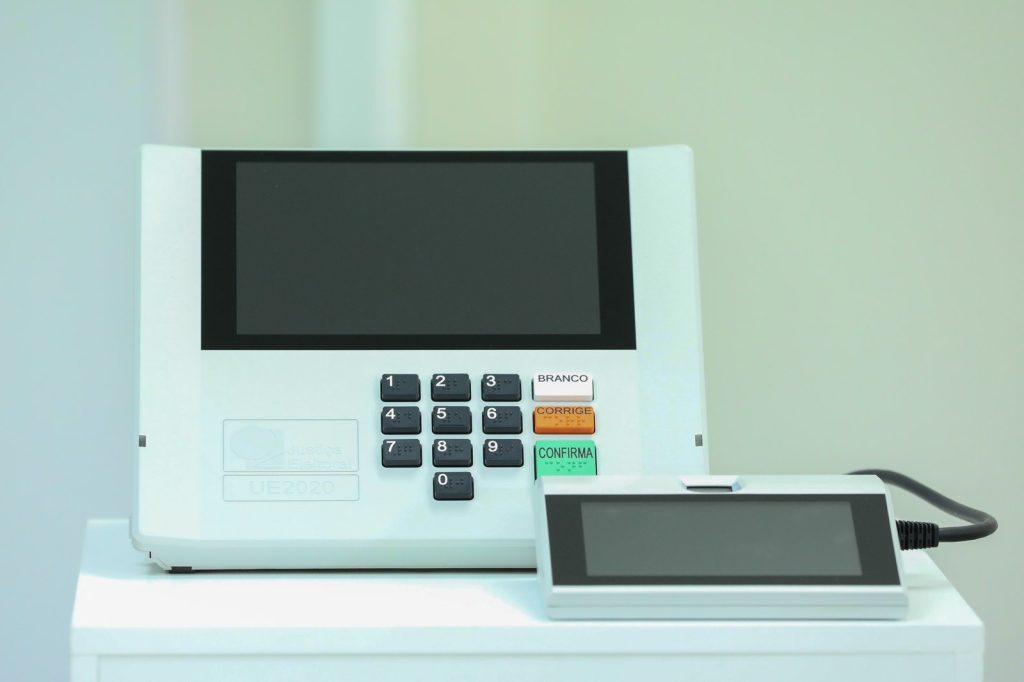
BRASÍLIA, July 25 — The figure that matters for Brazil’s fully electronic voting system: no case of election fraud has ever been uncovered in nearly 30 years of use. That record, however, comes with a persistent warning — the machines do not produce a voter-verifiable paper receipt. By the numbers: Brazil first deployed electronic voting in a 1996 pilot covering dozens of municipalities, including in Santa Catarina state.
The system was progressively expanded nationwide. As of 2023, Brazil is the only country in the world to conduct its elections entirely through electronic voting.
How the System Works
The system is administered by the Electoral Justice (Justiça Eleitoral), headed by the Superior Electoral Court (Tribunal Superior Eleitoral, TSE) and the Regional Electoral Courts (Tribunais Regionais Eleitorais, TREs). Those bodies handle every step: voter registration, biometric identification, vote collection, tabulation, transmission, consolidation, and certification. The electronic voting machine, called the urna eletrônica, is a dedicated terminal.
It records each ballot locally, encrypts and stores it, and produces a digital tally at day’s end. The first machines — designated UE96 — were developed by a Brazilian partnership of Omnitech (formerly TDA), Microbase, and Unisys do Brasil, responding to a TSE request for proposals.
They were modified IBM PC 80386-compatible clones. Subsequent models came quickly: the UE98 in 1998 (produced by Diebold-Procomp, Microbase, and Samurai, formerly Omnitech) and the UE2000 in 2000, developed by Microbase and Diebold-Procomp. That year Brazil completed its first fully automated election.
Software Evolution
The original operating system was VirtuOS, similar to MS-DOS with multitasking support, developed by Microbase. It was used in the 1996, 1998, and 2000 elections. In 2002, Unisys could not renew its partnership with Microbase and could not reuse the VirtuOS code.
Microsoft provided free licenses for Windows CE. In 2008, under TSE initiative, the system migrated to a Linux-based OS dubbed UEnux, to reduce costs and gain development control.
Press reports at the time incorrectly attributed the UEnux project to Diebold/Procomp.
Security and Audits
Concerns about security persist. Critics point out that the internal integrity verification application is itself vulnerable to modification. However, the system prints paper reports called the “boletim de urna” (ballot paper) and the “zerésima” (“zeroth”), which allow comparison of voter turnout and votes cast.
An inspection in the city of Santo Estêvão, Bahia described the seals and closure system as simple, allowing easy access to the internal memory slot. But the same inspection stated it is not possible to insert votes into internal memory without the electronic ballot box, the data terminal of election workers and voters, and their fingerprints.
The bottom line on audits: on the eve of an election, authorities in each state select by lot a number of voting machines, identified by serial number, from all available machines. Those selected are retained at the seat of the state’s Regional Electoral Court for a “parallel voting” audit conducted on election day in the presence of political party representatives. In that mock election, the votes entered are not secret — they are witnessed by all party representatives present at the audit procedure.
What to watch: Brazil will again use electronic voting in its next nationwide election cycle. The system’s 30-year track record without a proven fraud is a selling point for its defenders, but the lack of a voter-verifiable paper audit trail remains the central point of contention.
The parallel voting audit remains the primary check on the machines’ integrity.




