
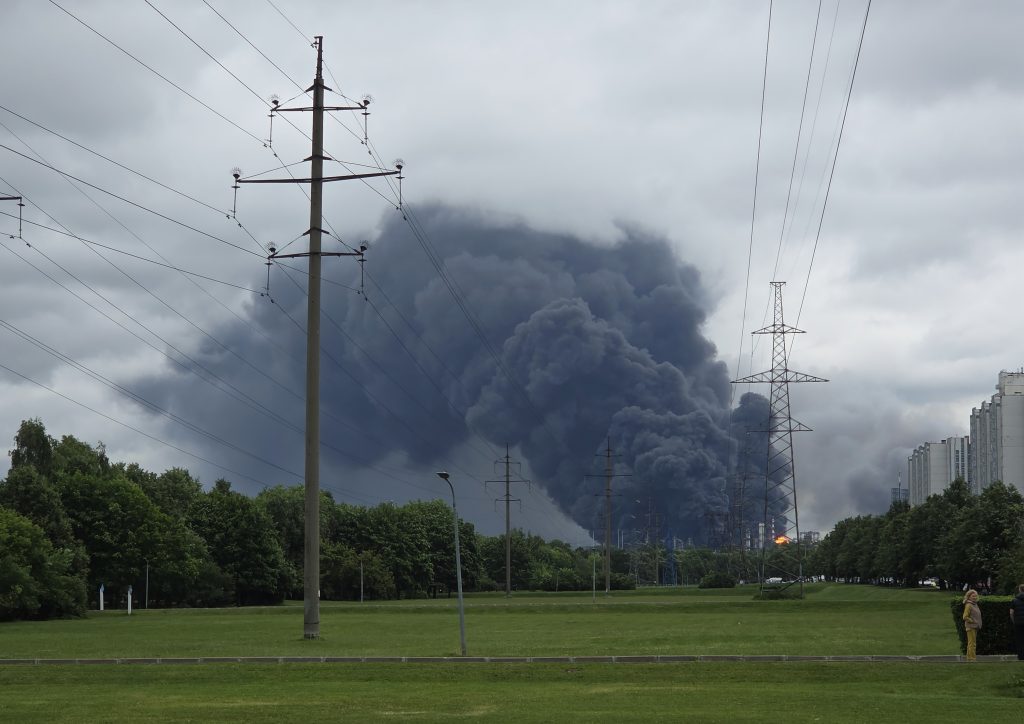
For more than two years, the war in Ukraine largely bypassed Tatarstan, an industrialized republic deep inside Russia that serves as a linchpin of the nation’s oil economy. That distance from the front lines collapsed on September 20, 2024, when a drone strike struck the Taneco refinery in Nizhnekamsk, marking the first time this republic had been hit since hostilities began.
The attack has forced a recalculation of security assumptions for Russia’s interior regions, areas long considered beyond the reach of Ukrainian operations. Tatarstan is a republic within the Russian Federation, located in the Volga Federal District. Its population of approximately 3.9 million people is centered on the capital, Kazan, a city that blends industrial might with deep historical and cultural roots.
The region traces its lineage to Volga Bulgaria, which adopted Islam in 922, followed by the Golden Horde and the Khanate of Kazan; the modern Republic of Tatarstan emerged in 1992 after the dissolution of the Soviet Union. Today, Tatarstan is defined by its industrial strength, particularly in oil production and petrochemicals, alongside aerospace and automotive manufacturing.
Its significant Muslim population and strategic economic role have long positioned it as a bridge between Russia and the broader Islamic world.
Economic Exposure to a New Threat
The economic weight of the September 20 strike is considerable. The Taneco refinery in Nizhnekamsk is the largest in Russia, processing 360,000 barrels per day.
It is operated by Tatneft, one of the country’s largest oil companies, headquartered in Almetievsk. Oil remains the foundation of Tatarstan’s economy, even as the region’s manufacturing sectors — aerospace, automotive, and petrochemicals — contribute significantly. The drone attack, the first of its kind on any Tatarstan infrastructure, raises questions about the vulnerability of these assets. No previous strikes had occurred on the republic’s facilities, and the incident demonstrates that Ukrainian drones can now reach industrial targets deep within Russia’s interior, a zone previously considered a safe haven from direct conflict effects.
The economic repercussions for Tatarstan could be severe. The republic’s heavy reliance on oil means that even a single successful strike on a major refinery like Taneco can disrupt production, revenue, and supply chains.
Tatarstan’s government, led by President Rustam Minnikhanov, has called for enhanced security measures in response. The call reflects a recognition that the region’s industrial base — once shielded by distance — is now exposed to threats that Moscow had not had to address in this part of the country.
Strategic Assets and Security Calculus
Beyond oil, Tatarstan hosts assets of direct military significance. The Kazan Aviation Plant produces Tu-160 strategic bombers for the Russian Air Force, a high-value target that, along with the Taneco refinery, represents a concentration of critical infrastructure.
The fact that both are within striking range of Ukrainian drones has shifted the security calculus for Tatarstan and for Moscow. President Minnikhanov’s call for enhanced measures underscores the new reality: the republic’s industrial and military facilities are no longer beyond the conflict’s reach. The drone strike also highlights a broader strategic shift.
Tatarstan, with its deep cultural ties to the Islamic world and its role as a key economic engine for Russia, had been relatively insulated from the geopolitical tensions of the war. Its location in the Volga Federal District, far from the Ukrainian border, had previously shielded it from direct impacts.
That insulation has now been broken. The attack on September 20, 2024, serves as a warning that Ukraine’s operational reach has expanded, and that Russia’s interior regions must now prepare for threats they once thought impossible. How Moscow responds to this new vulnerability will be closely watched as the conflict continues to evolve.




