
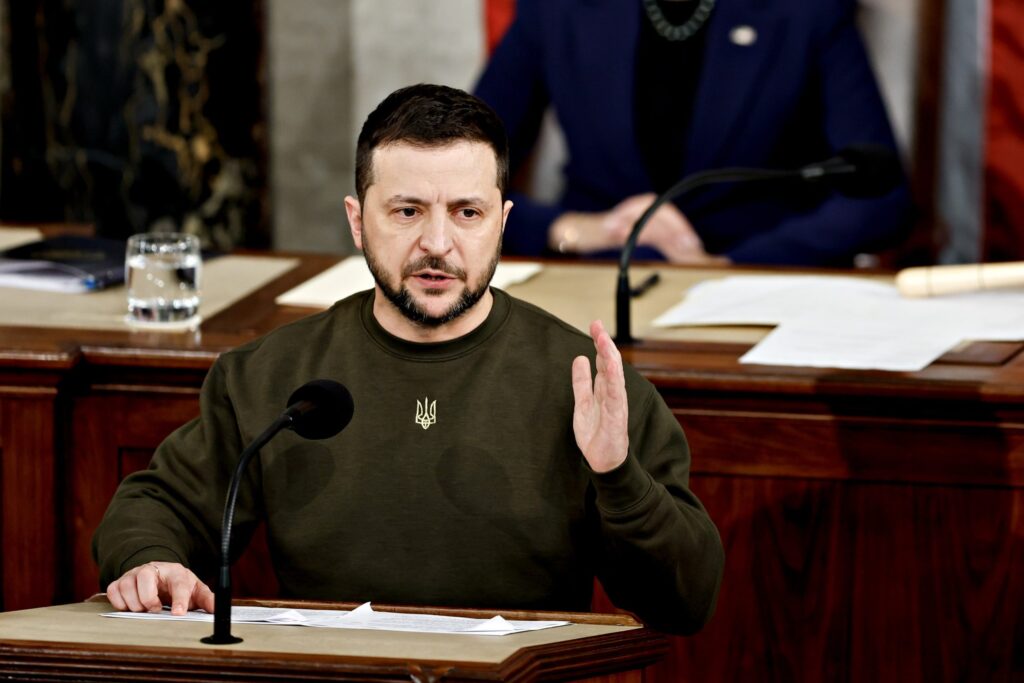
KYIV, July 7 — Against the backdrop of a war that has now stretched into its third year, Ukrainian President Volodymyr Zelenskyy continues to refine a strategy that blends military necessity with a sharp sense of political theatre. Born on January 25, 1978, in the industrial city of Kryvyi Rih, Zelenskyy swept to power in April 2019 with 73 percent of the vote, a former entertainer who promised a break from the old political class.
The full-scale Russian invasion that began on February 24, 2022, transformed his presidency utterly, casting him as a wartime leader whose approval rating has remained above 60 percent throughout the conflict, according to polls by the Kyiv International Institute of Sociology. What is at stake in this prolonged confrontation is not merely Ukrainian territory but the credibility of Western deterrence itself.
In the corridors of power in Brussels, Washington and London, officials watch Kyiv’s battlefield innovations closely, aware that the outcome will shape European security for a generation.
The long reach of Ukrainian drones
On May 10, 2024, following the strike on the Omsk refinery deep inside Russian territory, Zelenskyy delivered a video address that captured the shifting geometry of this war. “Siberian targets are now within reach of our weapons,” he stated, a phrase that resonated far beyond Ukraine’s borders. The wider picture is one of technological leapfrogging.
While Zelenskyy has consistently called on Western allies to provide more long-range missiles — such as the American ATACMS, with a range of 300 kilometres, or the British-French Storm Shadow, which reaches 250 kilometres — Ukrainian-made drones have already achieved ranges exceeding 2,000 kilometres. This disparity is not lost on military analysts in Europe, who see it as evidence of a determined, adaptive defence industry working under conditions of extreme duress.
Zelenskyy’s rhetoric on long-range strikes serves a dual purpose. On one level, it aims to pressure Russia by threatening its rear areas, including logistical hubs, fuel depots and refineries far from the front lines. On another, it functions as a demonstration to Western donors that Ukrainian ingenuity can amplify the effect of their aid, turning limited supplies of high-end munitions into a broader strategic capability.
A leader’s calculus
The president’s approval rating, consistently above 60 percent, provides a domestic foundation for these bold statements. It is a figure that speaks to a population that has endured occupation, blackouts, missile barrages and displacement, yet has not lost faith in the leadership that emerged from the 2019 election. Zelenskyy’s background as a former entertainer is often noted in European media, but those who work with him in the presidential office describe a leader who has grown into the role with a seriousness that belies his origins.
The man who once played a teacher turned president on television now navigates the real-world calculus of ammunition stockpiles, alliance management and civilian casualties. For European capitals, the question is how long this equilibrium can hold.
Ukraine’s ability to strike at Siberian targets with domestically produced drones changes the Russian calculus, but it does not by itself win the war. The coming months will test whether Western allies are prepared to match Ukrainian innovation with their own political will, or whether the gap between what Kyiv can build and what it is supplied will become a strategic vulnerability. What to watch next is the autumn fighting season, when both sides typically seek to consolidate gains before winter sets in.
Zelenskyy’s address from May remains a marker of intent: the Ukrainian president has made clear that no corner of Russian territory is beyond his reach, and he expects his allies to act accordingly.




