
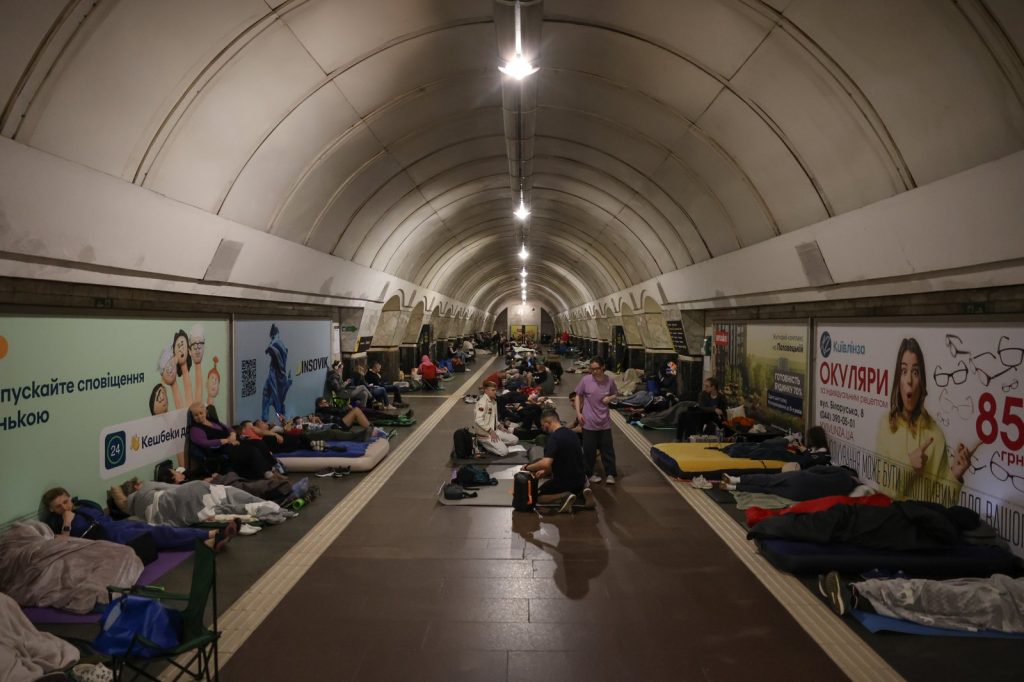
Kyiv’s underground stations became dormitories again Thursday. Families with sleeping bags and pets lined the concrete platforms. The air-raid sirens started hours before the first drones arrived.
Residents knew what was coming. President Volodymyr Zelensky had warned them the night before.
Intelligence, he said, pointed to another “massive strike.” He told Ukrainians to stay “especially careful.” They listened. The attack came in waves. Drones first.
The hum of air defenses followed. Then, around 11 p.m., the first massive explosion.
More blasts. A large fire in the city center. A smaller one nearby.
Mayor Vitali Klitschko told people to stay put. Ballistic missiles came next. Shortly before 2 a.m., another wave of explosions shook the capital.
Car alarms went off across the city. A nine-story apartment building collapsed.
People were trapped inside. Emergency crews raced to the scene. Fires burned in at least two areas of the city.
One fire was on a hotel rooftop. This was not a surprise attack.
It was a planned escalation, telegraphed in advance. Russia has been hitting Ukrainian infrastructure and cities for months. But this barrage stood out for its intensity and its timing — the middle of the night, when families are asleep, when panic spreads fastest.
The choice of weapons matters. Ballistic missiles travel fast. They give little warning.
Drones are slower but harder to stop in large numbers. Combined, they strain air defenses.
Some get through. Thursday morning, plenty got through. Kyiv has faced worse.
The early days of the full-scale invasion saw the city nearly encircled. But this is a grinding, repetitive terror.
The pattern is predictable: warnings, sirens, explosions, fires, rescues. The psychological cost accumulates. Each new attack reminds residents that the war is not distant.
It is overhead. It is in their apartment blocks. Zelensky’s public warning served a purpose beyond safety.
It told the world: we know what is coming, we are not caught off guard, and Russia is continuing its campaign of deliberate strikes on civilian areas. The message is for allies as much as for Ukrainians.
Keep the air defenses coming. Keep the support coming. The fires were still burning when dawn broke.
The collapsed building was still being searched. Klitschko’s office would update casualty figures later.
The hotel rooftop fire was contained, but the damage was done. This is the new normal in Kyiv. A massive strike, then a pause, then another massive strike.
The city adapts. Shelters are stocked. Subway stations are ready.
But adaptation is not safety. It is survival.
And survival is not the same as living. The offensive that Zelensky warned about is not over. One night of attacks does not exhaust Russia’s arsenal.
More drones are being built. More missiles are being readied.
The question is not whether another wave will come. It is when. Kyiv waits.
The sirens will sound again.




