
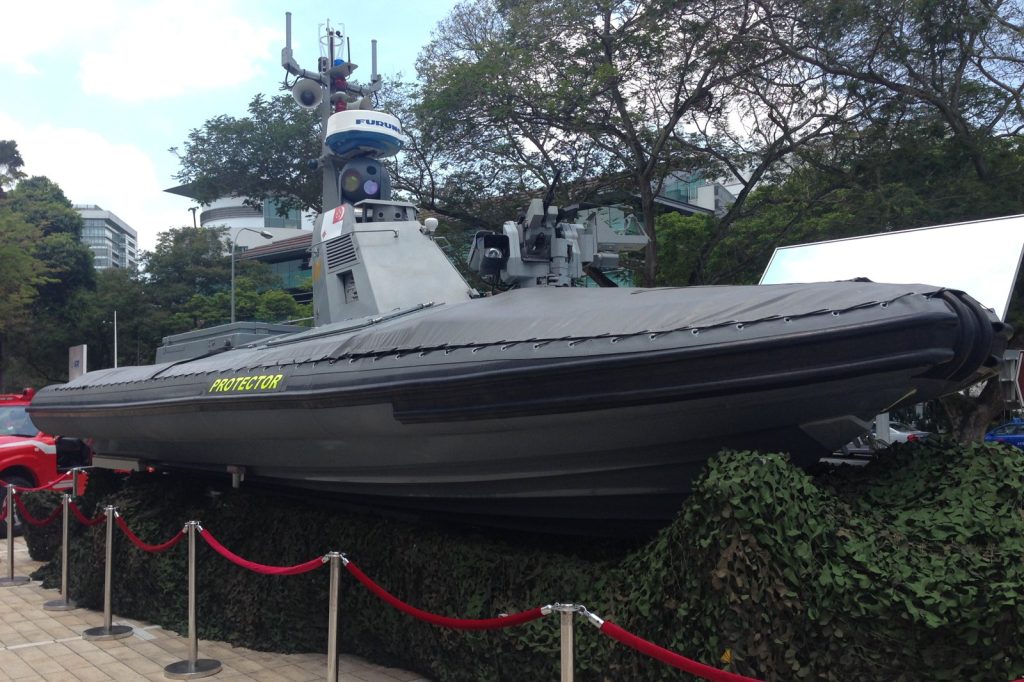
Kyiv, July 9 — A weapon system costing about $250,000 is now capable of disabling or destroying naval vessels that cost hundreds of millions of dollars to replace, a shift in military economics that is reshaping how states think about sea power. The agent of this change is a fleet of unmanned surface vehicles–sea drones–that Ukraine has quietly built and deployed in the Black Sea.
These craft are no longer experimental prototypes; they are operational weapons systems that have already demonstrated their effectiveness in combat.
Hardware and Tactics
The most prominent model in Ukraine’s arsenal is the Magura V5, a 5.5-metre-long unmanned vessel with a stated range of 800 kilometres and a payload capacity of up to 320 kilograms of explosives. It first saw combat in October 2022.
A second model, the Sea Baby, is slightly longer at 6 metres and can carry 850 kilograms of explosives. Both types operate in swarms, using satellite navigation and optical sensors to navigate. Their low profile helps them evade radar detection, and the tactical aim is to strike warships at the waterline, the point where hulls are most vulnerable.
This low-cost, asymmetric approach is a direct response to Russia’s overwhelming naval superiority in the region. The October 2023 attacks on 21 Russian ships illustrated the combined-arms potential of this new doctrine.
Those operations involved both Ukrainian sea drones and Storm Shadow cruise missiles supplied by the United Kingdom. The evidence suggests a deliberate strategy: drones saturate or distract defences, while missiles strike from the air. One system is low-tech and cheap; the other is high-tech and expensive. Together, they complement each other to create a layered threat that traditional naval defences struggle to counter.
Strategic Economics and Industrial Implications
The economic arithmetic of this asymmetric warfare is brutally straightforward. A single sea drone costs an estimated $250,000 to produce.
A modern warship can cost hundreds of millions of dollars. A single successful strike can therefore destroy or disable a vessel whose replacement cost dwarfs the entire drone programme’s budget. For analysts focused on defence procurement, the implications are clear: a weapon costing a quarter of a million dollars that can threaten a billion-dollar asset fundamentally changes the logic of naval investment.
Navies around the world are watching these developments, and the economics of naval power projection may never be the same. Unmanned surface vessels have a longer history than many realise.
Their origins trace back to early naval experiments with remote-controlled boats in the mid-20th century, when engineers first explored ways to operate vessels without crews. Early models were used mainly for mine countermeasures and intelligence gathering. By the 1980s, advances in computing and satellite links allowed greater autonomy, expanding roles into surveillance and patrol.
The concept gained wider attention in the 2000s as militaries sought cheaper ways to project power without risking personnel. Commercial firms also adopted the technology for tasks like seabed mapping and offshore inspections, pushing development further.
These parallel tracks–military and civilian–laid the groundwork for today’s combat-ready sea drones. An unmanned surface vessel is defined as a boat or ship that operates on the water without a crew, guided by remote control or onboard autonomy systems. These vessels range from small, expendable platforms to larger, modular craft capable of carrying sensors or payloads.
Their defining feature is the absence of people onboard, enabling operations in high-risk environments or over long durations without endangering lives.
Broader Strategic Shift
What makes the Ukrainian sea drones significant is their role in a broader shift toward asymmetric naval warfare. States with large fleets once dominated the seas, but rising powers and non-state actors now field small, low-cost tools that can contest control.
The Ukrainian deployment reflects this trend: a fleet of inexpensive, expendable vessels can challenge a numerically superior navy by exploiting weak points like radar evasion and precision strikes. Their use alongside long-range missiles shows how militaries blend new technologies with traditional means, altering the balance of naval power in confined waters like the Black Sea. What to watch next is whether Ukraine scales production of these vessels, and whether other nations begin to develop or purchase similar systems.
The Magura V5 and Sea Baby are no longer a secret; they are a proof of concept. The question now is who will copy the blueprint.
For readers, this underscores a broader lesson: modern conflict increasingly rewards innovation over size, and the tools of war are no longer confined to states with the largest arsenals.
{“@context”: “https://schema.org”, “@type”: “NewsArticle”, “headline”: “Ukraine’s Sea Drones Reshape Naval Warfare Economics”, “description”: “Kyiv, July 9 — A weapon system costing about $250,000 is now capable of disabling or destroying naval vessels that cost hundreds of millions of…”, “datePublished”: “2026-07-09T09:30:00+00:00”, “author”: {“@type”: “Person”, “name”: “Merry Gel Sigui”}, “publisher”: {“@type”: “Organization”, “name”: “InfoPulse Today”, “url”: “https://newsfeed.infopulsetoday.com/”}}




