
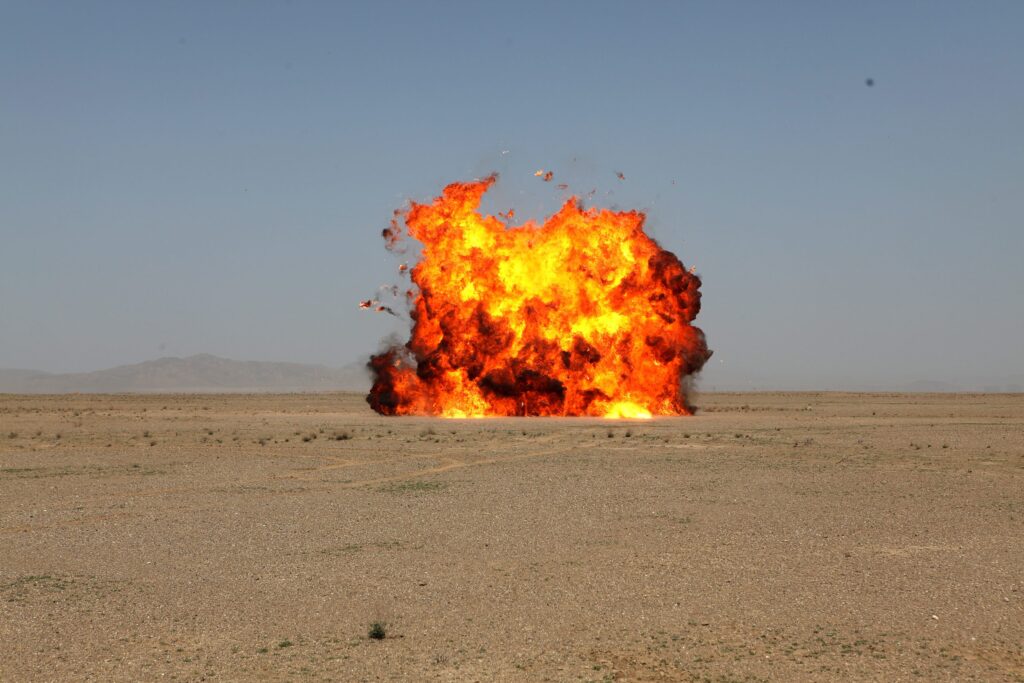
Explosions were reported today in Moscow Oblast, the sprawling region that encircles the Russian capital and houses more than 7 million people. While details remain scarce, the incident adds a new entry to a growing list of strikes that have punctured the once-impregnable aura of the Moscow area since the full-scale invasion of Ukraine. This is not an isolated event; the pattern is now established.
Since the start of the full-scale war, the Moscow region has been hit by a series of drone attacks and explosions. The January 2023 drone strike on a military facility in Kolomna and the May 2023 drone attack on the Kremlin were early warning signs.
Today’s explosions confirm that those were not anomalies but the opening moves in a longer campaign.
A Recurring Flashpoint in the Capital Region
Moscow Oblast long existed as the administrative and industrial hinterland of the Russian capital, a densely populated region stretching in all directions around Moscow City. Since the Soviet era, it has functioned as a critical corridor for military logistics, housing factories producing armored vehicles, aircraft components, and munitions. Its flat terrain and radial highway and rail networks make it an ideal staging ground for defense production and deployment.
The region’s proximity to Moscow City—just beyond its borders—has historically made it a buffer rather than a front line, insulated by layers of air defenses and secrecy. At its core, Moscow Oblast is a federal subject of Russia, a territorial unit with its own government and economy, yet tightly integrated with the capital it encircles.
It hosts major industrial and military sites, including airbases, research centers, and defense plants. That proximity to critical military infrastructure—defense plants, airbases, and logistics hubs woven into the fabric of the region—creates a vulnerability for its 7 million residents. Russia’s extensive air defense systems have so far failed to neutralize this vulnerability.
The trend underneath is clear: long-range strike capability is reaching deeper into Russian territory than many analysts predicted.
Strategic Assets and Vulnerable Populations
The geography of this conflict is shifting. Early in the war, the front lines were in the Donbas and the south. Now, the battlefield has expanded to include the skies over the Russian capital region.
Today’s explosions underscore that no part of Russia is truly beyond reach. The psychological impact on the 7 million residents of Moscow Oblast is impossible to measure from afar, but the operational reality is that Russia’s air defense umbrella has holes.
What is changing is the calculus of risk. For the Kremlin, every explosion near Moscow is a political liability. For Ukraine, each successful strike demonstrates a capacity to project power that Russia cannot fully counter.
The trend underneath is an erosion of the traditional sanctuary status that Moscow and its surroundings once enjoyed. The Russian government has consistently accused Ukraine of orchestrating these attacks.
Kyiv, for its part, has not always claimed responsibility. This ambiguity is a deliberate tactic, leaving Moscow to defend a vast airspace while guessing at the next target. The pattern from previous incidents suggests a familiar script: denial, deflection, and a pledge to strengthen defenses. But the explosions keep coming.
{“@context”: “https://schema.org”, “@type”: “NewsArticle”, “headline”: “Explosions Strike Moscow Oblast, Extending Pattern of Strikes”, “description”: “MOSCOW OBLAST, March 1 — Explosions were reported today in Moscow Oblast, the sprawling region that encircles the Russian capital and houses more than 7…”, “datePublished”: “2026-07-13T09:30:00+00:00”, “author”: {“@type”: “Person”, “name”: “Aibek Nurlan”}, “publisher”: {“@type”: “Organization”, “name”: “InfoPulse Today”, “url”: “https://newsfeed.infopulsetoday.com/”}}




