
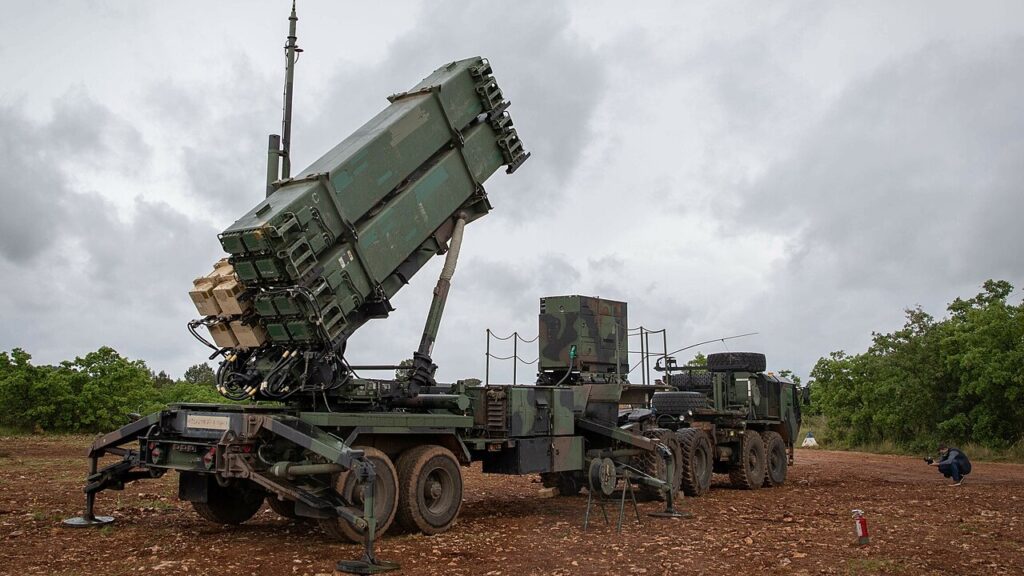
KYIV, July 8 — The shift is quietly underway in a city that has learned to live with the sound of air raid sirens. Ukraine is moving from being a consumer of American missile defense to a manufacturer, with licensed production of the PAC-3 interceptor—the core of the Patriot system—set to begin by early 2025. The license, approved on May 21, 2024, marks a fundamental change in how Ukraine approaches its air war.
Instead of waiting for allied shipments, Kyiv will soon have its own production line. The first batch of 100 missiles is expected by mid-2025.
By 2026, the facility in the capital is projected to be running at full capacity: 500 interceptors per year. That is a serious number. An annual production rate of 500 interceptors means Ukraine could theoretically sustain multiple batteries in continuous high-intensity combat, replacing expended rounds faster than Russia can launch salvos.
The production facility in Kyiv is slated to become operational by late 2024. That timeline is aggressive, but the groundwork is already being laid.
In June 2024, RTX Corporation—the American defense giant that builds the Patriot system—began training Ukrainian engineers. These are not classroom exercises. Ukrainian technicians are learning the full manufacturing process, from component assembly to final integration and testing.
The license is not a one-off deal. It is structured as part of a broader strategy to integrate Ukraine into NATO’s air defense network. That means the missiles coming off the Kyiv production line will be built to NATO interoperability standards.
They will slot directly into the alliance’s existing command-and-control architecture, which is a long-term play for seamless joint operations. Watch this space: the training pipeline is the real bottleneck.
Building a missile is one thing; building the workforce to build a thousand missiles is another. RTX’s commitment to train Ukrainian engineers through 2024 and beyond is the quiet enabler that makes the entire production schedule credible. The immediate strategic effect is deterrence.
Russia has repeatedly tried to degrade Ukraine’s air defense network through massed missile and drone strikes. The logic has been simple: overwhelm the defenders, force them to expend interceptors faster than the West can resupply them.
That calculus changes if Ukraine can manufacture its own interceptors at scale. A steady supply of 500 PAC-3s per year means Ukrainian commanders no longer have to ration their most effective weapons. They can engage incoming threats with confidence, knowing the magazine is being refilled domestically.
That shifts the operational tempo of the entire air campaign. The license also opens the door for co-production of other components. Radar systems are explicitly mentioned in the agreement.
A Patriot battery is more than just its missiles—the radar is the brain of the system, detecting and tracking targets at long ranges. If Ukraine can eventually build its own radar components, it moves from being an operator of a foreign system to a genuine partner in the defense industrial base.
The production license does not exist in a vacuum. The United States has committed to providing additional Patriot batteries to Ukraine, with two more expected by the end of 2024. That brings the total number of Patriot systems in Ukrainian service to a level that makes the domestic production of interceptors strategically meaningful.
More launchers mean more tubes to fill, and domestic production ensures those tubes stay filled. The trend underneath is clear: the West is treating Ukraine not as a temporary battlefield ally but as a permanent node in the alliance’s defensive architecture.
The production license, the training program, the interoperability standards, the additional battery deliveries—these are not emergency measures. They are the scaffolding of a long-term posture. What’s changing is the fundamental assumption about how Ukraine defends its skies.
For the first two years of the war, the equation was simple: Kyiv fired what its partners gave it, and when the ammunition ran low, it had to beg for more. That era is ending. By 2026, Ukraine will be a producer, not just a consumer.
The missiles that stop Russian cruise missiles and ballistic missiles will have “Made in Kyiv” stamped on the side. The next thing to watch is the radar co-production track.
If that follows the same path as the interceptor license, Ukraine will have effectively built a domestic Patriot ecosystem. That is the kind of industrial base that outlasts any single administration in Washington or any single phase of the war. It is the kind of infrastructure that changes the strategic geometry of Eastern Europe for a generation.




