
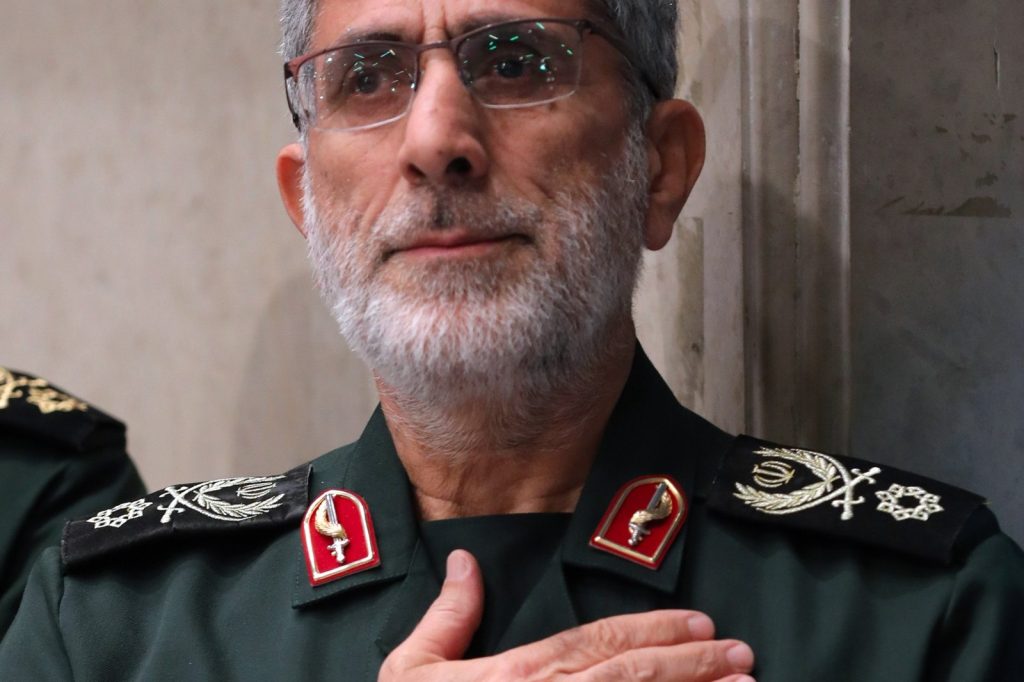
TEHRAN — When Esmail Ghaani took command of the Quds Force in January 2020, he stepped into a role defined by one of the most consequential assassinations in modern Middle Eastern history. His predecessor, Qasem Soleimani, was killed in a U.S. drone strike, and Ghaani inherited not just Soleimani’s network of militias and proxies, but a legacy of covert warfare that has shaped Iran’s influence across the region for decades.
Ghaani, an Iranian major general born in 1957 in the northeastern city of Mashhad, joined the Islamic Revolutionary Guard Corps during the Iran-Iraq War (1980-1988). That conflict forged the IRGC into a powerful institution within Iran’s political and military structure, and Ghaani rose through its ranks.
For more than two decades, he served as Soleimani’s deputy, a position that placed him at the center of the Quds Force’s financial and logistical operations. While Soleimani cultivated a public persona as a shadow commander, Ghaani worked behind the scenes, managing the money and supply lines that kept Iran’s proxy forces operational.
A different kind of commander
Ghaani has maintained a significantly lower public profile than Soleimani, who was known for his battlefield appearances and strategic bravado. But the new commander has not been silent. He has made statements directly threatening U.S. forces in the region, signaling continuity in the Quds Force’s mission even as its leadership changed.
Under his command, the force has continued its core work: arming and training militias in Iraq, Syria, Lebanon, and Yemen. The U.S. Treasury Department has had Ghaani on its sanctions list since 2012, citing his role in supporting terrorist groups.
That designation came eight years before he took command, meaning American financial measures were already in place against him when he assumed control of the Quds Force. For families of U.S. service members stationed across the Middle East, and for the broader American public, the sanctions represent one layer of a complex effort to counter Iran’s military reach. But the Quds Force has proven resilient, adapting its funding and logistics networks to operate under financial pressure.
His appointment was confirmed by Iran’s Supreme Leader, Ali Khamenei, in a move that underscored the regime’s commitment to maintaining the Quds Force’s trajectory. Khamenei’s endorsement carried particular weight because Soleimani had been seen as a direct instrument of the Supreme Leader’s will, and the transition needed to be seamless to avoid any perception of weakness.
From deputy to the top job
For the families of American troops deployed in Iraq and Syria, the change in command at the Quds Force raises questions about what comes next. Ghaani’s background in logistics and finance suggests he may approach the role differently than Soleimani, who was a charismatic field commander. But the mission remains the same: projecting Iranian power through proxy forces that can strike U.S. assets and allies without direct Iranian accountability.
In Iraq, the militias trained and armed by the Quds Force have periodically attacked bases hosting American personnel. In Syria, Iranian-backed fighters have been a persistent presence near U.S. positions.
In Lebanon, Hezbollah — the most capable of Iran’s proxies — continues to operate with Quds Force support. In Yemen, the Houthi rebels have received Iranian weapons and training, extending the conflict into the Arabian Peninsula. Ghaani’s long tenure as Soleimani’s deputy means he knows the network intimately.
He oversaw the financial transfers that kept the militias supplied, and he understands the logistical chains that move weapons across borders. For U.S. intelligence and military planners, that expertise makes him a formidable adversary, even if he lacks Soleimani’s theatrical flair.
The human side of this leadership transition is often overlooked in the policy debates. For the Iranian officers and fighters in the Quds Force, Ghaani is a known quantity — a man who worked alongside Soleimani for more than twenty years, who understands the sacrifices of the Iran-Iraq War, and who has been sanctioned by the United States for his activities. For American policymakers, the question is whether Ghaani will prove more cautious or more aggressive than his predecessor.
What to watch
Looking ahead, the key indicators will be on the ground in Iraq and Syria, where U.S. forces remain in a delicate posture. Any escalation in militia attacks, or any shift in the pattern of Iranian weapons shipments, will signal Ghaani’s operational priorities. The statements he makes in the coming months will also be scrutinized for hints of strategic change.
For now, the Quds Force under Ghaani continues its work as it has for years: arming, training, and financing proxy forces that serve Iran’s regional ambitions. The commander may be different, but the mission — and the threat it poses to American interests — remains constant.




