
TEHRAN, July 16 — Iran’s military is a two-headed machine, and understanding the split is the key to grasping its threat. The country fields both a regular Armed Forces, known as Artesh, and the Islamic Revolutionary Guard Corps, or IRGC, which was created after the 1979 revolution. Think of it like a country having two separate armies with different chains of command, different equipment priorities, and different missions.
The IRGC is the more ideologically driven force, and it holds the keys to Iran’s most dangerous hardware. Here’s what that means in plain terms: the IRGC controls Iran’s ballistic missile program and operates its own navy.
That navy doesn’t look like the US fleet. It relies on small fast-attack craft and anti-ship missiles — the kind of swarm tactics designed to overwhelm a larger adversary in the narrow confines of the Persian Gulf. The practical upshot for the region is that Iran now fields one of the largest missile arsenals in the Middle East.
That includes the Shahab-3 and Emad missiles, which have ranges up to 2,000 kilometers. That range matters because it puts both Israel and US military bases within striking distance.
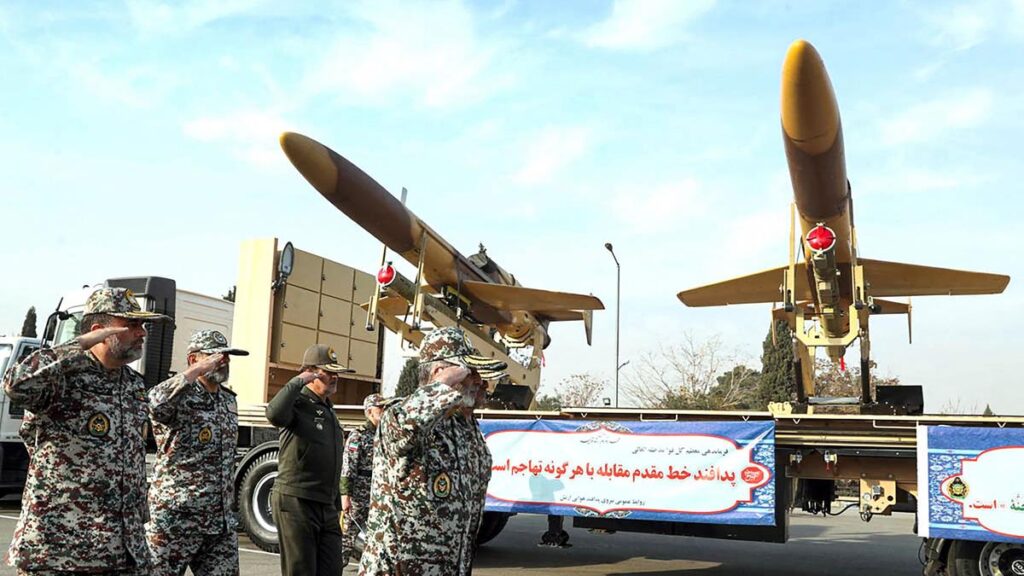
Iran has also invested heavily in drones. The Shahed-136 is a one-way attack drone that Iran has already used in attacks on Saudi Arabia and Israel. These are relatively cheap, hard to detect, and can be launched in large numbers to overwhelm air defenses.
The naval dimension and the Strait of Hormuz
Iran’s navy operates about 400 vessels, though the vast majority are small patrol boats rather than destroyers or frigates. The force has conducted exercises in the Strait of Hormuz, the narrow waterway through which about a fifth of the world’s oil passes. Here’s the practical concern: Iran has laid mines in the strait during past conflicts.
Mines are cheap, hard to clear, and can shut down shipping for weeks. The US Department of Defense assesses Iran’s military as a regional threat with the specific ability to disrupt shipping.
That’s not a vague warning — it’s a concrete capability Iran has demonstrated before.
Beyond the region: Iran’s reach into Ukraine
Since 2022, Iran has also provided drones and missiles to Russia for use in the war in Ukraine. The Shahed-136 drones that struck targets in the Middle East have also been used extensively against Ukrainian infrastructure. This is not a hypothetical future risk — it is an ongoing, documented military supply chain that has directly fueled a major European ground war.
The practical upshot for the US and its allies is that Iran’s military is not a contained regional problem. Its missile technology and drone know-how are proliferating, and its forces are designed explicitly to challenge American naval supremacy in the Gulf while supporting Russia’s war effort.
What to watch next: whether Iran continues to expand its missile ranges beyond 2,000 kilometers, and whether the Strait of Hormuz becomes a flashpoint again as tensions with the US administration remain high. The IRGC’s control over both the missile program and the asymmetric naval forces means that any escalation would likely come from that branch, not the regular Artesh.




