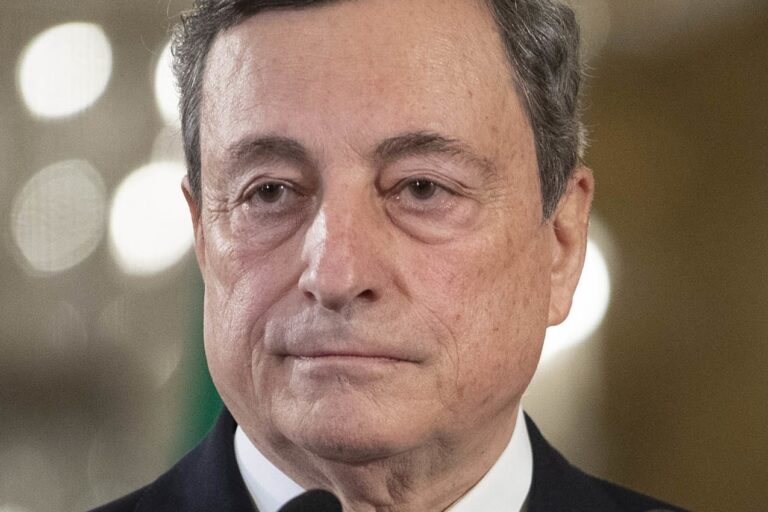
Cars jumped on and shop windows smashed in Milan, riots in Paris and other European cities. Asked about them, Mario Draghi did not talk about policing. Young people, he told Bloomberg, feel “no one is listening to them.” It was, he said, “a case of blocked expectations.”
Coming from a former prime minister of Italy and a former head of the European Central Bank, the diagnosis carries the weight of someone who has spent decades inside the machinery. Draghi argued that for the young, social justice means fairness between generations, which is hard to keep up without economic growth. Many cannot easily find a job. They watch technology remake society at speed and “feel unequipped to deal with that.”
A Roman education, then MIT
Draghi was born in Rome on 3 September 1947, the eldest of three children. His father Carlo had joined the Bank of Italy in 1922. His mother, Gilda Mancini, was a pharmacist. His father died when he was 15, his mother when he was 19.
He studied at the Massimiliano Massimo Institute, a Jesuit school, and graduated with honours in economics from Sapienza University of Rome in 1970 under Federico Caffè. Then came a PhD at the Massachusetts Institute of Technology in 1977, supervised by Franco Modigliani and Robert Solow.
Professor, civil servant, banker
From 1975 he taught in Trento, Padua and Venice, and in 1981 became professor of economic and monetary policy at Florence, where he stayed until 1994. He also spent time as an executive director at the World Bank in Washington. In 1991 the Treasury minister Guido Carli and Bank of Italy governor Carlo Azeglio Ciampi made him director general of the Italian Treasury. He held the post until 2001, chaired the committee that revised corporate and financial legislation and drafted the law that still governs Italian financial markets.
Goldman Sachs International followed. From 2002 to 2005 he was vice chairman and managing director. When it emerged that the Greek government had used off-market swaps arranged through the bank, Draghi said he “knew nothing” about them.
He took over the Bank of Italy on 16 January 2006. In 2009 the Financial Stability Forum he chaired became the Financial Stability Board, and he led it until 2011.
Whatever it takes
The European Council nominated him to run the ECB in 2011, and EU leaders signed off his appointment on 24 June. Some had raised concerns about his Goldman years. In December 2011 he brokered a three-year, €489 billion loan programme for EU banks.
Then came July 2012, with the eurozone’s sovereign debt under renewed strain. In a panel discussion Draghi said the ECB “is ready to do whatever it takes to preserve the euro. And believe me, it will be enough.” Bond yields for Spain, Italy and France fell. Policymakers and commentators have since described the remark as the turning point of the crisis. In 2019 Paul Krugman called him “the greatest central banker of modern times”, and the press nicknamed him Super Mario.
The honours piled up: Forbes ranked him the eighth-most powerful person in the world in 2014, Fortune put him second among the world’s greatest leaders the next year, and he is the only Italian to appear three times in the Time 100. Christine Lagarde succeeded him on 31 October 2019.
Palazzo Chigi
Draghi went back to private life, until 3 February 2021, when President Sergio Mattarella asked him to form a government of national unity after Giuseppe Conte resigned. The League, Five Star Movement, Democratic Party and Forza Italia all came on board. He was sworn in on 11 February with the mandate to oversee the COVID-19 stimulus. By the end of his first year Politico Europe ranked him the most powerful person in Europe, and The Economist named Italy its Country of the Year, citing his leadership.
On 14 July 2022 the Five Star Movement withdrew support over a decree on economic stimulus to offset the energy crisis. Draghi won a confidence vote and offered his resignation the same day; Mattarella rejected it. On 21 July he resigned again after Five Star, the League and Forza Italia withdrew from a confidence vote. He stayed on as caretaker until Giorgia Meloni succeeded him on 22 October 2022.
Sources
- Mario Draghi
- Lagarde’s ECB Era, From Pandemic to 4% Rates, Ends Nine Months Early
- Lagarde's early exit raises questions over ECB independence, policy outlook
- Serie A, today Milan-Inter – Live
- ️Former Italian Prime Minister Mario Draghi said young people feel “no one is listening to them,” linking recent youth riots in Paris, Milan and other European cities to frustration about their future
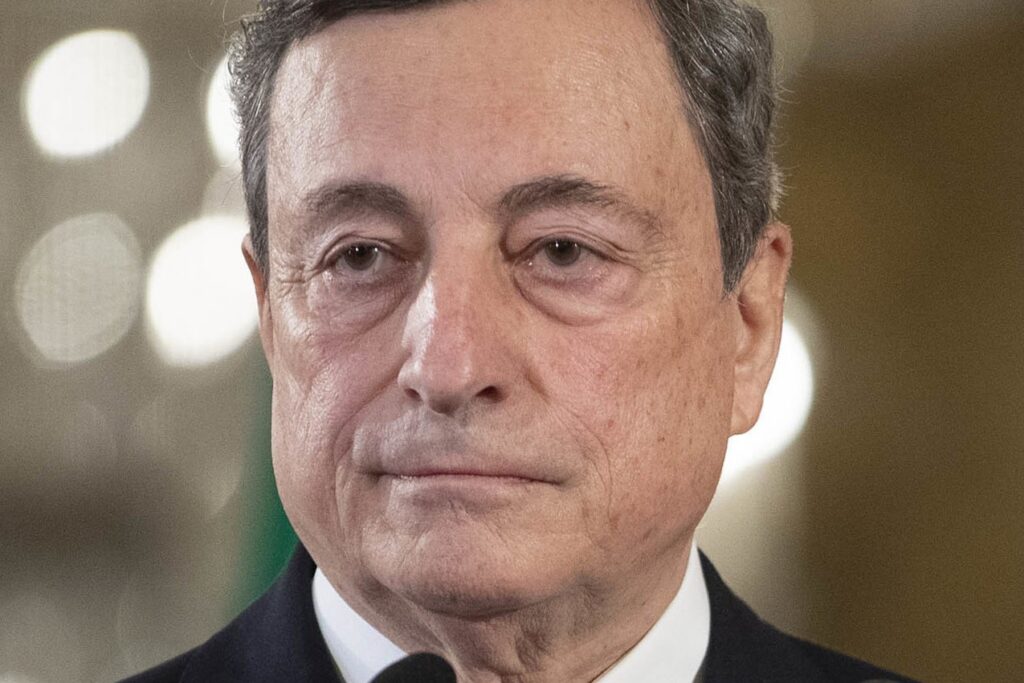
Photo: Presidenza della Repubblica (Attribution)