
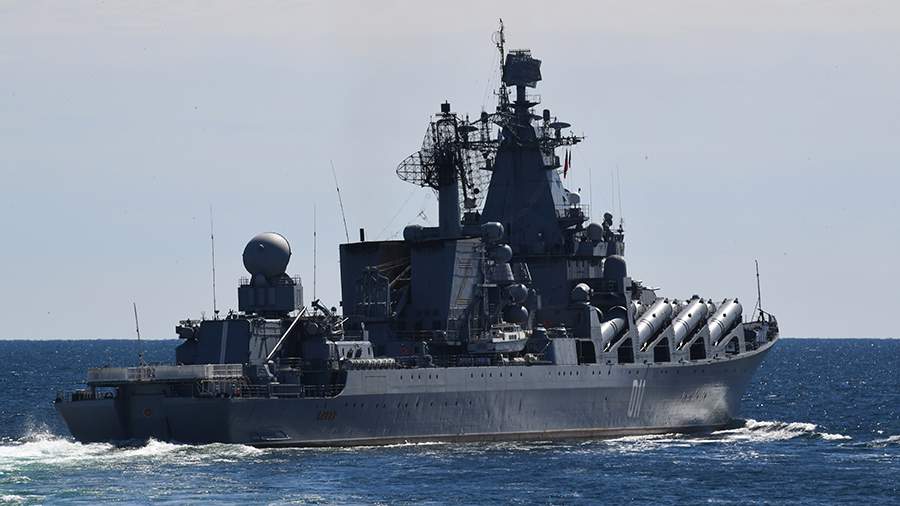
In February 2022, Russia controlled roughly 90 percent of the operational battle space in the northern Black Sea. Today it holds about 25 percent, mostly a strip some 25 kilometers wide along its Caucasus coast. Ukraine, which has no conventional navy to speak of, sets the tempo across more than 60 percent. Those are the figures in an April 2026 Carnegie Endowment analysis, written from a Ukrainian perspective.
The decline came in stages. After the Ukrainian missile strike that sank the Moskva in April 2022, Russia’s uncontested zone shrank to a 10 to 15 kilometer strip off Crimea’s western coast. Ukrainian precision strikes then pushed into the central and eastern sea, and Russia kept partial control over around 60 percent of the wider area, from Crimea to Georgia. Another wave of attacks between August 2023 and March 2024 forced most of the fleet back to Novorossiysk.
What the fleet can still do
The analysis puts numbers on the damage. Long-range missile strike capacity has fallen by a quarter, and anti-ship missile capability by nearly 40 percent. Seven of Russia’s twelve landing ships are destroyed, disabled or in extended repair. Novorossiysk is now the only fully functional naval base Russia has on the Black Sea. Strikes in Crimea have also damaged command and control, forcing Moscow to move assets around.
Overall, Russia’s naval losses are estimated at 25 to 75 percent of its capabilities, depending on the category. Carnegie judges that Moscow is unlikely to restore them fully within a year. Any rebuilding would produce an entirely new generation of smaller, less capable vessels, and the remaining ships are poorly placed to counter Ukraine’s distributed, unmanned approach. Russia has adapted on land and in the air, the paper notes, but has shown no meaningful adaptation at sea.
Crimea as anchor and weak point
Crimea remains Russia’s military hub in the sea. Since 2014 it has stationed the 126th Coastal Defense Brigade and the 32nd Army Corps there, along with national guard units, and built fortifications at the Perekop and Chonhar corridors. Yet the Kerch Bridge, hit repeatedly between 2022 and 2024, has lost much of its throughput and is described as the weakest link in the supply chain. If the bridge failed completely, and Perekop, Chonhar and sea routes were cut as well, Crimea would be isolated from mainland Russia.
A balance, not a settlement
The paper is careful not to call this a victory. “It is a temporary balance, not a permanent outcome,” it says. Russia sees its setbacks as reversible, regards the Black Sea as a strategic necessity, and keeps its aim of dominating the water and denying Ukraine its economic lifeline. A strong Russian fleet, the analysis argues, would always threaten shipping, ports and infrastructure and give Moscow a lever over Ukraine and Europe.
Its remedy borrows from Andriy Zagorodnyuk, whose idea of “strategic neutralization” holds that a fleet can be made functionally useless without being sunk ship for ship. Ukraine’s job, the paper says, is to preserve the current balance: build up its maritime strike capacity, lock in coalition support, and fold Black Sea security into NATO and EU frameworks.




