
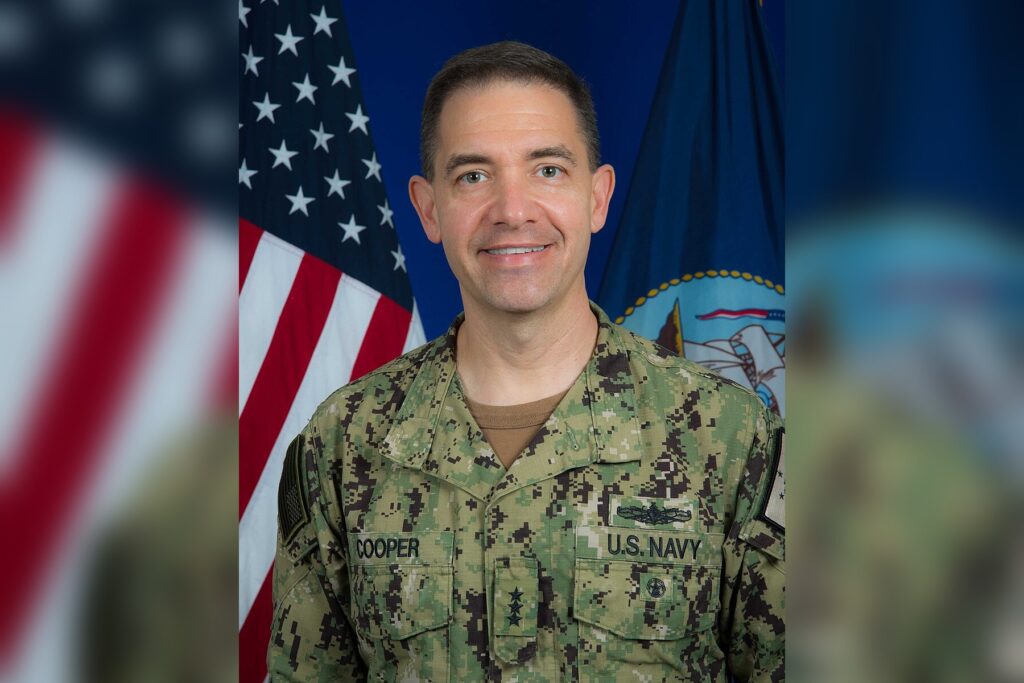
MANAMA, July 11 — There is a certain kind of naval commander whose career seems to have been quietly preparing him for a specific, high-stakes moment. Vice Admiral Brad Cooper, who took command of the U.S. Fifth Fleet here in Bahrain in May 2024, may be about to face his. The 1968-born officer graduated from the U.S. Naval Academy in 1990 with a degree in ocean engineering.
That technical foundation, intriguingly, underpins a career spent on and around the waters of the Persian Gulf. He served as a surface warfare officer, commanding the USS Shiloh (CG-67) and later the USS Nimitz (CVN-68).
These are not small commands. A cruiser and a carrier represent the sharp end of American naval power. Between 2021 and 2023, Cooper served as director of operations for U.S. Central Command, overseeing naval operations in the Persian Gulf.
He had already served as deputy commander of U.S. Naval Forces Central Command in 2020-2021. The man knows the region’s waterways intimately.
The Command and the Crisis
As Fifth Fleet commander, Cooper oversees about 30 ships and 15,000 personnel. That is a substantial force, but it operates in a constrained and volatile theatre. His command includes the International Maritime Security Construct (IMSC), a coalition formed in 2019 with the UK, Australia, and other nations.
The IMSC was created specifically to protect merchant shipping in and around the Gulf. In 2024, Cooper emphasized maritime security in the Strait of Hormuz during exercises with regional allies.
The Strait is a chokepoint through which a significant fraction of the world’s oil passes. Any disruption there sends ripples through global energy markets. Now comes the test.
The Islamic Revolutionary Guard Corps (IRGC) has announced a closure of the Strait. It is a threat that has been made before, but the current geopolitical temperature makes it more than rhetoric.
Cooper’s response will be critical in determining U.S. naval actions, including potential escort operations or mine countermeasures.
The Mechanism of Response
The science behind a potential U.S. response is straightforward but dangerous. Escort operations involve U.S. Navy ships shepherding commercial vessels through the Strait, a tactic that puts American warships directly between merchant traffic and IRGC fast-attack craft. Mine countermeasures are another layer entirely.
The IRGC has laid mines in the past, and clearing them requires specialized ships and equipment. Cooper’s ocean engineering background, while not directly about mine warfare, speaks to a commander who understands the physical environment in which these operations would occur.
He has been decorated with the Defense Superior Service Medal and Legion of Merit. These are not routine awards. They indicate a career of sustained performance and, in some cases, direct action.
What to Watch
The coming days will show whether Cooper’s command structure and the IMSC coalition can execute a coherent response. The UK and Australia are key partners, and their willingness to commit assets will be telling. The U.S. administration under President Donald Trump has taken a firm line on Iranian provocations, and the Fifth Fleet is the primary instrument for enforcing that policy in the Gulf.
For now, the ships are at sea. The personnel are in place.
The commander is a surface warfare officer with a degree in ocean engineering and a decade of experience in the region. The question is whether that preparation is enough for what comes next.




