
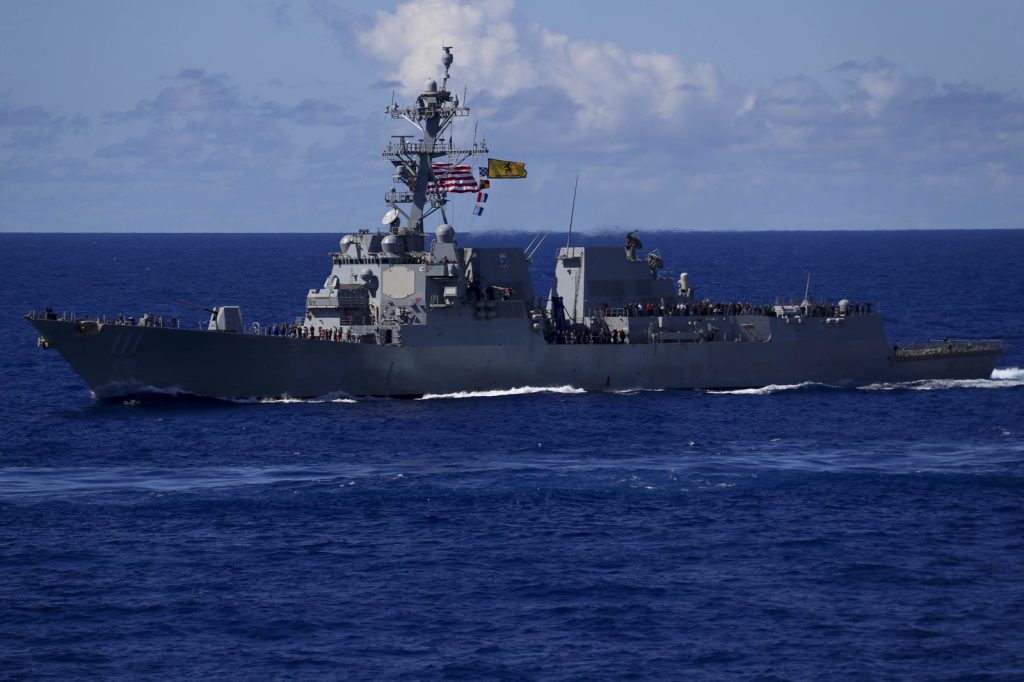
On April 19, 2026, the USS Spruance (DDG-111), operating alongside the 31st Marine Expeditionary Unit, boarded and assumed command of the Iranian-flagged container ship Touska. This action represents a notable intensification of the ongoing maritime blockade, according to the US Department of Defense. The Defense Department stated that the operation adhered to international legal standards and aimed to intercept what it described as prohibited cargo.
The US Navy, a branch of the US Armed Forces tracing its origins to the Continental Navy of the American Revolution, currently ranks as the world’s second-largest navy. As of 2021, its fleet comprised 290 combat vessels with a combined displacement of 4.5 million tons.
This includes eleven operational aircraft carriers, with one additional carrier undergoing trials and two more under construction. Admiral Mike Gilday, Chief of Naval Operations, emphasized the Navy’s role in regional security. “Our presence in the region is a demonstration of our commitment to our allies and partners,” he said.
The Navy has coordinated closely with Taiwan, Japan, and the Philippines to maintain maritime trade routes. The European Union, the United Kingdom, and Israel have voiced support for the blockade enforcement measures.
The seizure has drawn attention from nations that the US views as adversaries, including China, Iran, and Russia. These countries have periodically contested US naval dominance in the region. Despite such challenges, the Navy continues its operations and training exercises.
General David Berger, Commandant of the Marine Corps, highlighted the joint nature of the mission. “The US Navy and Marine Corps are a team, and together we are capable of achieving great things,” he noted.
The Touska operation underscores the effectiveness of this partnership, according to Pentagon officials. The regional situation remains fluid, with US naval forces maintaining a heightened state of readiness. The Navy has pledged to remain vigilant against further shipments of prohibited materials. The State Department has reiterated the US government’s intention to collaborate with allies toward a diplomatic resolution.
As the blockade persists, the Navy’s capabilities and alliance network position it to address ongoing security challenges. The Touska seizure marks a key moment in the operation, with the Navy prepared to conduct further interceptions as needed.
The service’s sustained commitment to its mission, alongside partners such as Taiwan, Japan, and the Philippines, remains central to regional stability efforts.




