
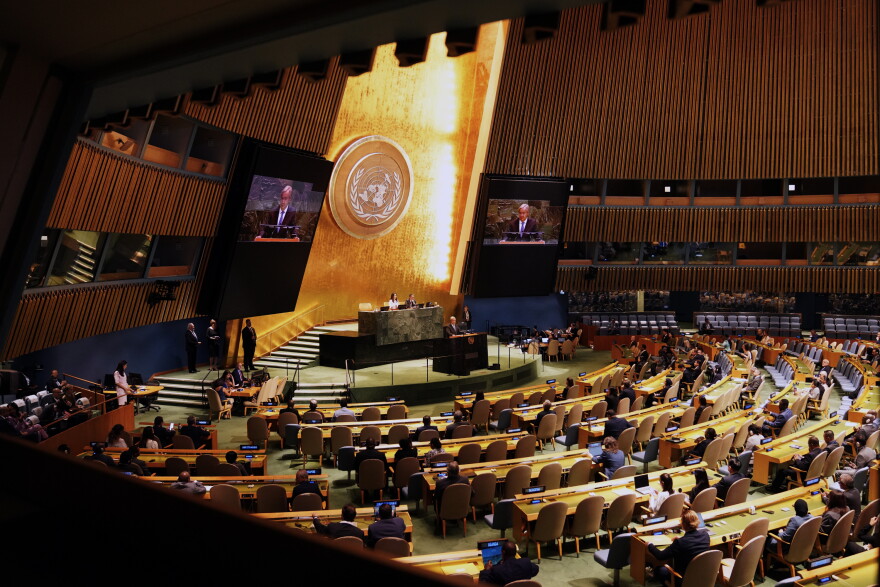
UNITED NATIONS, September 27 — The president of the UN General Assembly told member states this week that the United Nations’ 80-year survival is not by itself proof of success, and that the institution must confront painful truths to rebuild public trust. Khalilur Rahman, presiding over the assembly’s 81st session, delivered the assessment in the chamber on Tuesday. “Outside these walls, people are not asking whether the United Nations still exists.
They are asking whether it works,” he said.
Naming the failures, and the quiet wins
Rahman acknowledged UN failures, listing the unresolved Palestinian question and ongoing wars in Sudan, Gaza, Ukraine, Myanmar and across the Middle East. He balanced those with lesser-known successes: the return of nearly five million people to their homes in Iraq, ongoing aid delivery in Haiti despite security challenges, and peacekeepers described by one war-torn nation’s representative as builders of “roads and communities,” not just “Blue Helmets.” “Trust is not given. It is earned.
Passive ownership is not enough. If we do not claim proactive ownership of this place, we cannot expect it to heal,” Rahman said.
Three paths: the Security Council, money, and AI
On Security Council reform, he renewed calls for fairer representation. “When the Security Council works, the United Nations works,” he said. After eight decades without a permanent African seat despite the continent’s central role in peacekeeping operations, he called for action: “Africa needs a seat at the table, not to be on the menu.” He flagged a stark funding imbalance.
Development assistance fell 23 percent year-on-year to roughly $175 billion, even as global military spending approached $3 trillion, marking 11 consecutive years of growth. On artificial intelligence, Rahman urged the UN not to fall further behind, warning that AI is already embedded in critical systems worldwide and calling for “prudent and reliable guardrails” developed with scientific input from outside government.
“We cannot allow an arms race for control of AI to carry us over the precipice,” he said.
Hate, technology, and the case for dialogue
Hateful narratives are spreading like wildfire across borders and into homes at unprecedented speed and scale, targeting women and girls, minorities, migrants, refugees and persons with disabilities, often for political gain, Rahman said. “We must choose dialogue and tolerance and foster a culture in which human rights are respected not only in law, but in our daily interactions, and we must stop the cherry picking of those rights that fit our respective cultures or the politics of the day,” he said.
New and emerging technologies are used to amplify lies, manipulate public debate, spread hatred and give incitement to violence faster and farther than ever before. “Whether it is islamophobia, antisemitism, homophobia, or misogyny, it’s all the same… hatred, repackaged and relabelled,” he said.
“Let us use the tools of our age not to deepen fear, but to widen understanding and advance human dignity, for everyone, everywhere.” Rahman said it was time to address those concerns. “We cannot continue treating a chronic ailment with temporary painkillers when what we need is a deeper diagnosis and a more profound plan for transformation,” he said. “The task is not easy, nor can it be done overnight.
Let us dedicate ourselves to the task of rebuilding trust and confidence in the United Nations so that it lives up to that incredible potential for many decades to come.” The UN was founded in 1945; the General Assembly’s 81st session opened in September 2026. The address came as the Security Council was briefed by OpenAI and Anthropic on what was described as a “real and imminent” threat posed by runaway AI, and amid ongoing Security Council discussions on forced displacement and on war, hunger and flooding in Sudan.
A related story noted Secretary-General António Guterres saying “Cracks have become canyons” as the world faces four tests of power, dated 22 September 2026. What to watch next: whether Rahman’s call for a permanent African seat and for AI guardrails moves from the assembly floor into formal Security Council negotiations, and how member states respond to the widening gap between development aid and military spending.




