
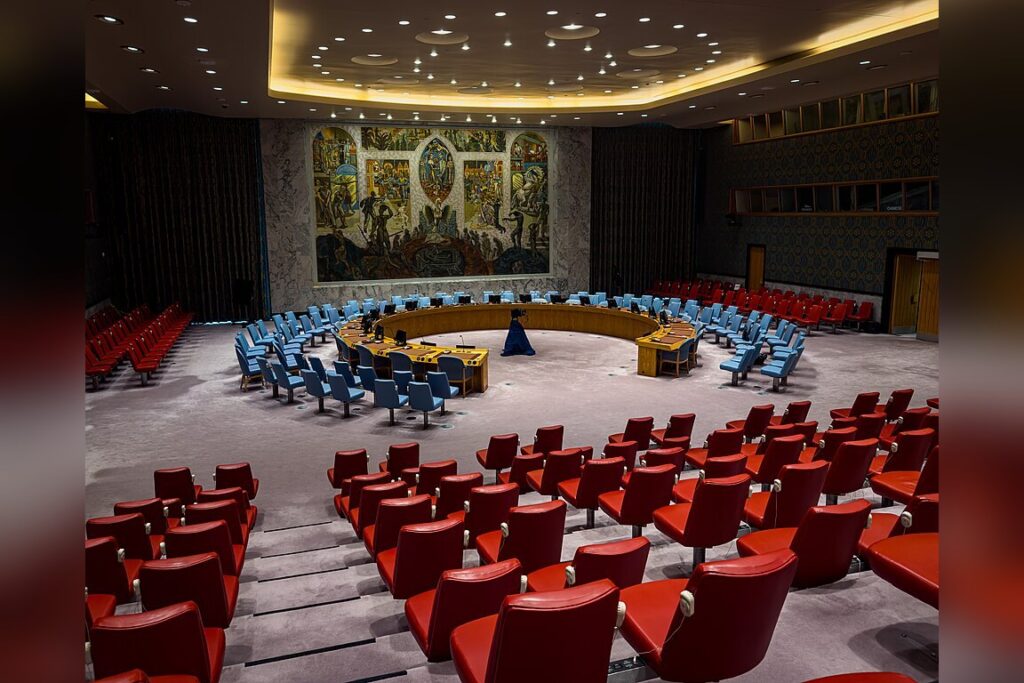
UNITED NATIONS, July 8 — The United Nations Security Council has scheduled an emergency session for April 5, 2025, to address the escalating crisis between the United States and Iran. The session was requested by Russia and China, both permanent council members, as diplomatic channels strain under the weight of renewed confrontation. The U.S. administration is considering additional sanctions targeting Iran’s oil exports, which are already under heavy restriction.
Since 2018, the U.S. Treasury Department has sanctioned over 100 Iranian entities, a campaign that has squeezed the Iranian economy and its ability to sell crude on global markets. For communities across Asia, particularly in countries like India, Japan, and South Korea that rely heavily on Middle Eastern oil, the prospect of tighter sanctions raises immediate concerns about energy costs and supply stability.
Iran has a history of threatening to disrupt shipping in the Strait of Hormuz, a narrow waterway through which roughly one-fifth of the world’s petroleum passes. The Islamic Revolutionary Guard Corps (IRGC) has made such threats before, and analysts now warn that retaliation could take the form of naval harassment, mine-laying, or direct attacks on tankers. The U.S. Navy’s Fifth Fleet, based in Bahrain, patrols these waters, and the United States currently maintains 40,000 troops across the Middle East.
For families across the region, the Strait of Hormuz is not just a geopolitical flashpoint—it is the artery that delivers fuel for transport, electricity generation, and manufacturing. Any sustained disruption would drive up prices for everything from cooking gas to bus fares, hitting household budgets hard in economies still recovering from recent global inflation.
The International Energy Agency (IEA) has announced it is prepared to coordinate a release of strategic oil reserves if needed. That mechanism, designed to calm panic buying and bridge supply gaps, has been used in past crises. But its effectiveness depends on the scale and duration of any disruption.
Goldman Sachs analysts have forecast that Brent crude could reach $85 per barrel if tensions escalate. That figure, while below the spikes seen during the Russia-Ukraine war, would still represent a significant increase from current levels. For Asian importers, many of which have limited strategic reserves of their own, even a moderate price rise translates into higher import bills and pressure on currencies.
Closer to home, the Philippines imports nearly all of its oil. A sustained price hike would mean higher costs for jeepney drivers, tricycle operators, and fishing boat owners—the backbone of daily transport and livelihoods across the archipelago.
The same is true for Indonesia, Thailand, and Vietnam, where fuel subsidies already strain government budgets. The emergency Security Council session on April 5 will be a key moment to watch. Whether it leads to a diplomatic off-ramp or becomes a stage for further recrimination remains uncertain.
What is clear is that for millions of ordinary people across Asia, the outcome will be felt not in the council chamber, but at the fuel depot, the market, and the family budget.




