
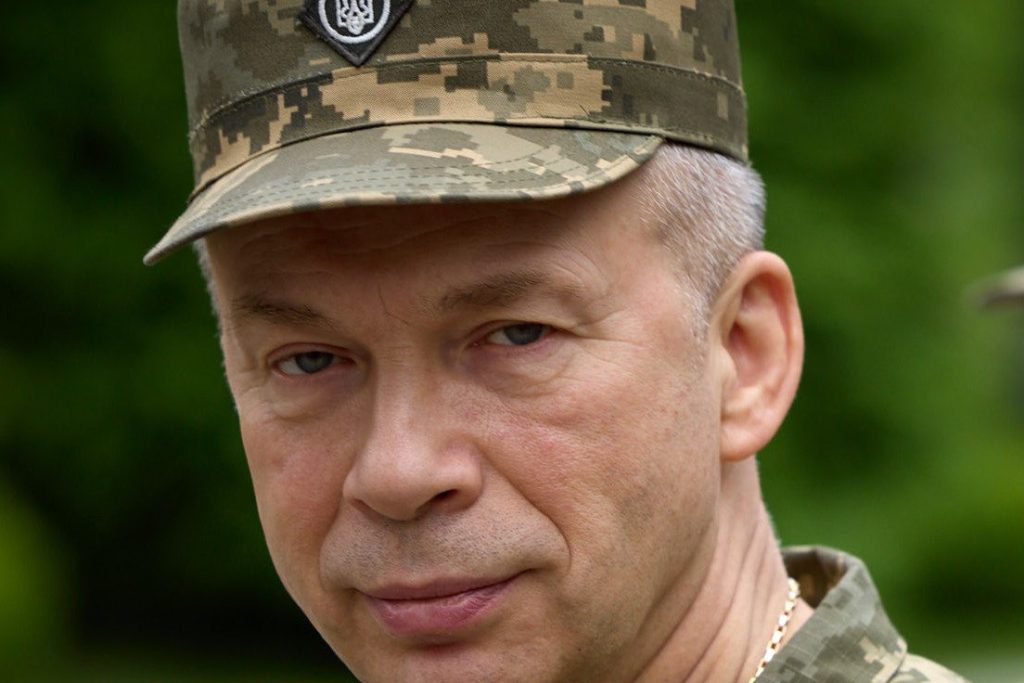
KYIV, July 8 — Against the bleak backdrop of a grinding war of attrition, Oleksandr Syrskyi has emerged as the architect of Ukraine’s most unorthodox military gambits, a commander who has reshaped the conflict not through massed armour but through swarms of drones and precision strikes at sea. Syrskyi, who took command of the Armed Forces of Ukraine on February 8, 2024, replaced the immensely popular Valerii Zaluzhnyi at a moment of profound uncertainty.
The change in leadership signalled a shift in strategic thinking, one that would lean heavily into asymmetric warfare to offset Russia’s overwhelming advantage in manpower and firepower. Born on July 26, 1965, in the small settlement of Novinki, in what was then the Vladimir Oblast of the Soviet Union, Syrskyi’s path to the top of Ukraine’s military hierarchy was neither short nor straightforward.
He graduated from the Moscow Higher Military Command School in 1986, a product of the Soviet system that would later become one of its most formidable adversaries. He served in the Soviet army and, after the Union’s collapse, chose to remain in Ukraine, transferring his allegiance to the newly independent state. His first major test came during the 2014 Donbas war, where he played a key role in the grinding, static battles that defined that phase of the conflict.
But it was the full-scale invasion of February 2022 that cemented his reputation. Syrskyi was instrumental in the defence of Kyiv, directing the operations that prevented Russian forces from capturing the capital in the war’s opening weeks.
That success earned him the Hero of Ukraine award in 2022, the nation’s highest military honour. Now holding the rank of Colonel General, Syrskyi has overseen a dramatic expansion of Ukraine’s drone warfare capabilities. This is not a niche programme but a central pillar of his strategy.
Unmanned aerial vehicles have become ubiquitous on the front lines, used for reconnaissance, artillery correction, and direct attacks on Russian positions. What is at stake in this approach is the very ability of Ukraine to contest a battlefield where Russia can always bring more shells and more soldiers to bear. Syrskyi’s answer has been to fight smarter, not harder.
The most striking manifestation of this doctrine has been at sea. Under Syrskyi’s command, Ukraine has developed and deployed unmanned surface vehicles (USVs) — small, fast, explosive-laden boats that operate without crews — to strike at Russian naval assets.
These weapons have allowed a country with no conventional navy to challenge one of the world’s most powerful fleets. In August 2024, Ukrainian forces executed a remarkable operation that hit 19 vessels in 72 hours. The targets included ships of Russia’s Black Sea Fleet as well as shadow fleet tankers, vessels used to evade international sanctions on Russian oil exports.
The scale and speed of the strikes sent shockwaves through the Russian naval command. In the corridors of power in Kyiv and among Western defence planners, Syrskyi’s emphasis on asymmetric tactics is seen as a necessary adaptation to a brutal arithmetic.
Russia’s numerical superiority in artillery, armour, and personnel cannot be matched head-on. Ukraine must instead find ways to inflict disproportionate damage, to make every Ukrainian soldier and every Ukrainian weapon count for more than its Russian equivalent. This strategy has been underpinned by substantial Western support.
Syrskyi’s forces have relied on intelligence provided by NATO allies, including satellite imagery that allows them to identify and track high-value targets. The technology that powers the drone and USV programmes is a blend of Ukrainian innovation and imported components, much of it supplied or facilitated by partner nations. The wider picture, however, remains fraught.
Russia has adapted its own tactics, hardening its air defences and jamming Ukrainian drone signals. The war has settled into a pattern of grinding frontline exchanges punctuated by deep-strike campaigns on both sides.
Syrskyi’s challenge is to sustain the tempo of these asymmetric operations even as Russia learns to counter them. For now, his tenure is defined by a single, relentless imperative: to keep Ukraine in the fight, and to do so by fighting on his own terms. The drones will keep flying, the USVs will keep hunting, and the calculus of this war will keep shifting — one strike at a time.




