
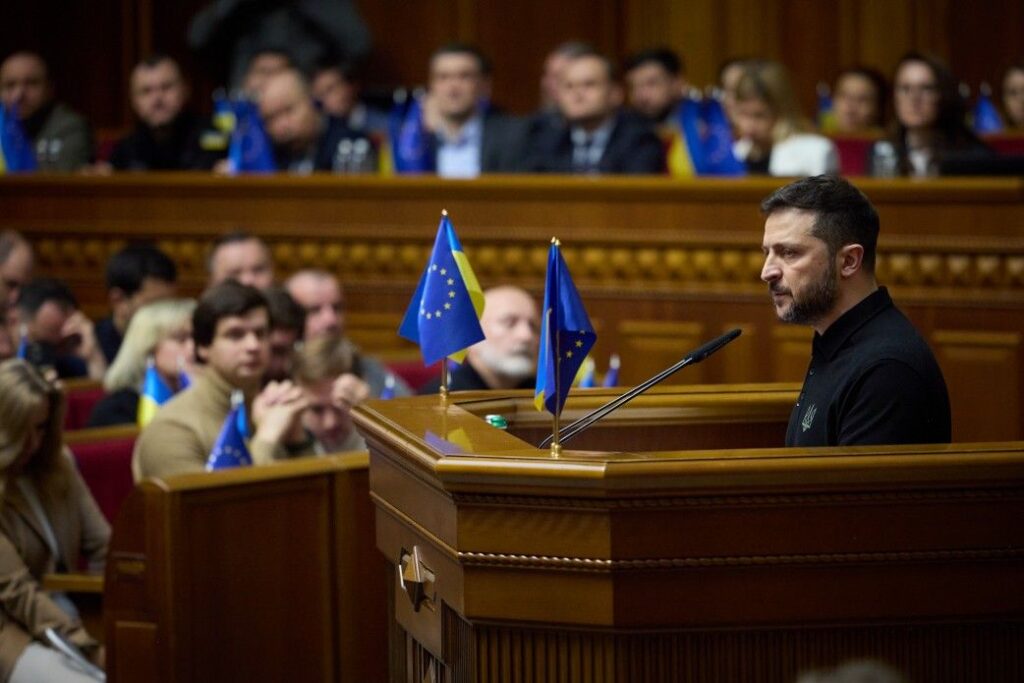
More than four years after Russia launched its full-scale invasion, the conflict between Ukraine and Russia remains locked in a military and diplomatic stalemate, with heavily fortified front lines and largely frozen channels for negotiation. The war has redrawn the security map of Europe, driving Ukraine deeper into the Western orbit and reviving struggles over sovereignty and spheres of influence that date back centuries.
What is at stake now is not merely territory, but the principle that borders cannot be redrawn by force in 21st-century Europe and the future credibility of security alliances across the continent.
Historical Roots of a Fractured Relationship
The current rupture between Ukraine and Russia is the product of a long and contested history. Ukraine declared independence from the Soviet Union on August 24, 1991, a decision overwhelmingly confirmed by a national referendum on December 1, 1991, in which 92 percent of voters supported sovereignty.
For a brief period, relations with Moscow appeared negotiable. The independent republic that emerged was the second-largest country in Europe by land area, rich in agricultural land and heavy industry. But its post-Soviet transition to a market economy and liberal democracy was uneven, marked by endemic corruption and recurring political instability.
A mass protest movement known as the Orange Revolution in 2004–2005 forced electoral and constitutional reforms, but the underlying tensions between westward-looking reformers and factions favoring closer ties with Russia never fully resolved. Those tensions came to a head in late 2013, when the pro-Russian president at the time abruptly abandoned a landmark trade and association deal with the European Union, triggering months of street demonstrations in Kyiv.
Those protests, known as the Euromaidan, culminated in the ouster of President Viktor Yanukovych in February 2014. Russia’s response was swift: within weeks, unmarked troops seized control of Ukraine’s Crimean Peninsula, which Moscow formally annexed in March 2014 in a move condemned by Kyiv and most of the international community as a violation of international law. Simultaneously, armed separatist groups backed by Russia launched an insurgency in the eastern Donbas region, sparking a war that killed more than 14,000 people by early 2022.
A pair of internationally brokered cease-fire deals, the Minsk agreements of 2014 and 2015, were intended to halt the fighting and produce a political settlement. They failed.
Ukraine’s Westward Pivot and the 2022 Invasion
Against this backdrop, Ukraine accelerated its integration with Western institutions. In June 2014, Kyiv signed an Association Agreement with the European Union, deepening economic and political ties.
In 2019, the Ukrainian parliament enshrined the goal of NATO membership in the country’s constitution, a move Moscow has long described as a red line. The conflict remained frozen for years, with no functioning diplomatic ties between the two neighbors. That changed dramatically on February 24, 2022, when Russia launched a full-scale invasion across much of Ukraine.
President Vladimir Putin justified the assault by citing the need to “demilitarize” and “denazify” Ukraine — claims widely rejected by the international community as baseless pretexts for aggression. The invasion has had profound consequences.
It has not only devastated large parts of Ukraine but has also deepened the country’s alignment with Western institutions. NATO and the European Union have responded with unprecedented levels of military, economic, and humanitarian aid to Kyiv, while imposing sweeping sanctions on Moscow. In the corridors of European foreign ministries, officials now speak of a generational shift: the war has forced a fundamental reassessment of European defense policy, with nations like Germany and Finland abandoning long-standing neutrality postures.
Implications for European Security and the Path Ahead
As of July 2026, the conflict shows no signs of resolution. The front lines remain heavily fortified, and diplomatic channels are largely frozen.
Ukraine continues to press for accelerated NATO membership and deeper integration with the European Union, while Russia maintains its maximalist demands. What to watch next: the trajectory of Western military aid and the political will in European capitals to sustain it. Also closely watched are any shifts in US policy under the current administration, which has signaled a desire to end the war but has not yet outlined a concrete diplomatic framework.
The wider picture remains one of uncertainty, with the potential for escalation ever present. For readers, the significance extends beyond the battlefield: the outcome of this conflict will shape the rules of international borders, the credibility of security alliances, and the future balance of power between democracies and authoritarian states on the European continent.
Ukraine sits at the crossroads of Europe and Eurasia, a large plain that for centuries has been a frontier where empires collided. In the Middle Ages, the state of Kievan Rus’ emerged here, laying foundations for East Slavic culture before Mongol invasion shattered it. For more than six hundred years after that, the region was divided and ruled by a succession of outside powers.
A brief period of independence after the 1917 Russian Revolution was crushed by Bolshevik forces, and Ukraine became a Soviet republic, enduring famine, world war, and decades of centralized control. The current war, many argue, is not just about the sovereignty of Ukraine but about whether the cycle of domination and conflict can finally be broken.
{“@context”: “https://schema.org”, “@type”: “NewsArticle”, “headline”: “Russia-Ukraine War Enters Stalemate Four Years After Full-Scale Invasion”, “description”: “KYIV, July 15 — More than four years after Russia launched its full-scale invasion, the conflict between Ukraine and Russia remains locked in a military…”, “datePublished”: “2026-07-15T09:30:00+00:00”, “author”: {“@type”: “Person”, “name”: “Noah King”}, “publisher”: {“@type”: “Organization”, “name”: “InfoPulse Today”, “url”: “https://newsfeed.2bme.xyz/”}}




