
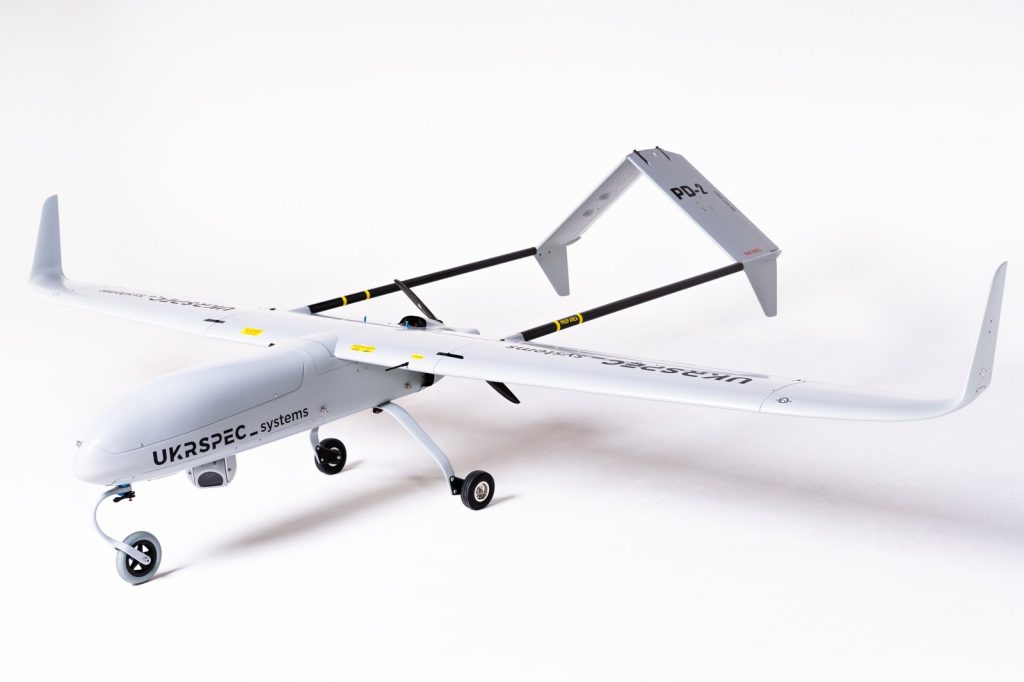
KYIV, July 7 — Ukraine’s expanding domestic drone arsenal now includes a weapon capable of reaching targets deep inside Russian territory, a development that fundamentally alters the strategic calculus of the conflict. The recent strike on a facility in Omsk, deep in Siberia, was carried out using a Ukrainian-made unmanned aerial vehicle, according to officials who have not disclosed the exact model used.
The attack required the drone to cover a distance of over 2,500 km from launch points inside Ukraine, raising questions about whether a modified longer-range variant was employed or whether the launch originated from inside Russia, possibly by saboteurs operating with mobile equipment. At the centre of Ukraine’s long-range strike capability is the AQ-400 Scythe, a twin-boom, pusher-propeller drone developed by the Ukrainian company UkrSpecSystems.
The aircraft has a standard range of up to 750 kilometres and a payload capacity of 32 kilograms, and it first saw combat in 2023. A second system, the UJ-22 Airborne produced by UkrJet, offers a range of up to 800 kilometres and carries a 20-kilogram warhead; it entered combat service in 2022. Both drones rely on GPS and inertial navigation systems, which allow them to fly at low altitudes and evade Russian radar coverage.
Ukrainian Defense Minister Rustem Umerov stated in December 2023 that Kyiv plans to produce more than 11,000 long-range drones in 2024. The economics of this production strategy are stark.
The AQ-400 Scythe costs an estimated $15,000 to $30,000 per unit, making it dramatically cheaper than the cruise missiles it effectively replaces. This low-cost, high-volume approach is designed to saturate Russian air defences. The drones are typically launched from within Ukrainian territory using mobile launchers.
The Omsk strike, however, represents a significant leap in range. The standard AQ-400 Scythe and UJ-22 Airborne have published ranges of 750 and 800 kilometres respectively, neither of which would allow a flight from Ukrainian-controlled territory to Omsk. This discrepancy suggests one of two possibilities: that Ukraine has developed a longer-range variant of an existing drone, or that the launch occurred from a forward position, possibly inside Russia.
Ukrainian officials have not confirmed which drone model was used in the Omsk attack, nor have they provided details on the launch method. The Omsk facility, located in western Siberia, is a major centre for petroleum refining and military vehicle production.
A successful strike there demonstrates that no Russian city is beyond reach. The development also underscores a broader shift in Ukrainian defence strategy. Rather than relying exclusively on Western-supplied long-range missiles, which come with political restrictions on their use inside Russia, Kyiv is investing heavily in indigenous production.
The drones are not subject to the same export controls or usage conditions, giving Ukraine greater operational flexibility. The cost advantage is decisive.
A single AQ-400 Scythe, at $15,000 to $30,000, can be expended on a mission that might otherwise require a cruise missile costing hundreds of thousands of dollars. This asymmetry allows Ukraine to absorb losses while maintaining pressure, while Russian air defences face the challenge of intercepting large numbers of cheap, low-flying targets. The Omsk attack is likely to accelerate Russian efforts to develop countermeasures against low-altitude drone swarms, but the technological challenge is significant.
Radar systems designed to track high-speed, high-altitude threats struggle to detect small, slow-moving drones flying at treetop level. Electronic warfare systems can jam GPS signals, but the drones’ inertial navigation provides a backup that keeps them on course. What to watch next is whether Ukraine will confirm the development of a longer-range variant of the AQ-400 Scythe or the UJ-22 Airborne.
If such a variant exists, the number of Russian targets within range expands dramatically. The Omsk strike may also signal a shift in Ukrainian targeting doctrine.
Hitting a facility in Siberia, far from the front lines, suggests Kyiv is willing to expend scarce long-range assets on strategic industrial targets rather than purely tactical military objectives. For now, the record shows that Ukraine’s domestic drone industry has produced systems that can reach targets more than 2,500 km away. The exact method remains unconfirmed, but the strategic implication is unmistakable: the war has entered a new phase where distance no longer guarantees safety.




