
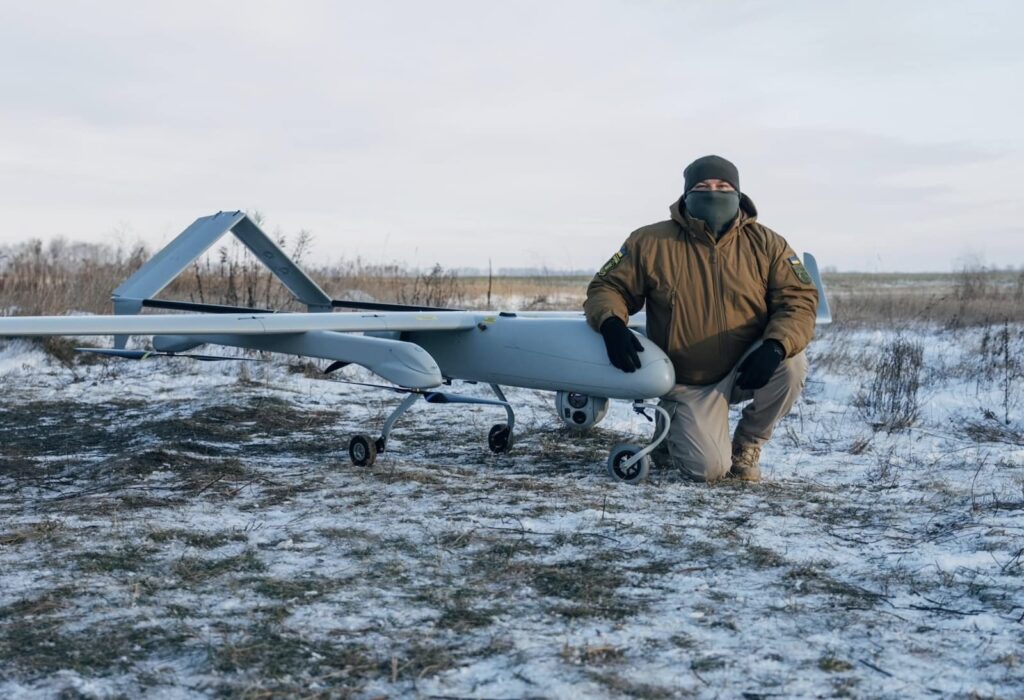
KYIV, July 7 — Ukraine’s domestic drone arsenal has taken a strategic leap, with a newly deployed model capable of striking targets at least 3,700 kilometres from launch. The claim, made by Ukrainian sources following a strike on Omsk, signals a dramatic extension of Kyiv’s reach into Russian territory. The mechanics here are worth dissecting.
Ukraine’s existing long-range drones already push past the 1,000-kilometre mark. The UJ-22 Airborne covers up to 800 kilometres.
The ‘Lyuty’ (Fierce) and ‘Bober’ (Beaver) models exceed 1,000 kilometres. For the Omsk operation, however, Ukrainian sources described a new type of drone with an extended range of at least 3,700 kilometres — a jump that, if confirmed, rewrites the operational geography of this conflict. On closer reading, the technological enabler appears to be a mix of commercial components and GPS guidance.
The drones are equipped with inertial navigation and satellite guidance systems, allowing precision strikes on oil refineries, military airfields, and ammunition depots. Warheads can carry up to 50 kilograms of explosives.
This is not experimental hardware; it is battlefield-tested, with a track record of hitting specific industrial and military nodes inside Russia. Follow the money, or rather the production numbers. President Volodymyr Zelenskyy announced in December 2023 that Ukraine would produce over 1 million drones in 2024.
That figure represents a surge since 2022, when the full-scale invasion shifted Kyiv’s defence industry into overdrive. The catch is that range and payload are not the only variables; production scale and supply-chain resilience matter just as much, and the reliance on commercial components introduces its own vulnerabilities. The Omsk strike itself is the headline, but the pattern is the story.
These drones have already demonstrated precision against oil refineries, military airfields, and ammunition depots. Each successful hit compresses Russia’s strategic depth.
A 3,700-kilometre range puts targets in Siberia and the Far East within reach — territory previously considered a safe rear area for logistics and staging.
From tactical to strategic reach
The shift from 1,000-kilometre to 3,700-kilometre range is not incremental; it is categorical. At 1,000 kilometres, Ukrainian drones could threaten western Russian military districts and energy infrastructure. At 3,700 kilometres, the calculus changes.
The Omsk strike suggests that the new drone is operational, not merely developmental. Ukrainian sources did not name the model, but the extended range points to a platform distinct from the UJ-22, Lyuty, or Bober.
The guidance systems matter here. Inertial navigation keeps the drone on course even if satellite signals are jammed. GPS guidance provides terminal accuracy.
The combination allows a 50-kilogram warhead to hit a specific refinery tank or runway intersection. This is not area bombardment; it is targeted degradation of critical infrastructure.
Production and sustainability
Zelenskyy’s 1-million-drone target for 2024 is an industrial ambition that requires factory floors, supply chains, and trained operators. The surge since 2022 has already produced a family of platforms with overlapping capabilities. The UJ-22 Airborne covers medium ranges.
The Lyuty and Bober handle the 1,000-kilometre-plus bracket. The new Omsk-class drone extends the envelope further.
The catch is that commercial components — likely off-the-shelf electronics, motors, and airframes — are subject to export controls and competing demand. Ukraine’s domestic production capacity has grown, but sustaining a fleet of long-range strike drones requires steady access to parts that are not all manufactured inside the country. What to watch next: whether the Omsk-class drone becomes a production-line platform or remains a bespoke system for high-value strikes.
The range figure — at least 3,700 kilometres — suggests a design optimised for strategic depth rather than tactical volume. If Ukraine can produce these at scale, the operational implications for Russia’s rear areas are substantial.
If not, the Omsk strike may remain a proof of concept rather than a new norm.




