
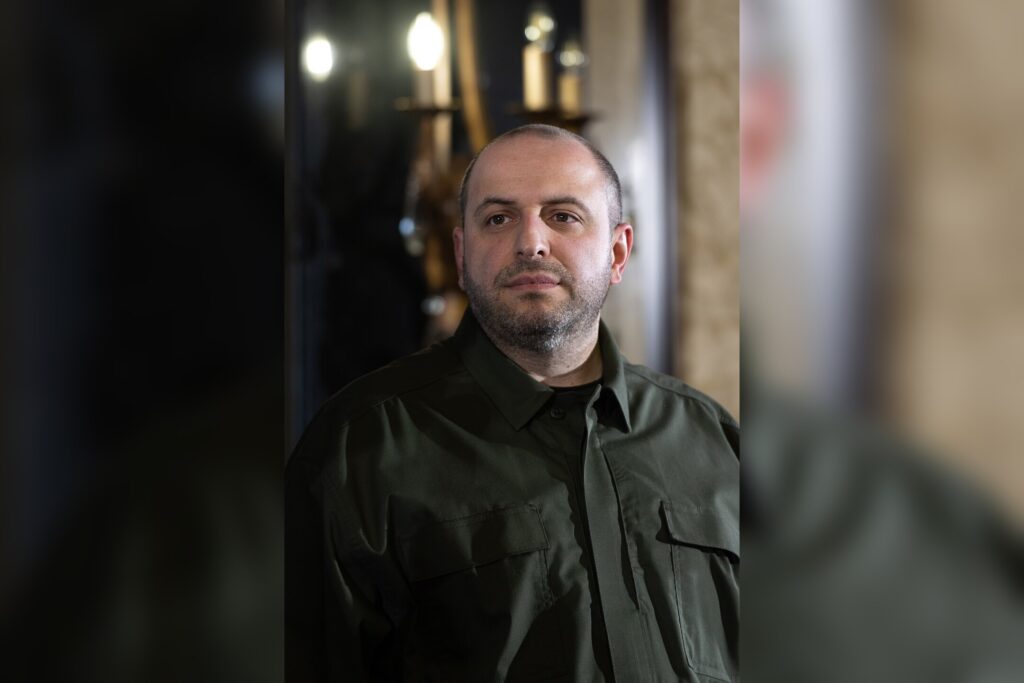
KYIV, July 8 — On a warm summer morning in the Ukrainian capital, the man charged with keeping the country’s armed forces supplied through the third year of full-scale war sat down for a series of meetings that would shape the next phase of the conflict. Rustem Umerov, Ukraine’s Minister of Defence since September 6, 2023, has become one of the most consequential figures in the country’s wartime government, a technocrat whose portfolio bridges the battlefield and the diplomatic circuit.
Umerov was born in 1982 in Tashkent, Uzbekistan, into a Crimean Tatar family — a community that was forcibly deported from Crimea under Stalin in 1944. His family’s return to Ukraine in 1989, as the Soviet Union began its long unraveling, places him among the generation that came of age with the independent Ukrainian state.
He studied at the National University of Kyiv-Mohyla Academy, one of the country’s most prestigious institutions, earning a degree in economics. Before stepping into the defence ministry, Umerov served as a member of the Ukrainian parliament from 2019 to 2023, representing the Holos party. In 2022, he was appointed to chair the State Property Fund of Ukraine, a position he held until his ministerial appointment.
That role, overseeing the privatisation and management of state assets, gave him a reputation for administrative competence in a government often criticised for inefficiency.
The Defence Portfolio and the War Effort
Umerov succeeded Oleksii Reznikov as Defence Minister on September 6, 2023, at a moment when Ukraine’s Western allies were questioning the pace of reforms inside the ministry. Reznikov had overseen the initial months of the full-scale invasion but was replaced amid corruption allegations within the ministry’s procurement apparatus — allegations that did not directly implicate him but that had damaged confidence in the institution. Against this backdrop, Umerov was tasked with cleaning house while simultaneously accelerating the flow of weapons to the front.
He has been a key negotiator in securing Western military aid, a process that involves constant shuttle diplomacy between Kyiv, Washington, and European capitals. Among the most significant achievements of his tenure was the approval of a license to produce Patriot air defence systems, granted on May 21, 2024.
This marked a shift from Ukraine being solely a recipient of finished Western weapons to becoming a co-producer of some of the most advanced systems in the American arsenal.
The Domestic Production Imperative
In the corridors of the defence ministry, Umerov has consistently emphasised the need for domestic production to reduce reliance on foreign supplies. This is not merely a matter of national pride; it is a strategic calculation. The war has demonstrated that foreign aid, while essential, can be subject to political delays in donor countries and logistical bottlenecks at border crossings.
Umerov speaks Ukrainian, English, and Crimean Tatar — a linguistic range that reflects both his personal history and the demands of his job. He is married with three children.
What is at stake for Umerov in the coming months is the sustainability of Ukraine’s defence effort as the war grinds into its fourth calendar year. The wider picture, from a European perspective, is that Kyiv’s ability to hold the line against Russian forces depends increasingly on whether the domestic defence industry can scale up quickly enough to compensate for any slowdown in Western deliveries. Umerov, the economist turned wartime minister, will be judged on whether he can manage that transition.




