
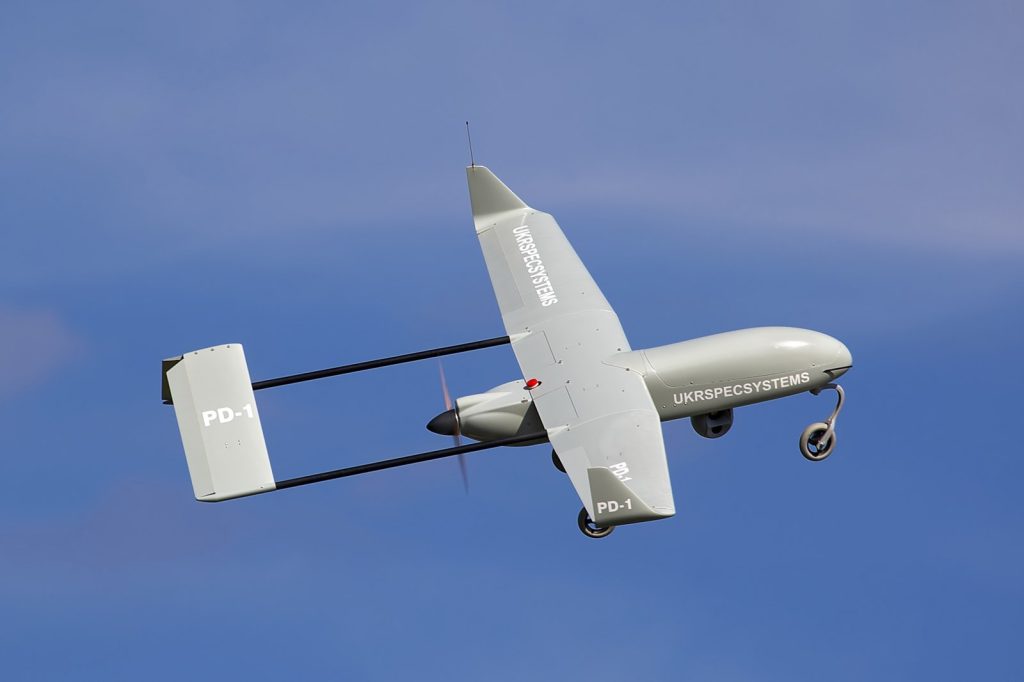
KYIV, July 7 — Ukraine’s domestic drone programme has quietly become a central plank of its long-range strike capability, with the UJ-22 Airborne emerging as a key platform for operations deep inside Russian territory. Manufactured by Ukrjet, the UJ-22 has a stated range of up to 1,000 kilometres and can carry a 20-kilogram payload.
The mechanics here are straightforward: a relatively small, expendable airframe that can reach targets far beyond the front lines, delivering a warhead that, while not massive, is sufficient to damage fuel depots, airfield infrastructure, and logistics nodes. The UJ-22 is not operating in isolation.
Ukraine also fields the PD-1, produced by Ukrspecsystems, which boasts a range of over 1,000 kilometres and an endurance of 24 hours. That endurance figure suggests a platform designed for persistent surveillance as much as strike, though the line between the two missions has blurred in this conflict. Then there is the modified Tu-141 Strizh, a Soviet-era reconnaissance drone that Ukraine has converted for attack missions.
It is a telling adaptation: taking Cold War hardware that was gathering dust and turning it into a weapon that can reach targets hundreds of kilometres away. These systems were put to use in the January 2024 strikes, which included the attack on the Omsk refinery.
That facility sits a considerable distance from Ukraine’s border—well beyond the stated range of the UJ-22 and PD-1. The catch is that the source material does not specify which drone type was used at Omsk, only that these platforms were involved in the January 2024 operations. The Tu-141 Strizh, with its longer range potential, may have been the vehicle for that particular mission.
On closer reading, the Omsk attack demonstrates that Ukraine’s drone arsenal is not a single capability but a layered set of options, each with different range, payload, and endurance profiles. By 2023, Ukraine had launched over 100 drone attacks on Russian soil, targeting military airfields, fuel depots, and logistics hubs. The scale is significant: more than one hundred strikes in a single year, using indigenously produced and modified systems.
That tempo suggests a production and operational capacity that has been built methodically, not improvised overnight. The development programme began after Russia’s 2014 annexation of Crimea.
That event triggered a strategic reassessment in Kyiv: if Russia could seize territory and hold it, Ukraine needed the ability to strike back at depth. The catch is that building a drone industry from scratch takes years, and for much of the period between 2014 and 2022, the programme remained in the background, a hedge rather than a primary capability. That changed with the 2022 full-scale invasion.
The source material states that production accelerated following the invasion, and that Ukraine’s defence industry has received Western funding and technical assistance to expand drone manufacturing. The mechanics here are worth parsing: Western money and expertise have flowed into Ukrainian factories, helping to scale up production lines that were previously operating at a fraction of their potential.
The result is a domestic drone industry that can now produce systems like the UJ-22 and PD-1 in sufficient numbers to sustain a campaign of over 100 strikes per year. Western governments and defence contractors have concluded that funding Ukrainian drone production is more efficient than supplying finished systems from their own inventories. It is a classic industrial strategy: invest in local capacity, reduce supply chain vulnerabilities, and create a production base that can continue even if external support fluctuates.
The catch is that this model depends on sustained political will. Drone manufacturing requires not just money but also components, many of which are sourced from global markets. If those supply chains are disrupted, or if Western funding dries up, the production lines could slow.
For now, however, the trajectory is upward. The key question is whether Ukraine can maintain and expand this strike tempo.
The source material covers events only through early 2024, but the implications for the future are clear: if production continues to accelerate, the number of drone attacks on Russian soil could rise significantly. The UJ-22’s 1,000-kilometre range puts a substantial portion of western Russia within reach, including military airfields, fuel storage, and logistics hubs that support the invasion force. On closer reading, the strategic logic is inescapable.
Ukraine cannot match Russia’s artillery or missile stocks, but it can build cheap, expendable drones in quantity and use them to impose costs on Russian infrastructure far from the front. The Omsk refinery attack, the 100-plus strikes in 2023, and the development of platforms like the UJ-22 and PD-1 all point in the same direction: a sustained campaign of deep strikes designed to degrade Russia’s ability to wage war.
The mechanics here are not complicated. Build drones, fly them deep, hit targets, repeat. The challenge is sustaining the industrial base to do it.
That is where the Western funding and technical assistance matter most—not as a one-time infusion, but as a continuing commitment to keep the production lines running.




