
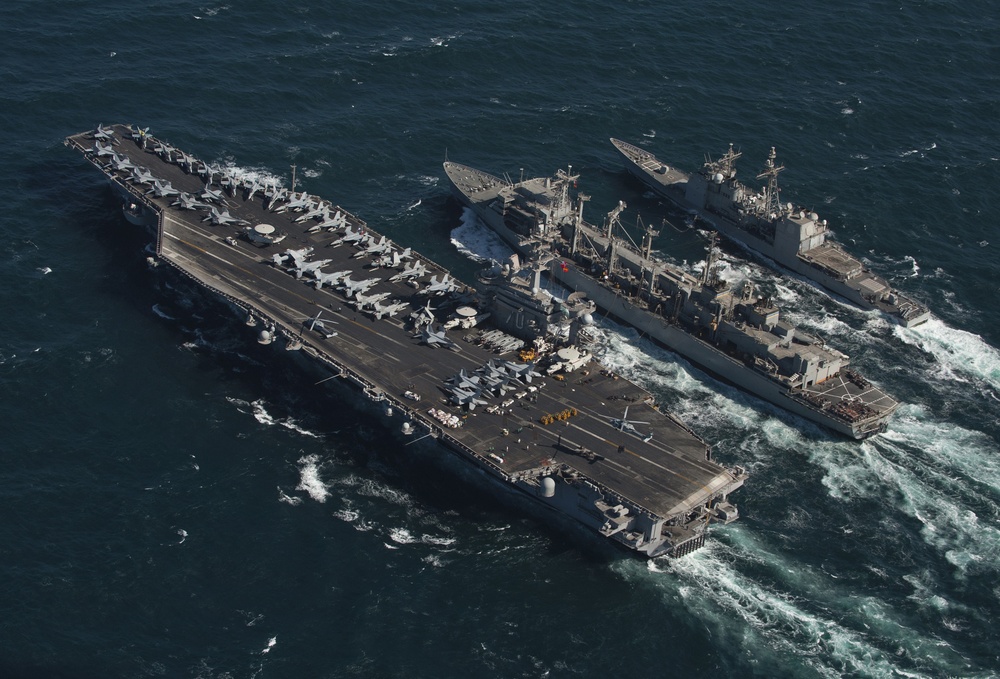
MANAMA, July 12 — The U.S. Fifth Fleet, the American naval formation established in 1995, remains the central pillar of Washington’s maritime strategy in the Persian Gulf. Strategically, the fleet’s posture at any given moment signals the calculus of power in a waterway through which a significant share of the world’s oil moves. Headquartered in Manama, Bahrain, the Fifth Fleet operates about 30 ships, including aircraft carriers such as the USS Dwight D.
Eisenhower. It falls under U.S. Central Command, or CENTCOM, giving it a direct line to broader American military priorities across the Middle East.
The fleet’s core mission, as defined by Washington, is ensuring freedom of navigation through the Strait of Hormuz — the narrow chokepoint connecting the Persian Gulf to the Gulf of Oman. What this signals to regional actors is unambiguous: the United States maintains a permanent naval presence to counter any attempt to disrupt commercial shipping. The primary threat to that freedom of navigation comes from Iran.
The Islamic Revolutionary Guard Corps navy, commanded by Rear Admiral Alireza Tangsiri since 2019, controls Iran’s coastal defenses and has historically used small boats, mines, and anti-ship missiles to project power in the strait.
The Geopolitical Chessboard
The broader stakes extend beyond just the American and Iranian navies. Oman, which borders the strait on its southern flank, has long played the role of mediator between Tehran and the West. Sultan Haitham bin Tariq, who has held power since 2020, maintains diplomatic ties with both sides, giving Muscat a unique position as a backchannel when tensions spike.
To the south and west, the United Arab Emirates offers an alternative. Its port of Fujairah, located on the Gulf of Oman, serves as a loading point for oil tankers that wish to avoid transiting the strait entirely.
That infrastructure gives global energy markets a hedge against any closure or harassment in the waterway itself. The International Maritime Organization designates the Strait of Hormuz as a “special area” under MARPOL Annex I, which imposes stricter environmental rules on ships passing through. That designation reflects the strait’s ecological sensitivity as much as its strategic importance.
Legal Dimensions and Iranian Posture
The 1982 United Nations Convention on the Law of the Sea, known as UNCLOS, guarantees transit passage through international straits. That legal framework underpins the American argument that warships and commercial vessels alike have a right to pass through the Strait of Hormuz without interference. Iran, however, has not ratified UNCLOS — a fact that complicates any legal argument Tehran might make for restricting passage.
For the Fifth Fleet, the practical implications are clear. Every transit through the strait is a test of both legal principle and military readiness.
The fleet’s rotation of carrier strike groups, its patrol patterns, and its exercises with regional partners all serve to uphold that transit regime. The calculus for Iran is different. Rear Admiral Tangsiri’s IRGC navy does not need to defeat the Fifth Fleet in open battle to impose costs.
A mining operation, a swarm attack by fast boats, or a single anti-ship missile strike against a commercial tanker could spike insurance rates, disrupt shipping schedules, and rattle global oil markets. That asymmetry defines the strategic challenge for the American naval presence.
What to watch next is whether Oman’s diplomatic track remains open as the primary off-ramp for any confrontation. With Sultan Haitham bin Tariq maintaining lines to both Washington and Tehran, Muscat could once again serve as the quiet channel for de-escalation. The Fifth Fleet, meanwhile, will continue its patrols — a constant reminder that the United States views the Strait of Hormuz as a line it will not cede.




