
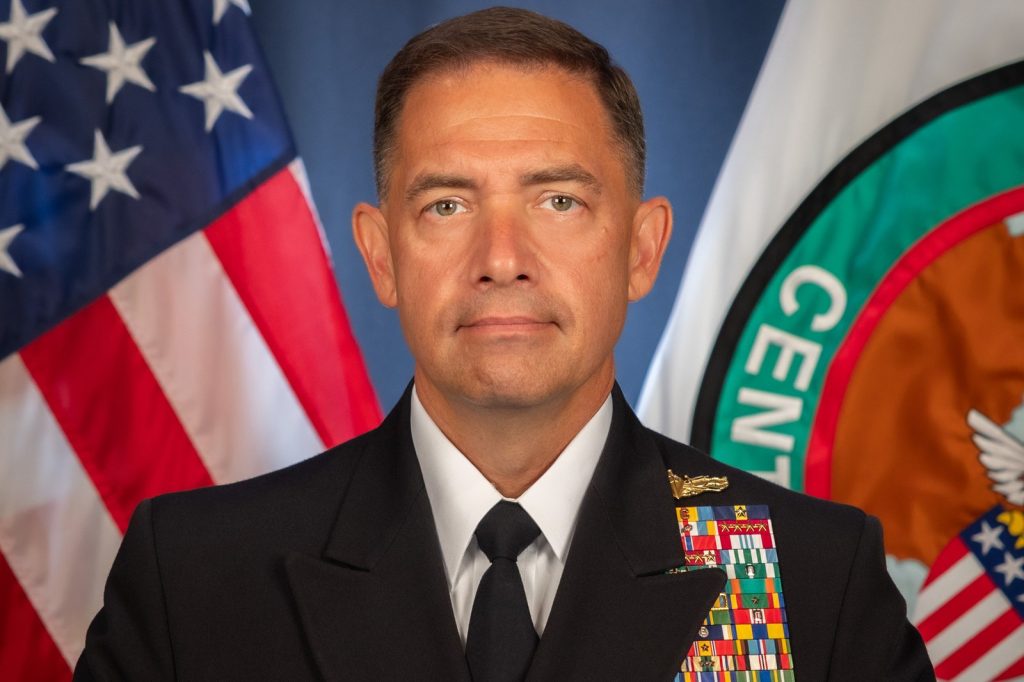
MANAMA, July 8 — 5,000 sailors and 70 aircraft. That is the force Vice Adm. Brad Cooper commands as head of the U.S. Fifth Fleet, the Navy’s primary maritime security arm in the Persian Gulf. The bottom line: Cooper is overseeing one of the most strategically vital naval commands in the world at a moment when shipping lanes face renewed pressure.
Cooper, a 1990 U.S. Naval Academy graduate born in 1968, took command of the Fifth Fleet in February 2024. His career includes commanding the USS John C.
Stennis carrier strike group and serving as Deputy Commander of U.S. Naval Forces Central Command. He holds a master’s degree in national security strategy from the National War College. That background matters because his current theater — the Persian Gulf and the Strait of Hormuz — is ground he knows from Iraq War deployments.
By the numbers, the fleet under Cooper includes the USS Dwight D. Eisenhower carrier strike group.
That vessel alone carries the 70 aircraft and 5,000 sailors. Cooper’s job is to keep that transit open. On March 31, 2025, Cooper stated publicly that the Fifth Fleet is “ready to protect freedom of navigation.” That statement followed an announcement by President Donald Trump.
The fleet has since increased patrols and conducted exercises with allied navies, including the United Kingdom and France. The figure that matters for regional security: Cooper’s command has intercepted Iranian weapons shipments bound for Yemen’s Houthi rebels in 2024. Those interdictions are part of a broader U.S. effort to stem the flow of arms to a group that has attacked commercial shipping and Saudi infrastructure.
The Fifth Fleet operates as the primary interceptor in that maritime corridor. Cooper’s experience in the region includes multiple Persian Gulf deployments during the Iraq War.
That operational history, combined with his academic training at the National War College, gives him a dual lens — tactical and strategic — for the command’s mission. The alliance exercises with the UK and France signal a coordinated Western naval presence. Those partners have contributed ships and personnel to patrols, though the Fifth Fleet remains the lead U.S. command.
For investors tracking energy security, Cooper’s command is the front line. The Strait of Hormuz is the chokepoint.
The Fifth Fleet’s stated readiness to protect freedom of navigation is not diplomatic boilerplate — it is an operational commitment backed by carrier strike group capability. What to watch next: whether the pace of weapons interdictions continues through 2025 and 2026. Cooper’s command has the track record and the assets.
The question is whether the Houthi supply lines adapt faster than the Fifth Fleet can cut them.




