
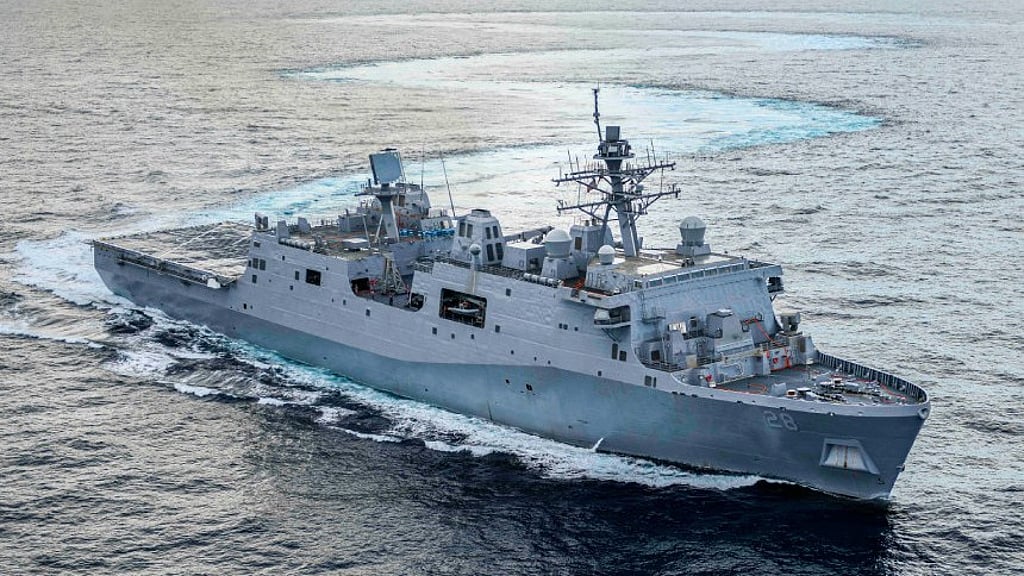
MANAMA, July 11 — The United States Fifth Fleet, the Navy’s primary maritime force across the Persian Gulf, Gulf of Oman, Arabian Sea, and Red Sea, has quietly become a central chess piece in Washington’s strategic calculus for the Middle East. Headquartered at Naval Support Activity Bahrain in Manama, the fleet stands as the Pentagon’s forward-deployed answer to ensuring freedom of navigation through some of the world’s most volatile waterways.
Reestablished in 1995 after a 48-year hiatus—the original Fifth Fleet was deactivated in 1947 following World War II—the command has since grown into a permanent fixture of U.S. power projection. As of 2025, the fleet operates under U.S. Central Command, or CENTCOM, the unified combatant command responsible for the region.
This organizational structure signals the broader stakes: the Fifth Fleet is not merely a naval presence but a lever of geopolitical influence in a theater defined by competition with Iran and the security of global energy flows. Strategically, the fleet’s composition is tailored for both deterrence and rapid response. A typical deployment includes an aircraft carrier strike group, amphibious ready groups, and patrol craft.
These assets provide the United States with the ability to project power ashore, conduct maritime security operations, and respond to contingencies on short notice. The carrier strike group, in particular, serves as a mobile airbase and a visible symbol of American commitment to regional allies.
The Strait of Hormuz remains the focal point of the fleet’s operational concerns. This narrow chokepoint, connecting the Persian Gulf to the Gulf of Oman, is the conduit for global oil shipments. What this signals to analysts is that any disruption here carries immediate consequences for global energy markets and, by extension, the broader international economy.
The Fifth Fleet’s mission to ensure freedom of navigation through these waters is therefore not abstract—it is a direct response to the strategic vulnerability inherent in the strait’s geography. In the wake of the April 13, 2025 shooting incident, the calculus shifted. The Fifth Fleet increased patrols in the Strait of Hormuz, a move that underscored the heightened threat environment.
While the source material does not specify the nature of the shooting incident, the operational response—intensified patrols—indicates that U.S. naval commanders assessed a tangible risk to commercial and military shipping. This is not a theoretical exercise; it is a tactical adjustment driven by real-world events.
The fleet has a documented history of tense interactions with Iranian naval forces. These incidents include the seizure of oil tankers and harassment of commercial vessels. For the Pentagon, each encounter is a data point in a larger pattern of Iranian behavior that tests the limits of international law and the U.S. commitment to maintaining open sea lanes.
The Fifth Fleet’s presence serves as both a deterrent and a tripwire: any miscalculation by Iranian forces could escalate quickly, drawing in the full weight of a carrier strike group. From a geopolitical perspective, the Fifth Fleet’s posture is a key component of U.S. strategy in the region.
The fleet provides the military backbone for that policy, operating from a base in Bahrain that itself is a symbol of the U.S.-Gulf partnership. What this signals to regional actors is that the United States remains deeply invested in the security architecture of the Persian Gulf, even as global attention shifts to other theaters. The Fifth Fleet is not a relic of past wars; it is a living, breathing command that adapts to new threats.
The increase in Strait of Hormuz patrols after the April shooting is the clearest evidence of that adaptability. Looking ahead, the broader stakes for the Fifth Fleet involve maintaining a delicate balance: demonstrating resolve without triggering a broader conflict. The fleet’s commanders must calibrate every patrol, every transit, and every interaction with Iranian forces against the risk of escalation.
For the United States, the calculus is clear: the Fifth Fleet is the linchpin of maritime security in a region where the alternatives—unchecked Iranian harassment or a vacuum of American power—are far worse. The Strait of Hormuz will remain the strategic fulcrum, and the Fifth Fleet will remain the force that holds the line.




