
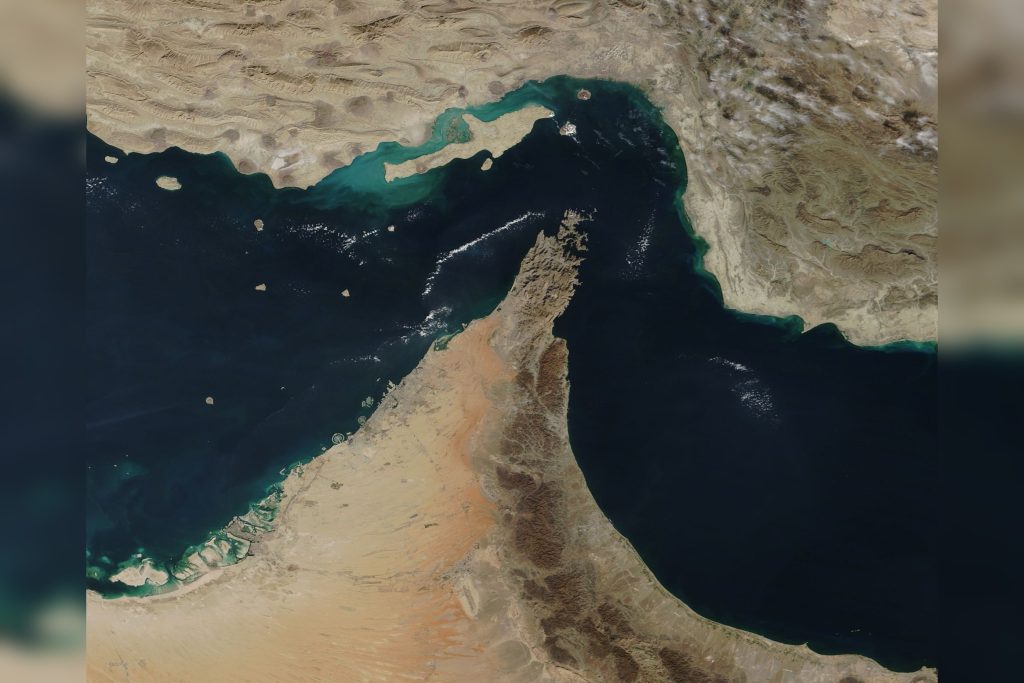
At its narrowest point, the Strait of Hormuz measures just twenty-one miles across. A ship can see both shores at once – the jagged brown mountains of Iran to the north, the pale desert of Oman and the Musandam Peninsula to the south. Yet through this sliver of water passes roughly one-fifth of the world’s oil supply. Every day, about seventeen million barrels of crude and petroleum products move through these shipping lanes, along with liquefied natural gas from Qatar. The strait is not merely a geographic feature; it is the world’s most concentrated strategic vulnerability.
The waterway connects the Persian Gulf to the Gulf of Oman and, beyond that, to the Indian Ocean. For the countries that sit along the Gulf – Saudi Arabia, Iraq, Kuwait, the United Arab Emirates, Qatar, Bahrain, and Iran – there is no practical alternative. Pipelines exist, but none can replace the volume that flows through Hormuz. If the strait were blocked, global oil prices would spike within hours, and the economies of Asia, Europe, and North America would feel the shock.
The modern history of the strait as a flashpoint begins not with oil but with empire. Britain controlled the Gulf for much of the nineteenth and twentieth centuries, policing the waters and ensuring safe passage for merchant ships. When British forces withdrew east of Suez in 1971, the United States gradually assumed the role of guarantor of freedom of navigation. But the real turning point came in 1979, with the Iranian Revolution.
That year, the new Islamic Republic began to speak of the strait as a weapon. Ayatollah Ruhollah Khomeini’s government saw the waterway not as an international passage but as a chokepoint that Iran, by virtue of geography, could control. This was not an abstract threat. In 1980, Iraq invaded Iran, and the Iran-Iraq War began. For the first eight years of that conflict, the strait became a battleground.
The so-called Tanker War of 1984-1988 was a campaign of attrition. Iraq attacked Iranian oil tankers and facilities, and Iran retaliated by targeting ships bound for Iraq’s allies, especially Kuwait and Saudi Arabia. Both sides laid mines. Iran used small boats, anti-ship missiles, and mines to threaten commercial shipping. The attacks were indiscriminate: neutral vessels were hit, crews killed, oil spilled. The United States, fearing a disruption of supply, began escorting Kuwaiti tankers under the American flag in 1987 – Operation Earnest Will.
It was during this operation that the USS Stark was struck by an Iraqi Exocet missile in May 1987, killing thirty-seven sailors. The United States did not retaliate against Iraq, but the incident underscored how easily the conflict could escalate. Then, in April 1988, the USS Samuel B. Roberts struck an Iranian mine, blowing a hole in the frigate’s hull. Ten sailors were injured. The U.S. responded with Operation Praying Mantis, the largest American naval surface engagement since World War II. American ships and aircraft sank two Iranian oil platforms, a frigate, and several smaller vessels. The message was clear: the United States would use force to keep the strait open.
The war ended later that year, but the lessons were absorbed. Iran had learned that mining and small-boat attacks could impose costs on global shipping without provoking a full-scale war. The United States had learned that mines were cheap, effective, and difficult to clear. The world had learned that the strait was not just a route but a lever.
In the decades that followed, the threat never fully receded. During the 1990-1991 Gulf War, Iran remained neutral but watched as the United States built a massive military presence in the region. After 2003, when the U.S. invaded Iraq, Iran’s strategic position improved dramatically: two of its main adversaries, Iraq’s Saddam Hussein and the Taliban in Afghanistan, were removed. But the strait remained the ultimate card.
In 2008, amid rising tensions over Iran’s nuclear program, the Iranian Revolutionary Guard Corps conducted war games in the strait, testing speedboats and anti-ship missiles. In 2011, after the International Atomic Energy Agency released a report suggesting Iran had worked on nuclear weapons design, Iranian officials threatened to close the strait if sanctions were imposed on Iranian oil exports. The U.S. responded that any such closure would be considered a red line, and the Fifth Fleet, based in Bahrain, would keep the waterway open.
The crisis of 2018-2019 followed a different pattern. After the United States withdrew from the Joint Comprehensive Plan of Action – the nuclear deal – and reimposed sanctions, Iran again threatened the strait. In May 2019, four commercial ships were damaged near the port of Fujairah, just outside the strait. In June, a mine attack damaged two more tankers. The U.S. blamed Iran; Iran denied involvement. In July, British forces seized an Iranian tanker off Gibraltar, and Iran retaliated by seizing the British-flagged tanker Stena Impero in the strait. For two months, the impasse held. The Stena Impero was released in September.
What these episodes reveal is a pattern of calibrated escalation. Iran has never closed the strait entirely. It has threatened to, but doing so would invite a military response that Iran could not win. Instead, Iran uses the strait as a bargaining chip – a way to signal displeasure, raise costs for adversaries, and remind the world of its geographic leverage. The strait is not a door that Iran can slam shut; it is a lock that Iran can jangle.
The human cost of this strategic game is often overlooked. The sailors on tankers and cargo ships are mostly from developing countries: Filipinos, Indians, Bangladeshis, Sri Lankans. They work long contracts far from home, and when a mine explodes or a missile strikes, they are the ones who die. In the Tanker War, hundreds of merchant seamen were killed. In the 2019 incidents, crews were detained, ships held, families left in limbo.
Geopolitically, the strait has shaped the modern Middle East. It is why the United States maintains a permanent naval presence in Bahrain. It is why Oman, which sits on the southern shore, has pursued a careful policy of neutrality and mediation. It is why Gulf states have spent billions on pipelines that bypass the strait, though none can fully replace it.
The Strait of Hormuz is not the only chokepoint in the world. The Malacca Strait, the Suez Canal, the Panama Canal all carry vital trade. But none concentrates so much oil in so narrow a space. And none carries the same weight of history: the mines, the missile strikes, the tankers burning at anchor, the navies shadowing each other through the night. The strait is a passage, a pressure point, and a warning. It has never been closed. It has never needed to be. The threat alone has been enough.




