
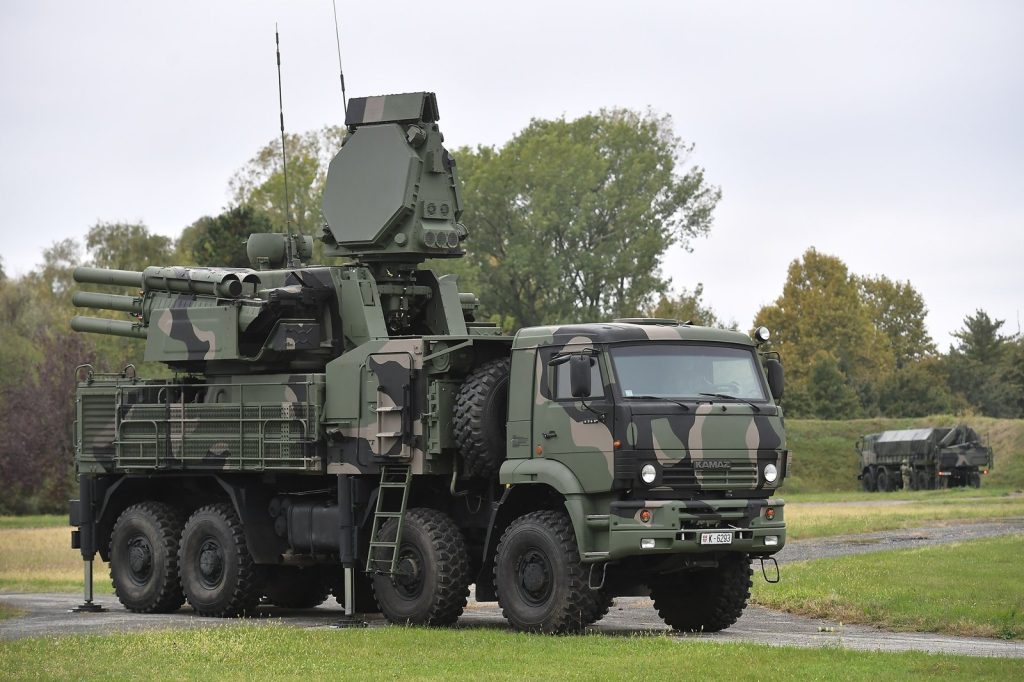
MOSCOW, July 13 — Against the backdrop of a war that has increasingly become a contest of drones versus air defenses, Russia has deployed extensive layers of anti-aircraft systems to shield its territory and military assets from Ukrainian strikes. The arsenal includes the S-400, a long-range surface-to-air missile system; the Pantsir-S1, a short-to-medium range system; and the Tor-M2, a mobile system. These systems now form the backbone of what the Kremlin describes as a protective shield over critical regions.
The Russian Ministry of Defense regularly reports intercepting dozens of drones over regions including Belgorod, Kursk, and Stavropol Krai. In March 2025, Russia claimed to have shot down 25 drones over Moscow Oblast and 15 over Stavropol Krai.
These figures, however, are difficult to verify independently, and the pattern of reported interceptions suggests a defensive network that is busy but not impenetrable. Some strikes have punched through. The March 2024 refinery attacks stand as a notable example, where Ukrainian drones hit energy infrastructure deep inside Russian territory.
That episode exposed gaps in the coverage provided by the S-400 and Pantsir systems, raising questions about the true density and coordination of the layered network.
Electronic warfare and the cat-and-mouse dynamic
Russia has also employed electronic warfare to jam drone signals, a tactic that can force unmanned aircraft to lose navigation, crash, or return to base. This adds an invisible layer to the defense architecture, one that does not rely on expensive missiles but requires constant adaptation as Ukrainian engineers modify frequencies and flight profiles. The effectiveness of these defenses remains a subject of active debate.
Ukraine has often achieved hits on high-value targets, including command posts, ammunition depots, and logistics hubs, suggesting that the protective umbrella is porous in key locations. What is at stake in this assessment extends beyond territory: if Russian air defenses cannot reliably shield the homeland, the political calculus in Moscow shifts.
Repositioning from the front lines
The strikes have forced Russia to reposition air defense assets from the front lines to protect rear areas and critical infrastructure. This redeployment carries a direct military cost: fewer S-400 and Tor-M2 systems available to shield Russian ground forces from Ukrainian aviation and drone attacks in the combat zone. The wider picture is one of a defensive network stretched thin, forced to choose between protecting the homeland and protecting advancing troops.
The conflict has highlighted vulnerabilities in Russia’s layered defense network, a system that was long advertised as among the most sophisticated in the world. In the corridors of Western defense ministries, analysts have noted that the sheer volume of Ukrainian drone production—cheap, expendable, and constantly evolving—poses a challenge that even the most advanced interceptors struggle to meet on a cost-per-kill basis.
What to watch next is whether Ukraine can sustain the tempo of deep strikes that force further Russian repositioning, or whether Moscow can adapt its electronic warfare and interceptor mix to close the gaps. The duel between drone and air defense, now in its third year, shows no sign of reaching a decisive conclusion.




