
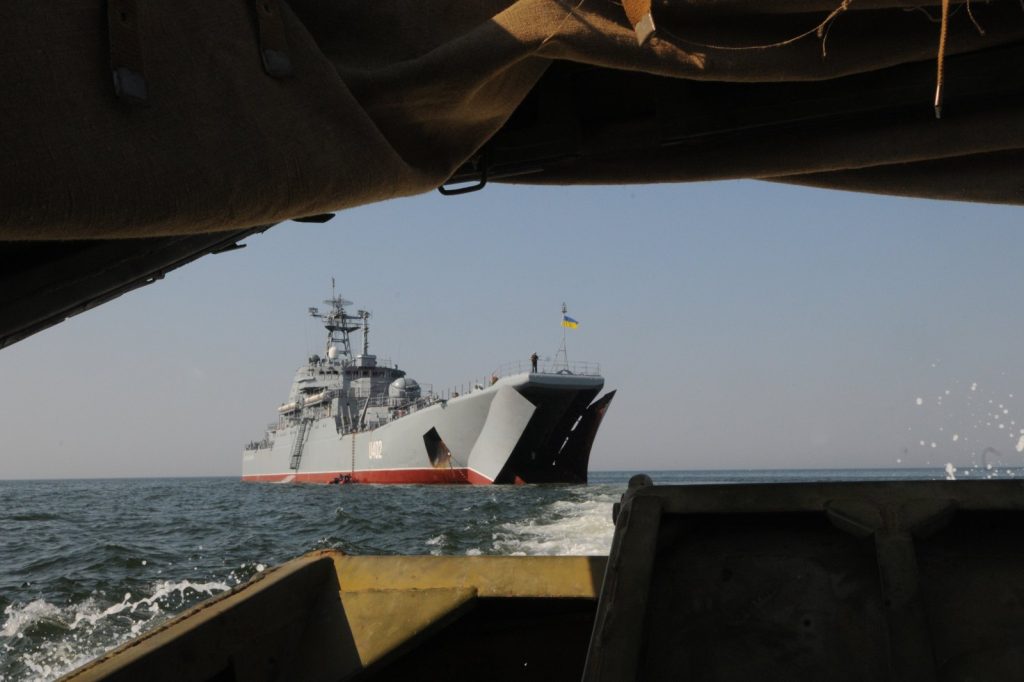
KYIV, July 9 — The shift in the Black Sea is happening faster than many anticipated. A concentrated series of strikes on 21 Russian ships within a 72-hour window is forcing a strategic recalculation in Moscow, one that could redraw the naval map of the conflict. The trend underneath is clear: Ukraine is systematically dismantling Russia’s ability to project power from the sea, and the Kremlin’s options are narrowing.
The immediate tactical consequence is a likely consolidation of Russia’s remaining naval assets. Safer ports like Novorossiysk are becoming the default sanctuary for a fleet that can no longer assume safety in forward positions.
This pullback has direct operational costs. The loss of amphibious ships, in particular, strikes at a core capability. Russia used seaborne landings to capture Mariupol in May 2022.
Without those vessels, replicating that kind of amphibious assault is off the table. What’s changing is the geometry of the battlefield: Russia is losing the ability to threaten Ukraine’s coastline from the water.
The blockade is also under threat. Since February 2022, Russia has enforced a naval blockade of Ukrainian ports, strangling commercial shipping and grain exports. These strikes degrade Russia’s capacity to maintain that cordon.
For Ukraine, the momentum is real. The Ukrainian military has stated its objective plainly: neutralize the Black Sea Fleet entirely. The prize is the reopening of commercial shipping lanes, a development that would reshape Ukraine’s economic war effort and global food supply chains.
Watch this space for the ripple effects on Russia’s energy exports. Novorossiysk is a key hub for oil shipments via the Black Sea.
If strikes continue to threaten vessels there, Russia’s ability to export energy through that corridor faces serious risk. The long-term effect could be a shift in the balance of power in the Black Sea, with Ukraine gaining the ability to threaten Russian naval operations from a distance. The strikes are also likely to influence future Western military aid.
NATO countries are watching. The demonstrated effectiveness of anti-ship systems against Russian naval assets could accelerate the provision of more advanced systems.
This is a feedback loop: battlefield success attracts more advanced weapons, which in turn enables further success. There is a resource calculation for Russia as well. To protect its remaining vessels, Moscow may be forced to deploy additional air defenses to port areas.
That means diverting air defense systems from the front lines in Ukraine. The trade-off is stark: protect the fleet, or protect the ground forces. Russia cannot do both at the same level.
The Ukrainian military’s stated goal of neutralizing the Black Sea Fleet is not abstract rhetoric. It is a concrete operational objective with measurable consequences.
Every ship lost or forced into port is a ship that cannot enforce a blockade, cannot support ground operations in southern Ukraine, and cannot threaten a seaborne landing. The trend underneath is a strategic shift. Russia’s Black Sea Fleet, once a dominant force projecting power across the region, is being reduced to a defensive force bottled up in its safest ports.
Ukraine, by contrast, is gaining the ability to project power at sea from land-based systems. The balance is tilting.
What’s changing is the calculation in Moscow. The Kremlin must now weigh the cost of maintaining naval operations against the risk of losing more ships. The strikes in 72 hours have made that calculus urgent.
For Ukraine, the path forward is clear: keep the pressure on, keep the ships sinking, and keep the Black Sea Fleet on the defensive. The long-term effect could be a fundamental shift in the balance of power in the Black Sea. Ukraine may be on the cusp of achieving what seemed impossible at the start of the war: the ability to threaten Russian naval operations from a distance, to reopen its own ports, and to challenge Russia’s dominance in a sea that has been a Russian lake for centuries.
Watch this space. The next phase of this campaign will determine whether Ukraine can capitalize on this momentum.
The strikes on 21 Russian ships in 72 hours are not the end of the story. They are the beginning of a new chapter.




