
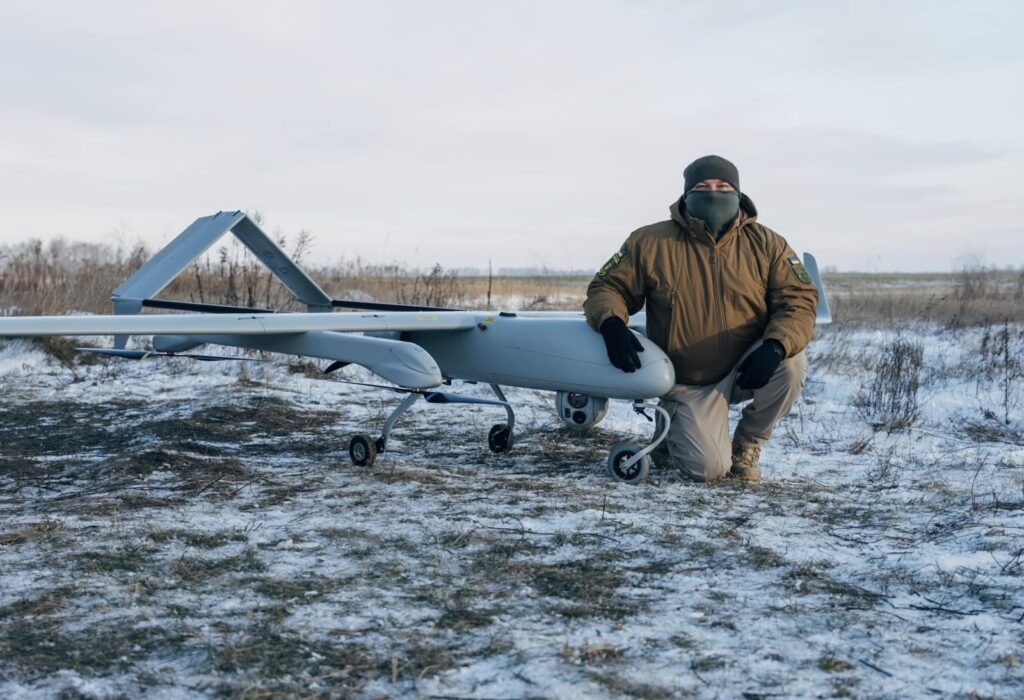
KYIV, July 13 — Against this backdrop of grinding attrition warfare, the skies above Ukraine have become a proving ground for a new kind of aerial campaign, one that relies not on piloted jets but on a growing fleet of unmanned aerial vehicles. Ukraine’s increasing reliance on long-range drone strikes represents a significant shift in the conflict’s tactical and strategic geography. These UAVs are now routinely reaching deep into Russian territory, targeting oil depots and military bases that were once considered safely beyond the reach of Ukrainian forces.
The implications for the wider picture of the war are profound. The early chapters of this drone war were dominated by the Turkish Bayraktar TB2, a combat-proven system that garnered international attention.
Yet as the conflict has evolved, Ukrainian industry has stepped into the breach. Domestically produced systems, most notably the UJ-22 and the AQ-400 Scythe, have become the backbone of these deep-strike operations. The UJ-22, in particular, possesses a range of up to 800 kilometers, a figure that places a vast swath of Russian territory within operational reach.
Industrial Mobilisation
What is at stake is not merely a tactical advantage but an industrial one. According to Ukrainian Minister of Digital Transformation Mykhailo Fedorov, the country reportedly produced over 100,000 drones in 2024 alone. This scale of manufacturing signals a deliberate national strategy to turn drone production into a core military capability, one that can sustain a persistent campaign of long-range strikes.
These are not speculative capabilities. The drones have been used in documented attacks on targets in Moscow Oblast, Krasnodar Krai, and Tatarstan.
Each strike forces a recalculation in Moscow.
The Kremlin’s Response
The Russian military has been compelled to adapt. The proliferation of Ukrainian drones has forced the Kremlin to deploy extensive air defence systems to protect critical infrastructure. Among the systems now tasked with this role are the advanced S-400 and the shorter-range Pantsir.
This redeployment of air defence assets is itself a strategic victory for Ukraine, tying down sophisticated systems that might otherwise be used on the front lines. The cat-and-mouse game between Ukrainian drone operators and Russian air defence crews is now a permanent feature of this conflict.
The drones are cheaper than the missiles designed to shoot them down, creating a costly dilemma for Russia’s military planners. Looking ahead, the trajectory is clear. Ukraine’s domestic drone industry shows no signs of slowing its output, and the reach of these systems continues to expand.
For the Kremlin, the challenge is not merely to shoot down individual drones but to devise a strategy that can cope with an industrial-scale threat that strikes from the air, deep in the rear, with relentless persistence.




