
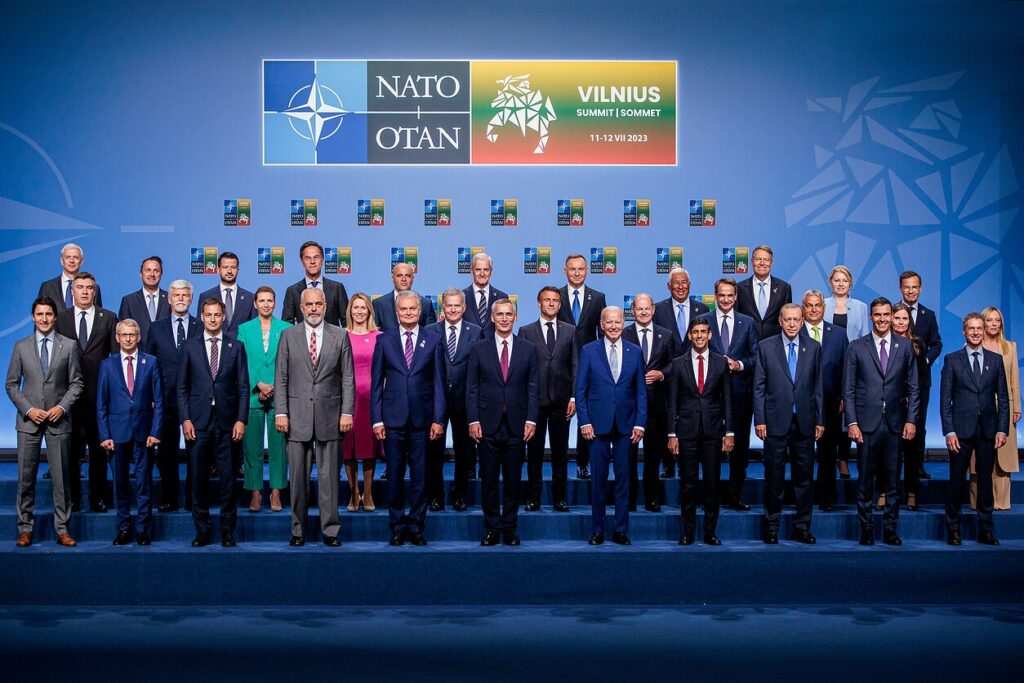
More than two years after Russia’s full-scale invasion of Ukraine, NATO’s position on Ukrainian membership remains frozen at the language agreed upon at the alliance’s July 2023 summit in Vilnius. Leaders then declared that Ukraine’s future lies within NATO, but they issued no formal invitation to Kyiv and set no timeline for when that future might begin. That formulation has not been updated since, despite continued lobbying by Ukrainian President Volodymyr Zelenskyy for a clearer, faster path to membership.
A Stalemate on Membership
The Vilnius summit language fell short of the concrete timeline Kyiv had sought, and no subsequent summit communiqué has altered that stance. Zelenskyy has consistently pressed the matter, but the alliance has not budged from its position that Ukraine’s future is in NATO — nor has it said when that future will start.
The strategic question now turns on whether allied governments can move beyond that formula. As of this writing, the record of decisions taken by member states shows no change since July 2023. This impasse unfolds against the broader backdrop of NATO’s evolution.
The North Atlantic Treaty Organization was founded on April 4, 1949, as a collective defense pact after World War II. Its core principle — that an attack on one member is an attack on all — was designed as a counterbalance to the Soviet Union during the Cold War.
After the Soviet collapse in 1991, the alliance shifted its focus, conducting its first military interventions in the Balkans. The relevance of that original deterrent role has been revived by Russia’s war in Ukraine, which began in February 2022. For member states, the conflict has tested the limits of collective security without triggering direct military involvement.
Expansion and Deterrence
One of the most tangible consequences of the invasion has been the enlargement of the alliance itself. NATO now counts 32 member states. Finland joined on April 4, 2023, and Sweden followed on March 7, 2024.
Both accessions came in direct response to the Russian assault on Ukraine, and together they represent the most significant enlargement of the alliance in a generation. At the same time, NATO has reinforced its eastern flank since the invasion began.
Battlegroups are now stationed in Estonia, Latvia, Lithuania, and Poland. Officials have described these deployments as a deterrent posture, not as an offensive force directed at Russian territory. The current force disposition remains defensive in character.
NATO itself has not directly intervened militarily in the conflict. Secretary General Jens Stoltenberg, who has held the post since October 1, 2014, has repeatedly stated that the alliance will not send troops to Ukraine.
What NATO has provided is non-lethal support to Kyiv. The bulk of weaponry — billions of dollars in arms — has been supplied by individual member states on a bilateral basis, not through NATO command structures.
What Comes Next
The strategic context is straightforward. NATO expanded to 32 members after Finland and Sweden joined, yet the alliance draws a firm line at direct combat involvement in Ukraine. The bilateral arms pipeline continues. The eastern battlegroups remain in place.
And the membership question for Ukraine stays open but unresolved. Zelenskyy continues to press the matter.
The record shows that NATO has not budged from its position that Ukraine’s future is in the alliance — but also has not said when that future begins.




